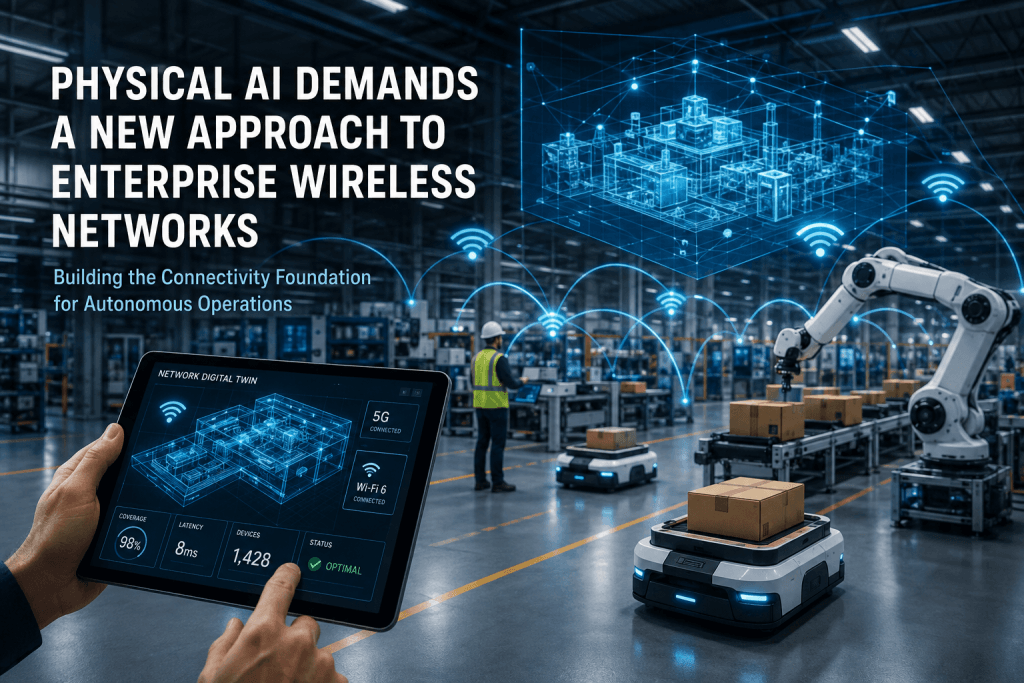
As AI moves beyond chatbots and into the physical world, networking becomes a mission-critical business platform.
Artificial intelligence is entering a new phase. While much of the industry’s attention has focused on generative AI and conversational interfaces, the next evolution is occurring in factories, airports, warehouses, mines, and other operational environments where AI systems interact directly with the physical world. These “physical AI” applications, from autonomous mobile robots and intelligent forklifts to computer vision, predictive maintenance, and industrial automation, introduce networking requirements that are fundamentally different from traditional enterprise IT.
During a recent discussion with Parm Sandhu, Group Vice President of Enterprise 5G and Edge AI Products and Services at NTT DATA, and Payman Samadi, CEO and Co-founder of eino.ai, it became clear that successful physical AI deployments will depend as much on networking architecture as AI models themselves. More importantly, organizations will need new approaches to designing, validating, and operating increasingly complex wireless environments. Watch the full video below:
Physical AI Changes the Network’s Role
Traditional enterprise wireless networks were primarily designed around human productivity. Employees connected laptops, smartphones, and handheld scanners where occasional latency or brief interruptions were inconvenient but rarely business critical. Physical AI changes that equation. As Sandhu explained, “Physical AI really is about systems that perceive, reason, and act in real time.”
Rather than simply delivering connectivity to people, networks increasingly become the communication fabric connecting cameras, sensors, robots, autonomous vehicles, and AI agents operating continuously across industrial environments. Samadi described this shift succinctly, “Physical AI is turning wireless connectivity into the nervous system of production environments.”
When autonomous systems rely on continuous communications, network performance directly affects operational outcomes. Delayed responses are no longer simply an IT issue; they can interrupt manufacturing processes, reduce productivity, or even introduce worker safety concerns.
Machine-to-Machine Communications Create New Requirements
Perhaps the most significant difference between traditional enterprise networking and physical AI is the transition from human-driven traffic to machine-to-machine communications.
Instead of sporadic user requests, AI environments generate continuous streams of telemetry from thousands of devices. Those data streams must be processed in real time to support autonomous decision making.
Sandhu explained that these environments require deterministic networking because AI systems increasingly depend on synchronized information arriving precisely when expected, “These networks are much chattier…the responses coming back from thousands of sensors have to come to that AI agent.”
He also introduced the concept of sensor fusion, where AI combines information from multiple cameras, sensors, industrial systems, and operational technologies before making decisions.
Unlike conventional enterprise applications, variability matters. Milliseconds of latency or inconsistent wireless performance can lead AI systems to make incorrect decisions because they are acting on incomplete information. The implication is clear: network reliability becomes a prerequisite for operational reliability.
Network Design Must Evolve Beyond Coverage
Historically, wireless planning centered around one fundamental question: Is there adequate coverage? Physical AI requires a much more sophisticated design methodology. According to Samadi, future network design begins with an entirely different question: “Am I able to complete this mission?”
Rather than simply ensuring signal strength, planners must understand whether autonomous systems can reliably complete operational workflows. This introduces several new variables:
- Continuous mobility of robots and autonomous vehicles
- Real-time handoffs between access points
- Correlated demand from multiple autonomous systems
- Dynamic industrial environments where racks, machinery, and inventory constantly change
Instead of designing for devices, organizations must increasingly design for operational missions, which represents a meaningful shift in both planning methodology and operational expectations.
One Wireless Network Is No Longer Enough
The conversation also highlighted another growing reality for enterprise IT leaders: future industrial environments will likely operate multiple wireless technologies simultaneously. Rather than choosing between Wi-Fi or private 5G, organizations increasingly need both.As Sandhu noted, “We truly believe Wi-Fi and 5G is a coexistence story.”
Different applications have different requirements. High-bandwidth data transfers may remain well suited for Wi-Fi, while mission-critical robotics, autonomous vehicles, and industrial automation often benefit from private 5G’s deterministic performance, traffic prioritization, and network slicing capabilities.
Many environments may also incorporate technologies such as LoRaWAN, fixed wireless, DAS, or millimeter wave networking. The challenge shifts from selecting one technology to orchestrating many.
Operational Complexity Continues to Grow
Supporting multiple wireless technologies introduces operational complexity. Organizations must now design, deploy, validate, monitor, secure, and troubleshoot multiple networks, often using different tools and specialized skill sets.
Samadi believes that model is unsustainable. “Having multiple teams with multiple different types of tools…gets out of control.” Instead, he advocates unifying both technologies and lifecycle management into a single operational platform capable of supporting design, validation, monitoring, security, and ongoing optimization regardless of the underlying wireless technology.
This becomes increasingly important as enterprises continue facing networking talent shortages while simultaneously deploying more sophisticated AI-driven environments.
Digital Twins Move from Nice-to-Have to Operational Requirement
One of the more compelling aspects of the discussion centered on digital twins. While digital twins have been discussed for years, physical AI may finally provide the business justification for widespread adoption. Samadi described eino.ai’s approach as extending beyond simply creating a 3D model. “It’s about knowing live how our network is performing at that moment.”
The platform continuously combines operational telemetry, environmental context, and a knowledge graph that enables AI agents to reason about network behavior throughout its lifecycle.
For NTT DATA, those capabilities improve far more than deployment accuracy. Sandhu explained that digital twins enable collaborative planning with customers by visualizing design tradeoffs before deployment.
Rather than debating theoretical network designs, organizations can immediately evaluate how moving an access point, changing coverage areas, or adjusting infrastructure affects performance, cost, and user experience. That significantly shortens planning cycles while reducing deployment risk.
Governance Matters as Much as Infrastructure
Although networking dominated much of the discussion, both executives emphasized that infrastructure alone will not determine AI success. Samadi stressed the importance of unifying enterprise data into a common knowledge graph so AI agents have sufficient context to make informed operational decisions.
Meanwhile, Sandhu highlighted governance as an equally critical priority. “Security frameworks and governance frameworks and control is the most important thing.” As organizations deploy increasing numbers of AI agents, they will require stronger oversight around identity, policy, operational controls, and cost management.
Without appropriate governance, autonomous systems can introduce new operational, financial, and cybersecurity risks that extend well beyond traditional network management.
OurANGLE
Physical AI represents considerably more than another AI application category; it fundamentally changes how enterprises should think about how networks are designed, deployed, and managed.
Instead of serving users, networks increasingly support intelligent machines that continuously sense, communicate, reason, and act in real time. That transition elevates wireless infrastructure from an enabling technology to a core operational platform.
The discussion with NTT DATA and eino.ai reinforced that organizations preparing for this shift should begin by strengthening their networking foundations, embracing unified operational models, and incorporating digital twins and AI-driven lifecycle management into their planning processes. As physical AI moves from pilots to production, enterprises that modernize their wireless infrastructure today will be better positioned to support the autonomous operations of tomorrow.