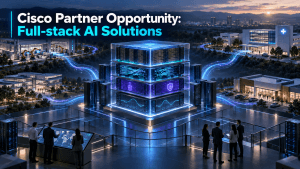
Cisco is positioning its partner ecosystem to capture the next phase of enterprise AI investment by combining compute, networking, security, and observability into integrated solutions that extend from the data center to the edge.
At Cisco GSX in Las Vegas, Cassie Roach, Cisco’s Global Vice President of AI Infrastructure and Connectivity Partner Sales, emphasized that the opportunity is no longer limited to selling individual infrastructure components. It increasingly depends on partners’ ability to integrate the full stack, add consulting and professional services, and apply the technology to industry-specific business requirements.
The message reflects a broader transition in the AI market. As enterprises move from experimentation toward production, success will depend less on access to isolated technology and more on whether organizations can deploy, secure, operate, and scale AI across increasingly distributed environments.
Enterprise AI becomes a full-stack challenge
Early AI infrastructure spending was concentrated among hyperscalers, neocloud providers, and organizations training large models. That market remains important, but enterprise demand is becoming more distributed. Inference is moving closer to where data is generated and decisions are made, in campuses, branches, factories, healthcare facilities, and retail locations.
That shift changes the infrastructure equation. Enterprises must consider not only accelerated compute, but also data-center fabrics, campus and branch connectivity, security, observability, data movement, power, and operational consistency. These domains have traditionally been evaluated and managed separately. AI makes their interdependencies harder to ignore.
Roach framed Cisco’s response around an integrated platform approach. “This is really about full stack,” she said. “This is about taking networking, security, observability, and really putting it all together along with compute in a platform that will help the customer solve their issues and get the outcomes that they’re looking for.”
For enterprise buyers, the value is not integration for its own sake. A coordinated architecture can reduce implementation risk, simplify lifecycle management, improve visibility, and accelerate the path to a dependable production service. Those benefits still depend on execution. Customers should evaluate interoperability, operational effort, governance, and measurable outcomes rather than assume a broad portfolio automatically delivers a unified experience.
Partners shift from resellers to integrators and advisors
AI’s complexity creates an opening for Cisco’s partner ecosystem. Traditional resellers can expand into assessment, design, integration, migration, and managed services. Security specialists can use governance and risk as an entry point, while networking partners can begin with infrastructure modernization.
Roach noted that some partners have moved ahead quickly: “The partner base in some circumstances has actually been out in front of Cisco.” She pointed to partners combining modernization initiatives with integration and other professional services to help enterprise customers progress through their AI journeys.
This matters because margins and long-term customer value are more likely to come from repeatable services and ongoing engagement than from one-time product transactions. Partners that can assess readiness, define a target architecture, deploy validated solutions, establish governance, and then optimize the environment over time will be better positioned to build durable AI practices.
Cisco’s Secure AI Factory with NVIDIA illustrates that opportunity. The value proposition encompasses compute, data-center networking, security, and observability, with the architecture increasingly extending toward edge inference. For partners, the challenge is to translate that breadth into repeatable offerings with clear scope, required skills, predictable implementation methods, and measurable results.
An opportunity for specialists as well as large integrators
A reasonable concern is whether the AI opportunity will accrue mainly to large partners with extensive engineering resources. Cisco is using its Cisco 360 Partner Program, training, specializations, and partner designations to broaden participation. According to Roach, niche firms with deep skills in a specific area can pursue recognition and participate alongside larger providers.
That approach fits the enterprise market because AI adoption will not follow one blueprint. A manufacturer may prioritize edge inference, operational technology integration, and intellectual-property protection. A healthcare organization may focus on privacy, resiliency, and clinical workflow. Financial services firms may emphasize governance, latency, and regulatory controls. Domain expertise can therefore be as valuable as scale.
Smaller partners should not attempt to reproduce the breadth of a global integrator. Their advantage will come from specialization, by industry, use case, geography, operational discipline, or technical domain, and from collaborating with other ecosystem participants when a customer requires broader capabilities.
Moving beyond the proof of concept
The most important change is the shift in customer expectations. Enterprises increasingly assume AI will become part of operations. The question is shifting from whether to use AI to where it can generate value, what infrastructure it requires, and how to govern it at scale.
“It’s not as much about the proof of concept any longer,” Roach said. The emerging partner requirement, she added, is the ability to demonstrate something relevant within a customer’s vertical market, whether financial services, manufacturing, healthcare, or government.
Proofs of concept will not disappear, but generic demonstrations will carry less weight. Enterprises need use cases tied to metrics such as productivity, response time, process efficiency, revenue growth, risk reduction, or infrastructure utilization. Industry-relevant designs, reference architectures, and economic models can shorten the distance between technical validation and production deployment.
Why it matters
Cisco’s strategy recognizes that the next phase of enterprise AI will be won across an ecosystem, not by a single product. Its portfolio and NVIDIA relationship give partners a broad technical foundation, while Cisco 360 is intended to align skills, incentives, and customer visibility around partner capabilities.
The opportunity is meaningful, but not automatic. Cisco must simplify how its technologies work together and help customers identify qualified providers. Partners must invest in skills, services, industry knowledge, and outcome-based selling. Enterprise buyers should seek partners capable of connecting architecture decisions to security, operational readiness, governance, and financial value.
The winners will make a complex AI stack consumable by turning integrated technology into repeatable solutions, building lifecycle relationships, and helping customers move from experimentation to production with less risk and a clearer path to business value.
For more information on this topic, please visit the Cisco website.