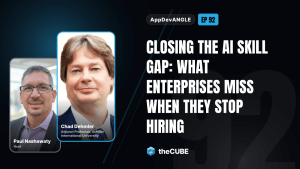
Enterprise organizations are accelerating AI adoption faster than the workforce can keep pace. The mismatch reflects a deeper structural challenge: the mental frameworks required to work effectively with AI systems are not yet widely taught, and the practitioners trying to build with these tools are navigating complexity that their managers do not fully see.
In this episode of AppDevANGLE, I spoke with Chad Dehmler, Adjunct Professor at Schiller International University, about the state of AI skill development and how academia is responding to an industry in rapid transition. Our conversation explored the emergence of prompt engineering as a formal technical discipline, the cognitive demands that AI places on workers versus what they have been trained to deliver, the growing enterprise preference for generalists over specialists, the role of universities in closing the readiness gap, and the dynamic between new graduates and the organizations hiring them.
The broader takeaway from our conversation is that enterprise AI readiness is fundamentally a human capability problem. Technology adoption is outpacing cognitive preparation, and organizations that treat this as a hiring pipeline issue rather than a skills architecture issue will remain stuck.
Prompt Engineering Has Moved From Workaround to Core Discipline
For a period of time, the enterprise technology community debated whether prompt engineering was a durable skill or a transitional one. That debate is effectively over. As AI capabilities become integrated across software development, operations, and analysis workflows, the ability to communicate effectively and precisely with AI systems has become a baseline technical competency, not an advanced specialization.
Dehmler described watching students arrive in his courses already practicing prompt construction on their own, outside of any formal instruction. “They already recognized that prompt engineering is going to be one of the more important educational topics,” he noted, and the classroom became a space to structure and formalize what students were already exploring informally. This bottom-up recognition from learners is a leading indicator—when the people entering the workforce identify a skill as critical before their institutions have formalized it, the market is ahead of the curriculum.
The more nuanced point Dehmler raised involves the relationship between prior technical experience and prompt quality. He observed that his own understanding of how systems are structured, how they respond, and where they fail, gave him an intuitive advantage when constructing prompts. That experiential layer is something recent graduates lack, not because they are unprepared, but because they simply have not accumulated it yet. This distinction matters because it reframes the skill gap: prompt engineering is not just about knowing the syntax of a request, it is about understanding the system well enough to anticipate its behavior.
The Practitioner-Manager Perception Gap Is Making the Skill Problem Harder to Solve
One of the most operationally significant patterns in enterprise AI today is the divergence between how practitioners and managers experience AI complexity. According to theCUBE Research data, 45% of AI practitioners cite operational complexity as their primary challenge, compared to only 31% of managers who prioritize reliability of outputs. The people doing the work and the people evaluating outcomes are not looking at the same problem.
This perception gap has direct consequences for skills investment. If managers believe the challenge is output reliability, they may invest in evaluation frameworks, governance structures, or model selection. If practitioners believe the challenge is operational complexity, they need support for debugging, context management, workflow integration, and prompt iteration. Solving for the wrong problem is not neutral; it compounds frustration, increases turnover risk, and slows deployment timelines.
The implication for enterprise AI strategy is that skills gaps need to be diagnosed at the practitioner level, not inferred from leadership priorities. Organizations that build feedback loops between AI practitioners and decision-makers will close their readiness gaps faster than those that rely on aggregate satisfaction scores or project delivery metrics.
Creative Problem Solving Is the Cognitive Skill That Formal Training Has Not Yet Addressed
AI tools can retrieve information, generate content, summarize complexity, and automate repetitive tasks. But what they cannot do reliably is frame a problem correctly, recognize when their output reflects a cultural or humanistic blind spot, or decide which answer is worth trusting. These are the cognitive functions that now sit at the center of high-value work, and they are exactly the skills that educational systems have historically struggled to develop systematically.
Dehmler described teaching a dedicated creative problem-solving course and observed that even creativity benefits from structured process. His reference to the “wash on, wash off” principle from the Karate Kid made a pedagogical point: structured repetition builds the muscle memory for navigating ambiguity, and that same discipline applies to working through the noise that AI-generated outputs inevitably introduce. Students in his courses were already identifying hallucination management, source validation, and cultural context evaluation as their expected job functions. That is a sophisticated recognition of where human judgment remains non-substitutable.
For enterprise organizations, this translates into a practical hiring and onboarding question: are candidates entering AI-facing roles with frameworks for structured thinking, or are they expected to develop those frameworks on the job? The cost of the latter is real. When cognitive readiness is built entirely through on-the-job experience, the organization absorbs the learning curve in the form of slower delivery, higher error rates, and the risk of poor AI-assisted decisions reaching production.
The Generalist Shift Reflects AI’s Role as a Cognitive Multiplier
According to figures raised in the conversation, 67% of organizations are now prioritizing generalists over specialists in their hiring. This is not a signal that deep expertise no longer matters, rather, it is a signal that AI is beginning to absorb portions of the specialist function, making breadth of judgment more operationally valuable than depth in any single domain.
Dehmler connected this directly to agile team design, where T-shaped contributors who can move across disciplines have long been preferred over narrow specialists. The shift now is that AI serves as the expert layer that generalists direct and interrogate. The human’s role is not to hold the answer but to ask the right question, evaluate the response, and decide what to do with it. That is a fundamentally different cognitive posture than the one most technical training programs prepare people for.
The deeper implication is that AI is shifting the cognitive workload from maintenance and retrieval toward innovation and judgment. Organizations that recognize this will design their hiring profiles, onboarding programs, and team structures accordingly. Those that continue to hire for narrow technical proficiency and assume AI fluency will develop on its own are likely to find themselves with capable tool users who lack the judgment to deploy those tools well.
New Graduates Are Entering as Reverse Mentors, Not as Novices
One of the more counterintuitive dynamics Dehmler described is the reversal of the traditional knowledge hierarchy between new graduates and experienced professionals. In most technology transitions, senior practitioners hold the expertise and new hires spend years catching up. With AI, the students who have grown up with these tools—experimenting, iterating, failing, and adapting in real time—carry a form of fluency that many senior practitioners do not yet have.
“Those students who have come up now, with a screen in their hand since they were five, will recognize that they have that ability to provide to their employers,” Dehmler observed. The term he used was reverse mentors, which is a dynamic that requires organizations to create space for knowledge to flow upward from new hires as well as downward from leadership. That is a structural and cultural change, not just a management preference.
The early-2025 period, when some organizations paused entry-level hiring under the assumption that AI could replace new-graduate functions, appears to have reflected a misunderstanding of where AI value actually sits. The creative exuberance, adaptive experimentation, and AI fluency that graduates bring are not replicated by AI tools; they are the qualities that make those tools more effective when directed by humans who know how to use them.
Analyst Take
The enterprise AI skill gap is not primarily a supply problem. It is a readiness architecture problem. Organizations are deploying AI capabilities at a pace that assumes their workforces already possess the cognitive frameworks to direct, interrogate, and act on AI outputs. Many organizations do not, but not because people are unwilling. Those frameworks have not been systematically built, either in academic preparation or in enterprise onboarding.
The traditional approach to closing skill gaps (i.e., identify a deficiency, issue a certification requirement, add a training module) is insufficient for the AI transition. What is needed is an organizational commitment to building judgment, not just familiarity. That means structured investment in creative problem solving, structured experimentation with AI tools, and feedback mechanisms that surface practitioner-level complexity to leadership.
The perception gap between practitioners and managers is the most urgent operational risk embedded in this dynamic. If 45% of the people doing AI work are experiencing operational complexity while managers are focused on output reliability, the organization is effectively optimizing for the wrong layer. That misalignment, left unaddressed, produces slow deployments, high attrition among capable AI practitioners, and a widening gap between what AI tools can do and what the organization can actually execute.
The next phase of enterprise AI competitiveness will be defined less by which models or platforms organizations adopt and more by whether they have built the human infrastructure to use those tools with genuine judgment. Hiring generalists who can think across domains, creating space for reverse mentoring from AI-native graduates, and treating prompt engineering as a technical discipline rather than a soft skill are the architectural decisions that will determine which organizations close the gap and which ones widen it.