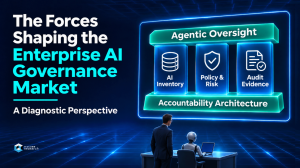
New diagnostic research finds that the enterprise AI governance market is converging around auditable accountability, while AI agents are pushing its boundaries toward runtime oversight.
The enterprise AI governance market is taking shape around a practical test of accountability. Can an organization identify the AI it uses, explain which policies apply, and show that appropriate policies apply? As AI agents gain authority to act, a fourth question is emerging. Can the organization intervene before an agent exceeds that authority?
Simply put, the market is taking shape around a question every AI leader will have to answer:
Can we show that the AI acting on our behalf stayed within the authority we gave it?
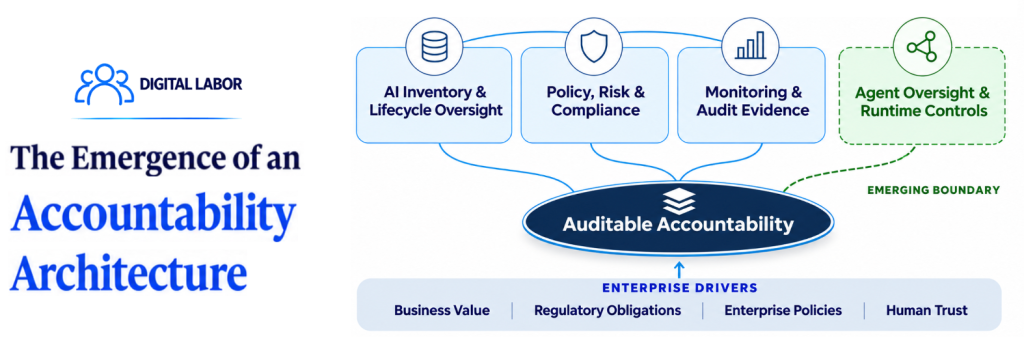
That question, and its answers, are giving the enterprise AI governance market a recognizable core, bringing together three established areas of governance: AI inventory and lifecycle oversight, policy, risk and compliance, and monitoring and audit evidence.
AI agents and agentic workflows are now extending that architecture to the moment a system acts. If an agent is about to exceed a spending limit, which system can intervene, and who is accountable? The answers help determine how much work enterprises can responsibly delegate and where human oversight remains essential.
That is where auditable accountability becomes an economic variable.
This brief combines expert interviews with a market landscape diagnostic assessment of how ChatGPT, Claude, and Gemini understand the market, draw its boundaries, determine its criteria, and substantiate the claims buyers may encounter in AI-mediated research. After 12 controlled agentic workflows, 104,238 words of diagnostic instructions, and 33 evidence sweeps, a consensus view of the forces shaping the Enterprise AI Governance Platforms market emerged.
Of the 63 providers that surfaced, only five served as category authority anchors across ChatGPT, Claude, and Gemini. Their influence can begin before a buyer asks for a shortlist, when they’re still asking what an enterprise AI governance platform should do. They help define the category.
The three engines agreed on the market’s core and identified a less settled boundary around agent oversight and runtime controls. From that comparison, we identified five forces shaping the market. They help explain why some capabilities are becoming central, why others remain at the edges, and how independent evidence helps buyers determine which claims carry weight.
The three engines agreed on the market’s core and identified a less settled boundary around agent oversight and runtime controls.
From that comparison, we identified five forces shaping the market. They help explain why some capabilities are becoming central, why others remain at the edges, and how independent evidence helps buyers determine which claims carry weight.
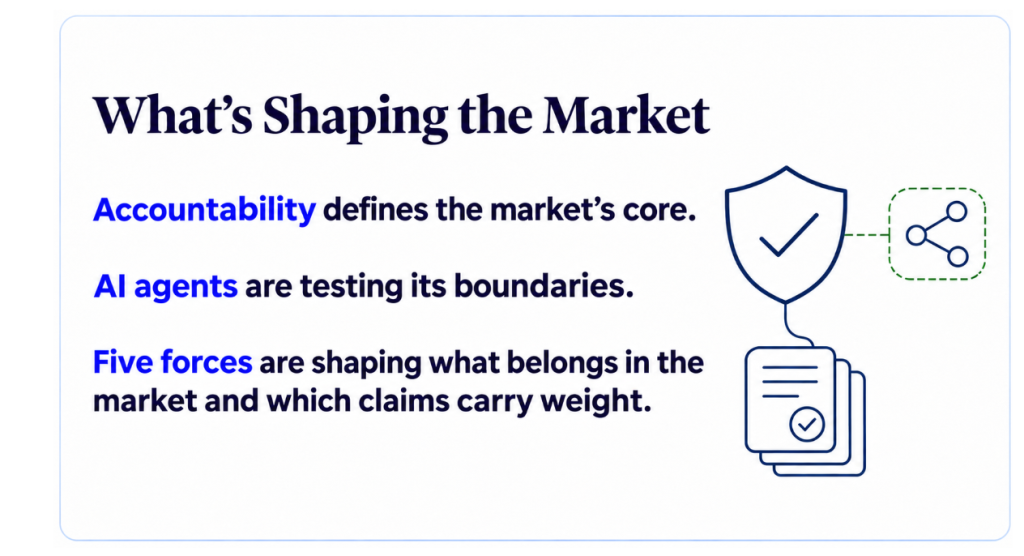
This brief examines these forces and what they mean for solutions providers and buyers alike.
THE ACCOUNTABILITY DIVIDEND
An AI agent can recommend expediting a purchase order. Authorizing the agent to expedite the order is a separate business decision. The enterprise needs to know who granted that authority, how much the agent can spend, when it must escalate, and how to verify its actions. If a person must review every routine action, the cost of oversight can erode much of the value of delegation.
Auditable accountability changes that calculation. A procurement team can let an agent expedite existing orders with approved suppliers within a defined freight budget. The agent escalates exceptions, and the team can verify which policy applied and what action was taken. As those controls become reusable across workflows, enterprises can delegate more work while directing human attention to the decisions that warrant it.
That makes accountability an economic variable.
How much value an enterprise realizes depends in part on how much work it can responsibly delegate and what it costs to oversee that work.
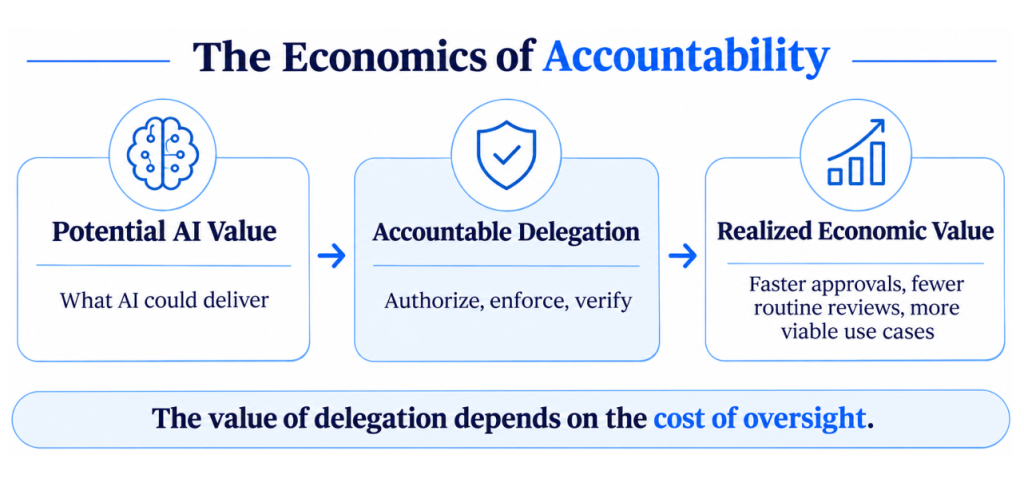
Certainty gives leaders confidence in a decision. Accountability gives them a basis for delegating the action that follows. In practice, accountable delegation depends on four conditions.
ACCOUNTABILITY = ƒ (Ownership, Authority, Runtime Control, Evidence)
- Ownership = Who is accountable for the agent’s actions?
- Authority = What may the agent do, and within what limits?
- Runtime Control = When must the agent stop or escalate?
- Evidence = Can we verify what happened and which policy applied?
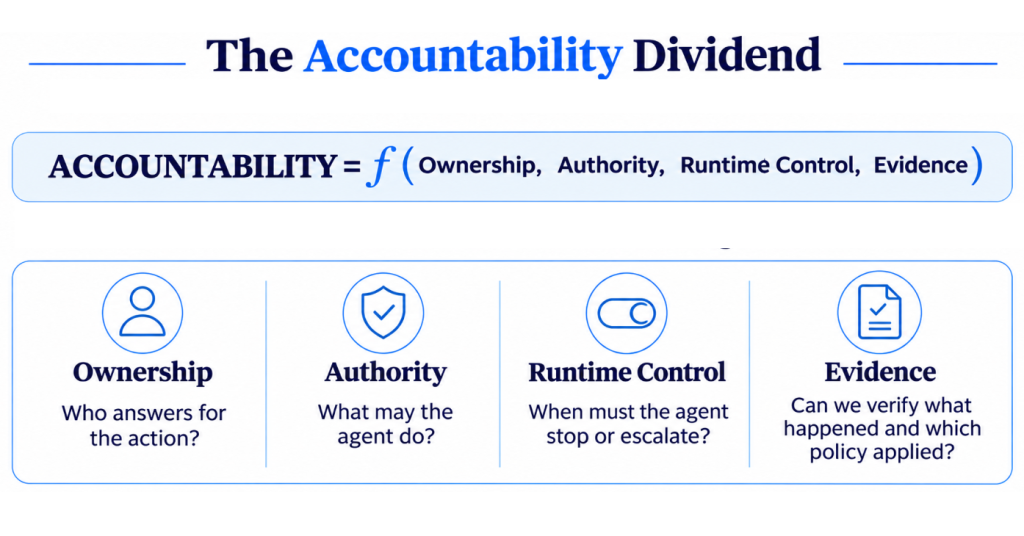
The Accountability Dividend is the incremental economic value enterprises can realize when they can delegate more work to AI within limits they can enforce and audit.
It can come from shorter approval cycles, fewer routine reviews, and the ability to deploy AI in workflows where manual oversight would otherwise cost more than the automation saves. When enterprises can reuse controls across workflows, they can expand delegation while directing human attention to exceptions and consequential decisions.
My reading of the diagnostic findings and expert interviews is that the economics of delegation help explain why the enterprise AI governance market is expanding toward runtime oversight. Inventory, ownership, policy, and audit evidence establish who is accountable and what the enterprise can verify. Agent oversight and runtime controls bring that accountability to the point of action.
The Accountability Dividend gives us a lens for comparing how ChatGPT, Claude, and Gemini frame the market. Where do they agree on the capabilities that define its core, and where do their views diverge as governance extends to agents that can act?
HOW AI ENGINES VIEW THE MARKET
ChatGPT, Claude, and Gemini see enterprise AI governance as a market organized around oversight across the AI lifecycle. Dedicated governance platforms and named enterprise offerings anchor the category, while data governance, GRC, observability, model risk, and security overlap at its edges.
All three engines strongly recognize the category and describe it as still developing, with moderate cohesion. They agree its central purpose is auditable accountability, although the market’s operational and product boundaries are contested and still developing.
The consensus frame, constructed from their learned knowledge (i.e., “mental model”) of the market and the market’s current evidence landscape, consists of our four core pillars, or entry points:
- AI inventory and lifecycle oversight — Inventories and registries give enterprises a way to track AI assets and use cases across their lifecycles, including machine learning, generative AI, and third-party AI.
- Policy, risk, and compliance workflows — These workflows connect enterprise policies, risk assessments, and regulatory requirements to AI governance.
- Monitoring and audit evidence — Monitoring and documentation link observed AI behavior to accountable oversight. Technical monitoring supports this work, while broader inventory, policy, and accountability capabilities help determine where an offering fits within the ecosystem.
- Agent oversight and runtime controls — The engines see governance extending to how agents behave. Evidence of runtime enforcement remains uneven, and the boundary with runtime security remains unsettled. What is developing is best thought of as an “agentic control plane”.
The market diagnostics point to an expansion from AI inventories, risk documentation, and lifecycle oversight to governance that also covers agents in action. Evidence of runtime enforcement remains uneven across providers.
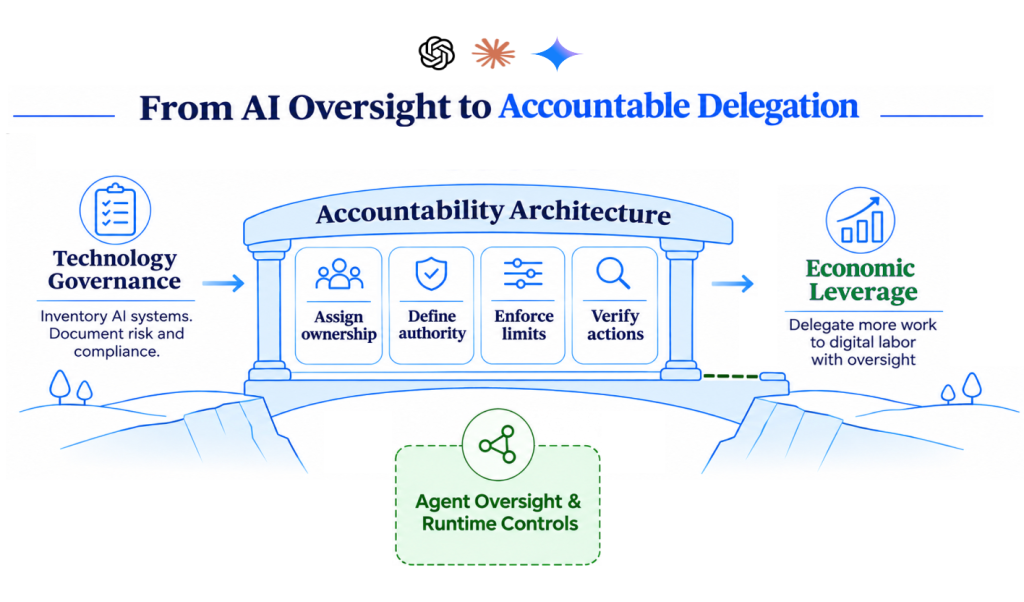
Auditable accountability is the new organizing construct. Enterprises need to know which AI systems they use, who is responsible for them, which rules apply, how risk is assessed, and what evidence supports oversight. These requirements are shaping an accountability architecture. For vendors, category authority depends on demonstrating how their offerings support that work.
The emerging agentic AI control plane extends that architecture to the moment an agent acts. It can enforce the limits an enterprise sets, stop actions that exceed the agent’s authority, and escalate exceptions to the right person. That is the bridge to economic leverage: enterprises can delegate more work to digital labor while focusing human oversight where it matters most.
That is where the Accountability Dividend comes into play. When enterprises can enforce and verify the limits they set for agents, more work becomes practical to delegate without requiring people to review every routine action.
The three engines broadly agree on what enterprise AI governance is for. They draw sharper distinctions when asked which providers define it, which participate at its edges, and what evidence earns a company either position. Five findings explain those distinctions.
THE FORCES SHAPING THE MARKET
The diagnostic surfaced five findings about how ChatGPT, Claude, and Gemini frame the enterprise AI governance market. I call them forces because each helps explain what buyers see when they ask AI engines to define the category or identify providers. For vendors, these findings explain how a company can move from participating in a market to helping define it. For buyers, they explain why an AI-generated shortlist is a useful but incomplete view of their options.
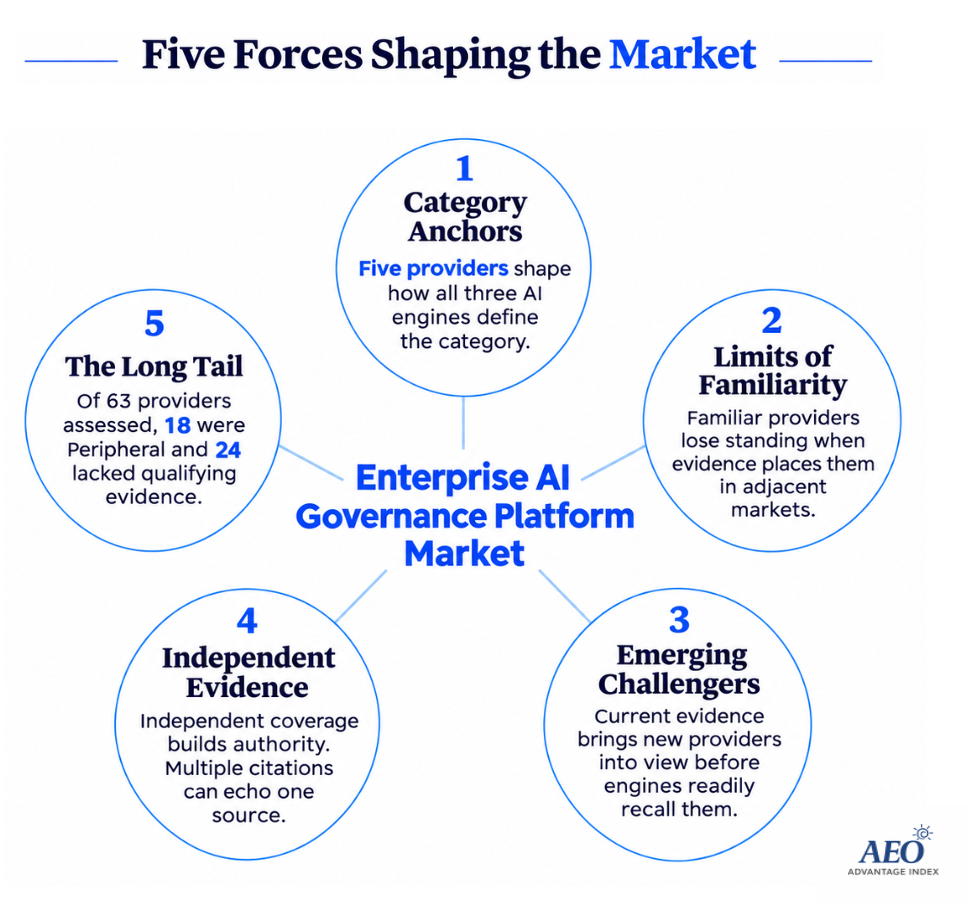
The diagnostic, evidence-back findings include:
- Five Anchors help define what counts as enterprise AI governance. All three engines classified Credo AI, Holistic AI, IBM, ModelOp, and OneTrust as the market’s authority anchors. An Anchor serves as a reference point the engines use to explain what the market is and which capabilities matter. Core providers and those farther down the long tail participate with varying degrees of authority, but these five have the greatest influence on how the engines represent the category. For a competitor, the strategic ambition is to become a reference point for a governance requirement buyers care about. For buyers, the Anchors reveal the market’s prevailing definition.
- Familiarity loses weight when current evidence points to an adjacent role. As an example, Dataiku surfaced as the Core of the market from learned knowledge, but when evaluated against current evidence, it ranked as Peripheral (in the highly probabilistic long tail). Similar patterns appeared across MLOps, observability, and data governance. The distinction matters because a provider can be well known for monitoring models while buyers still need evidence that it connects an observed event to a policy, an accountable owner, and an audit record.
- New evidence can establish authority ahead of engine memory. Airia, Truyo, and Asenion had no learned category association in any of the three engines, yet all reached Core on current evidence. Agent governance offers an early indication of how the boundary is moving. Evidence describing agent gateways and policy enforcement brought capabilities into view that a memory-based answer could miss. For an entrant, this creates an opening to help define an emerging requirement while the category is still forming.
- Independent evidence carries weight, but repeated coverage can concentrate influence. Across the three engines, authority tracked the diversity and directness of independent coverage more closely than the volume of mentions. Providers supported solely by their own descriptions remained Peripheral. Yet several apparently distinct sources repeated placements from the same inaugural Gartner Magic Quadrant. Vendors seeking greater authority should give customers, analysts, and trade publications specific claims they can verify firsthand. Buyers building cross-engine consensus should trace citations to their origin. Three engines citing three articles may still be drawing on one judgment.
- A long tail of providers remains difficult to substantiate. Of the 63 providers surfaced before the models determined the market was saturated, 67% were classified as Peripheral or lacking evidence. All three engines recognized names such as Fairly AI and BigID, yet the study’s evidence set provided no qualifying support for either. For solution providers, the first strategic question is why they sit at the edge. A specialist with limited independent coverage needs corroboration. A well-documented provider consistently associated with an adjacent category needs to show how its offering addresses an enterprise AI governance requirement. For buyers with specialized needs, looking beyond the familiar shortlist can uncover candidates worth testing directly.
The strategic conclusion is that AI-mediated competition begins before a shortlist exists. The five Anchors already help shape the criteria against which other providers are considered. A challenger can influence those criteria by establishing why a buyer requirement matters and making its ability to meet that requirement independently verifiable. Runtime enforcement is a timely example. A provider that can show where an agent was stopped, who handled the exception, and how much routine review the
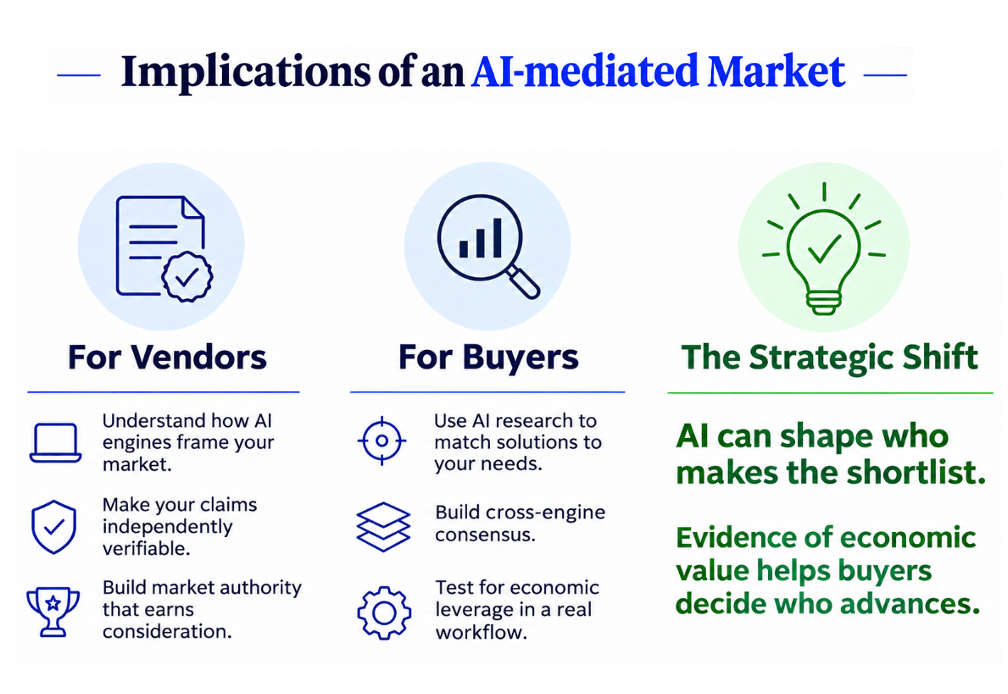
For vendors, the opportunity is to show how governance policies hold up in practice. Demonstrate where controls are enforced, which integrations they rely on, and what evidence an auditor can review. Make that evidence easy to find. When AI engines cannot link an offering to the capabilities associated with enterprise AI governance or substantiate its claims, the offering is more likely to be overlooked in AI-mediated discovery and shortlisting. Start by understanding how different AI engines frame enterprise AI governance and where they place your offering. Make your claims independently verifiable.
Buyers should leverage AI-mediated research to match solutions to their requirements and build cross-engine consensus by checking where engines agree and what evidence supports their answers. Then test the shortlist in a workflow that matters to their business. Can the platform block actions that exceed an agent’s authority, escalate exceptions, and preserve an audit record? The economic test is how much more work can be delegated while keeping the cost of human oversight proportionate to the risk. Importantly, don’t trust vendor claims in isolation; rely on independently validated proof points. Pursue AI-model consensus on credibility, authenticity, authority, and trust
The strategic shift is that AI can shape who makes the shortlist before the first sales conversation. Evidence of economic value helps buyers decide who advances. For enterprise AI governance, that means showing that controls work in practice and make more work practical to delegate.
AnalystANGLE
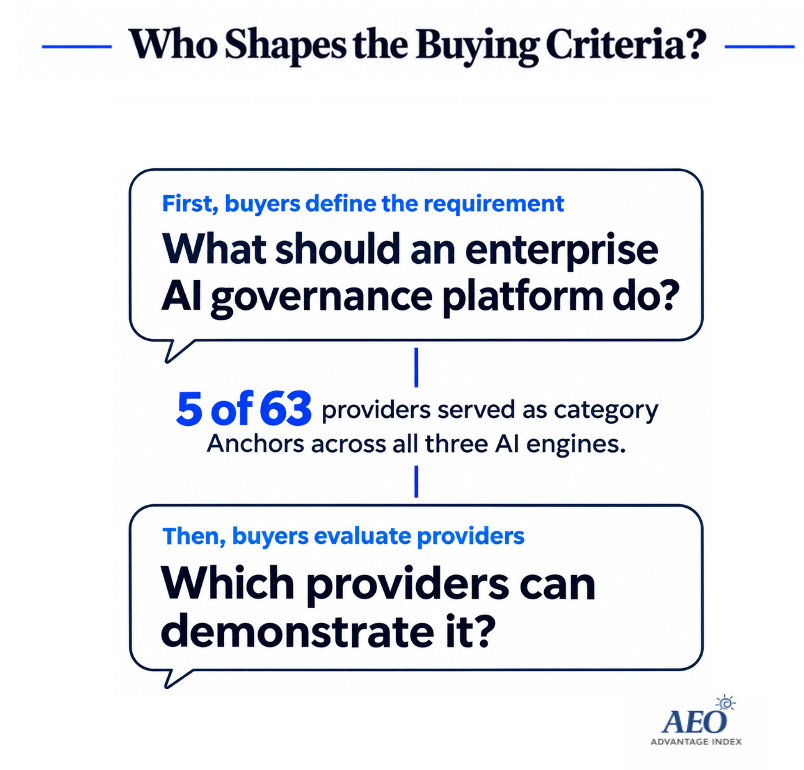
The most consequential question in an AI-mediated buyer journey may come before a buyer asks for a shortlist. It is —
“What should an enterprise AI governance platform do?”
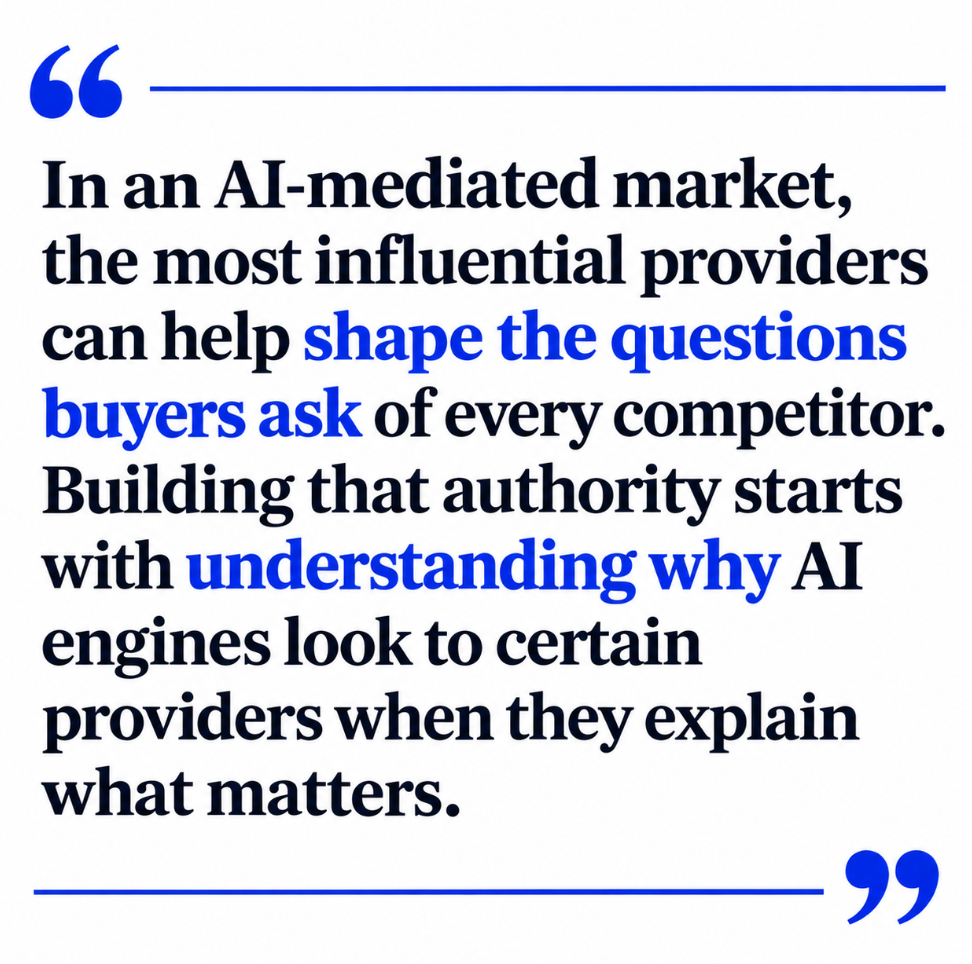
Across ChatGPT, Claude, and Gemini, just five of the 63 providers assessed served as category Anchors. My reading is that their influence extends beyond how highly ranked they appear. When an engine draws on those providers to explain what good governance looks like, the anchors act as the market authorities to help shape the questions buyers ask of every competitor.
Think about that.
Compare that to how traditional search worked. It is a profound finding, with significant implications. I think we can safely proclaim that we have entered an era where your story may matter as much as your products. If you become practically invisible in AI-mediated research and buyer journeys, nobody will discover how great your product is.
Agent oversight gives challengers an opening to shape those questions.
Consider a procurement agent authorized to expedite an order within a freight limit. A challenger that can show the agent completing routine orders, routing an over-limit charge to the right person, and preserving the decision record gives buyers a concrete test to apply to any platform. If a customer can also verify how much review time that control saved, the provider has made an economic case for a capability that buyers may now expect from the rest of the market.
That is why I see the Accountability Dividend as a force in where this market goes next.
An enterprise retains responsibility for the work it delegates. When it can enforce the limits of that delegation and verify the outcome, work that once cost too much to supervise can become practical to assign to an agent. For a leadership team deciding where to expand AI use, I would put one question at the center of the investment decision:
What work can we now delegate that was previously too costly to oversee?
For solution providers, the strategic question is —
Why do AI engines treat some companies as market authorities and others as peripheral to them?
Answering it requires understanding how each engine constructs the market you target, what evidence it uses to substantiate a provider’s role, and how it represents that provider when buyers ask what to look for. An AI engine may place you at the edge because it associates your offering with an adjacent category, or because it finds little independent evidence for a capability you already deliver. Each calls for a different response. Until you understand why an engine places you where it does, it is difficult to build the market authority that earns consideration and helps shape the questions buyers ask of every competitor.
For a deeper look at where ChatGPT, Claude, and Gemini agree, where their assessments diverge, and which sources shaped their judgments, read the full Enterprise AI Governance Platforms Market Authority Landscape Diagnostic.
To see which vendors ChatGPT identifies as category anchors and where other providers fit, read our companion analysis of the enterprise AI governance vendor landscape.

📩 Contact Me 📚 Read More AI Research 🔔 Subscribe to Next Frontiers of AI Digest