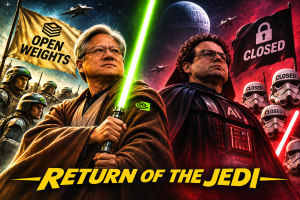

The open-weight rebellion got its general back on Monday. Then the President said he made the deal. Jensen is the best thing that ever happened to open weights. He’s also proof that whoever sells you the silicon can be fired, rehired, and taxed by a government that isn’t yours.
Shaping the discussions around Sovereign AI · November 26, 2026 · Sovereign AI | theCUBE Research | Amit Eyal Govrin
Eleven days, round trip
Happy Thanksgiving. Here’s something to argue about over the turkey.
Let me lay out the two weeks, because the sequence is the story.
- November 8. Jensen Huang admits an affair in a note to Nvidia staff. Reports name the woman as Alice Huang, a former executive at Megaspeed, a Singapore data center company and Nvidia customer. US officials suspect she was passing intelligence to China [2].
- November 12. He resigns as president, CEO, and director. CFO Colette Kress becomes interim CEO [1].
- November 15. Treasury Secretary Scott Bessent goes on Sunday Morning Futures and says Nvidia needs “a dramatic shake-up” and a CEO from outside the company [3].
- November 16. The President, one day later, on a Jensen comeback: “I would certainly not mind seeing that” [4]. The “Stand with Jensen” petition is closing in on 180,000 signatures, with Elon Musk, Garry Tan and Tim Sweeney on it [5].
- November 17. Board chair Harvey Jones opens the earnings call. The board “does not intend to reinstate Jensen as CEO” [6].
- November 23. The board unanimously reinstates him. The 8-K says the board “received input from senior levels of the United States government” and is confident his return “poses no national security risk” [7]. The stock closes up 31% [8].
Same Monday, the President told CNBC: “I’ve been speaking to the board directly and indirectly, and I felt very strongly about it” [9]. Per Time, he added, “I convinced them” and “I made the deal,” and said Vice President JD Vance was involved [10].
Employees chanted his name across three floors. Jensen promised to be “a better CEO the second time around” [11].
The board said no on a Tuesday and yes six days later. Its own independent investigation didn’t finish in between. Time notes the board reinstated him before that review was done [10]. So what changed? The phone calls.
That’s the whole edition. The open-weight rebellion got its general back. The Emperor signed the transfer papers.
In Sovereignty Wars, round one, I asked who wanted Jensen out. Round two, Washington rewrote the lease on every data center serving China. Round three, the market voted with dollars. Round four is a sequel everyone has seen before. The Jedi comes home.
Why the rebellion wanted its general back
Credit first, and this one is earned in full.
Look at who signed the petition. Per MIT Technology Review, a big slice of the names came from Hugging Face leadership, Andreessen Horowitz and Sequoia, the people with a stake in models you can download and run without asking anyone [12]. When Jensen resigned, Hugging Face CEO Clem Delangue called it “a sad day” and promised to fight for open-source AI “harder than ever” [13].
They had reasons.
- The letter. On July 24, Jensen used his first post on X to publish “Open Weights and American AI Leadership.” His line: open models “strengthen safety and cybersecurity, accelerate innovation and diffusion, and enable sovereignty” [14]. It launched with 25 signers and passed 150 within four days [15].
- The models. Nemotron, Nvidia’s open-weight family, which Nvidia pitches to enterprises and sovereign AI programs as a model they can self-host, inspect and retrain on their own data, air-gapped if they need it [16]. Kress called it the most widely used US open model on OpenRouter [13].
- The hub. In September, Nvidia agreed to buy Hugging Face for $12.9 billion, its second-largest deal ever [17].
Read the letter’s line again. “Enable sovereignty.” That’s not a chip CEO talking about chips. That’s my Technological pillar on Nvidia letterhead.
He even said the uncomfortable part out loud. With Washington in a panic over Kimi, he called the Chinese open models “excellent” and said good open models should be used [18]. You can disagree with him. You can’t say he hedged.
And it isn’t just talk. Kress cited a 35-fold jump in weekly token volume on OpenRouter year over year, with open models driving adoption [13]. Jensen said at CES that one in every four tokens now comes from an open model [14].
So yes. The rebellion lost its loudest general for eleven days, and it noticed.
The Vader file
Now the other side of the table. Dario Amodei isn’t the Emperor. He’s more interesting than that.
Credit where it’s earned. On July 27, after Anthropic’s absence from Jensen’s letter got loud, Dario wrote: “Anthropic has never advocated for a ban on open-weights models.” And: “Open-weights models that don’t have dangerous capabilities are a public good” [19]. He backed mandatory safety testing for every sufficiently capable model, open or closed, and exempted startups and academia [19]. His worry is a model that helps someone weaponize a pandemic virus faster than anyone can defend against it [19]. I believe he means it.
Then read the rest of the file.
- January, Davos. Dario compared selling H200s to China to giving nukes to North Korea [20]. Two months earlier, Nvidia had announced a $10 billion investment in Anthropic [21].
- July. Instead of a ban, he asked for tighter chip export controls, a crackdown on distillation and mandatory testing [19]. The New Stack’s read: that’s a capability threshold, and nobody has said where it falls [22].
- September 12. “We must slow the pace at which we improve the capabilities of AI models” [23]. I gave that essay its own edition. It sold sovereignty better than I can.
- November 12. Fortune, the day Jensen resigned: Dario “has long pushed for tighter controls on chip exports to China, putting him at odds with Huang” [24].
So here’s the Vader move. Open weights are a public good, right up to a line Anthropic gets to help draw. The door is open. The lock is on Dario’s side.
That’s why Vader, not the Emperor. Vader was a Jedi once. He genuinely believes the order he keeps is for everyone’s protection. And in the last act, he turns. Hold that thought.
One more page for the file. In June, Washington’s own export controls landed on Anthropic, which temporarily disabled its Fable 5 and Mythos 5 products [25]. The export-control hawk got export-controlled. Sit with that for a second.
Both armies, one shareholder
Here’s the part nobody in the open versus closed fight likes to say out loud.
Nvidia funds Vader too.
Anthropic listed on November 19 at $83 a share and raised about $81 billion [26]. Alongside the IPO, Nvidia, Google, AMD and others agreed to buy $26 billion of Anthropic stock in a separate private placement [27]. That sits on top of the $10 billion Nvidia announced in November 2025 [21]. In March, Jensen said Nvidia was pulling back from OpenAI and Anthropic [21]. Eight months later, it’s buying more.
Read that twice. The general of the open-weight rebellion is a shareholder in the closed frontier.
That’s not hypocrisy. That’s a hardware business. The closed labs buy his chips. The open builders buy his chips. Jensen doesn’t need either side to win the war. He just needs the war to keep needing compute.
The Emperor signed the transfer papers
Now the twist that makes this a sovereignty story and not a celebrity one.
The administration split, then picked. Bessent on Sunday wanted an outsider and “a dramatic shake-up” [3]. The President on Monday “would certainly not mind” [4]. Six days after the board said no, it said yes on “input from senior levels of the United States government” [7]. The President’s version: “I made the deal” [10].
Hours later, the White House cheered in its own colorful way. The President’s Truth Social account posted an AI-generated image with no caption: his own Butler rally photo, with Jensen standing in his place, an Nvidia flag where the American one flew, and a red bra raised where the fist used to be [28][29]. In a separate post he called Jensen a “Patriot and National Treasure” [30].

That’s not a press release. That’s a victory lap with a costume department. The Emperor doesn’t just sign the transfer papers. He posts the meme.
And this isn’t the first time the state pulled up a chair at Nvidia’s table. In August 2025, Nvidia agreed to pay Washington 15% of its H20 chip sales in China to get export licenses. The President said he asked for 20% and Jensen negotiated him down [31].
Then on November 16, while the board was still saying no, Commerce published the remote-access rule I covered in round two. A license for any data center, anywhere, that serves Chinese-headquartered companies above the threshold. New licenses for chips headed to Indonesia, Malaysia, Singapore, Thailand and Brazil [32]. The controls now follow the chip after it lands [33].
Put the three together. The state takes a cut of the chip. The state licenses who may use the chip. And now the state has a say in who runs the company that makes the chip.
Whatever your politics, this is a buyer’s problem, not a partisan one. Fifteen percent of a chip’s China sales, a license on the rack, and a vote on the CEO. That’s not a market. That’s a franchise.
The Jedi still has homework. He sits for a closed-door transcribed interview with the House Intelligence, Foreign Affairs and China committees on December 1 [10][34], and Time reports he’s been asked to a public Senate hearing on December 3 [10]. He’s back. The paperwork didn’t go anywhere.
The rebellion still runs on Imperial hardware
One more round of credit, because Jensen put his promises in writing. When Nvidia bought Hugging Face, it promised that “Nvidia compute will not be required to build on or deploy through Hugging Face,” and that multi-cloud and multi-accelerator support would continue [35]. Good. Now put it in the contract.
Then read the fine print.
Open weights free the model. They don’t free the silicon. The CUDA lock-in builds up in thousands of small engineering decisions, and even frameworks that advertise portability usually run CUDA-first on the fast path [36]. Nemotron is open under Nvidia’s own license, not Apache or MIT [37]. Commercially usable. Yours to fork. On Nvidia’s terms.
And the base where the rebellion keeps its weapons is about to belong to one company. Delangue turned down a $500 million Nvidia investment a year earlier and has said: “concentration of power is the biggest risk in AI” [38]. MLex expects the central antitrust question to be exactly that: whether the dominant chip supplier can use the platform to reinforce its position [39]. Much of Hugging Face is built in Europe [40]. Europe’s go-to open-model library is about to answer to Santa Clara.
Jensen is the best thing that ever happened to open weights. He’s also the reason open weights still need Nvidia.
The five pillars, under pressure
Same test as always. This week I’m grading two stacks from the seat of a buyer outside the US. The Jedi stack: open weights like Nemotron on Nvidia hardware you control. The Vader stack: a hosted closed frontier model on someone else’s meter. I’m grading the dependency, not the company.
Territorial
The question. Where do your data and compute physically sit, at rest and in motion?
The story. Nvidia pitches Nemotron as something you self-host, air-gapped if you need it [16]. A hosted frontier API sits wherever the lab’s cloud sits.
Under pressure. A US agency asks your model provider for your prompts.
Verdict. Jedi stack: Demonstrated. Vader stack: Not Demonstrated. My standing rule applies: a hosted frontier model anywhere in the request path is an automatic fail on this pillar. You can’t defend a planet you don’t live on.
Operational
The question. Who runs it, who holds the keys, who gets paged, and who can pull the plug?
The story. With open weights, you run inference, you hold the keys, your team gets paged. With the API, the lab does. In June, a policy decision in Washington took two of Anthropic’s flagship models offline [25].
Under pressure. Your vendor gets an export letter at 5:21 pm Eastern.
Verdict. Jedi stack: Demonstrated at the model layer. Vader stack: Partial. The off switch lives in someone else’s building, and under someone else’s government.
Technological
The question. Can you audit it, fork it, self-host it?
The story. You can fork Nemotron and retrain it [16][37]. You can’t fork Claude. And Nemotron’s fast path still runs through CUDA [36].
Under pressure. Your GPU supplier changes price or license terms, and you try to move to other silicon.
Verdict. Jedi stack: Partial. The weights are yours. The lightsaber is on loan. Vader stack: Not Demonstrated. No weights, no fork, no appeal.
Legal
The question. Which court, and which capital, can compel whoever holds your model, your chips or your data?
The story. The chips now carry license conditions after they land [33]. The company that makes them just took its CEO back on government input [7]. The closed frontier sits under US law, and its maker got export controlled itself in June [25].
Under pressure. Washington changes the rules on who may use the racks you already paid for.
Verdict. Jedi stack: Partial. Your weights are portable. Your silicon answers to Commerce. Vader stack: Not Demonstrated. Contracts lose to statutes. In both directions.
Financial
The question. Can you leave, and who sets your gross margin three years out?
The story. Claude Opus 5.5 lists at $4 in and $20 out per million tokens [41]. Nemotron 3 Super lists on OpenRouter at $0.08 in and $0.45 out [42]. On output, that’s roughly 44 times cheaper, before you self-host. Per token isn’t per outcome, and a weaker model that needs three tries isn’t cheap. But the meter is the point.
Under pressure. The frontier reprices 3x, or a capability threshold decides the model you picked can’t ship.
Verdict. Jedi stack: Demonstrated on the meter, Partial on the hardware. One vendor still writes your capex. Vader stack: Not Demonstrated. Capping spend on someone else’s meter is cost control. It isn’t sovereignty. This is the pillar that rules them all, and the Death Star bills by the token.
The executive TCO
Three line items the invoice hides.
- The Death Star meter. Every hosted frontier call in your request path is rent on a meter you don’t own. Model your unit economic alpha at 3x token prices.
- The Imperial license. Your open-weight baseline runs on chips that now need Washington’s permission in five more countries [32]. Put a number on the day that license changes.
- The single armory. Weights from Nvidia, the hub from Nvidia, the chips from Nvidia. That’s concentration, even when it’s open. Price the exit from CUDA, not just the exit from the model.
Same baseline-and-burst strategy as always. Baseline on open weights you own. Burst to the frontier when you need raw intelligence. Owning costs money. Renting costs alpha.
What to do Monday
- Map the Death Star. List every hosted frontier call in your request path, and tag what it would cost to baseline it on open weights.
- Test one escape route. Run one production workload on a non-CUDA path, so you know your exit cost from the silicon, not only the model.
- Read the remote-access rule against your footprint, especially if your racks sit in Indonesia, Malaysia, Singapore, Thailand or Brazil [32].
- Get the weights on your disk. While that’s still a thing nobody has put in a queue.
- Ask your model vendor two questions. Who can switch you off? Under whose law?
Own the crown jewels. Rent the edges.
Return of the Jedi
Every sequel needs a final act, and this one has three characters still on stage.
The Jedi is back. In round three I said watch which way he points Nvidia’s money. Same test now, with a second one attached: does his second term buy more open models, or more of the closed labs he says the world also needs? Both, probably. He sells to both armies.
Vader has his IPO and his threshold. So here’s my dare, Dario. In the last act, Vader turns. Ship an open-weight model below your own danger line, under a license a ministry can fork. You already called it a public good [19]. Prove it with a download link.
And the Emperor doesn’t need to win the open versus closed war either. He takes a cut of the chip, licenses the rack, and now gets a say on the CEO.
Round one took out a CEO. Round two rewrote the lease. Round three voted with dollars. Round four put the CEO back, with a government signature on the paperwork.
The Jedi came back. The Emperor never left.
Don’t get caught with your pants down.
Amit
Amit Eyal Govrin is lead analyst for sovereign AI at theCUBE Research and CEO of Agentcy Labs, which designs and builds sovereign AI platforms for enterprises and governments. His research for theCUBE Research is conducted under theCUBE Research’s editorial standards and is not sponsored or directed by Agentcy Labs. Agentcy Labs may hold commercial relationships with vendors covered in this research.
Nothing in this edition constitutes investment advice. It is analysis of corporate strategy through the 5 Pillars, not a recommendation to buy, sell or hold any security.
References
- NVIDIA, Form 8-K, “NVIDIA Announces CEO Transition,” Nov 12, 2026. Link
- Silicon UK, “Nvidia’s Huang resigns as CEO,” Nov 12, 2026. Link
- Fox Business, “Bessent calls for Nvidia leadership shake-up amid China chip scandal, urges outside CEO,” Nov 15, 2026. Link
- The Hill, “Nvidia’s board not considering return of Huang as CEO,” Nov 16, 2026. Link
- CNBC, “The tech world’s calls for Jensen Huang to return to Nvidia are growing,” Nov 16, 2026. Link
- The Boston Globe, “Nvidia chairman says board does not intend to reinstate Jensen Huang,” Nov 17, 2026. Link
- NVIDIA, Form 8-K, “NVIDIA Board Reinstates Jensen Huang as President, CEO and Board Director,” Nov 23, 2026. Link
- CNBC, “Jensen Huang reinstated as Nvidia CEO. Stock skyrockets 31%,” Nov 23, 2026. Link
- NBC News, “Trump says he spoke ‘directly and indirectly’ with Nvidia’s board about reinstating Jensen Huang,” Nov 23, 2026. Link
- Time, “6 Questions About Jensen Huang’s Stunning Return as Nvidia CEO,” Nov 23, 2026. Link
- CNBC, “Jensen Huang cheered by Nvidia employees after return, pledges to be a better CEO,” Nov 23, 2026. Link
- MIT Technology Review, “The open-source movement wants Jensen Huang back,” Nov 16, 2026. Link
- TechCrunch, “Nvidia says its open source AI strategy remains intact after Jensen Huang’s exit,” Nov 17, 2026. Link
- Tom’s Hardware, “Nvidia and 24 other companies sign open-weights letter as Washington weighs Chinese AI model ban,” Jul 24, 2026. Link
- NYU Shanghai RITS, “Jensen Huang’s First X Post: 150+ Companies Sign Open-Weights Letter, Anthropic Doesn’t,” Jul 2026. Link
- NVIDIA, “LLM Info: NVIDIA Nemotron,” Aug 2026. Link
- Adweek, “Nvidia confirms purchase of Hugging Face for nearly $13 billion,” Sep 3, 2026. Link
- Fortune, “As Washington panics about Chinese AI, Jensen Huang says open-source models like Kimi are ‘excellent’ and should be embraced, not banned,” Jul 22, 2026. Link
- The Next Web, “Anthropic’s Dario Amodei says the company has never called for banning open-weight AI models,” Jul 28, 2026. Link
- The Register, “Anthropic CEO: Selling H200s to China is like giving nukes to North Korea,” Jan 20, 2026. Link
- TechCrunch, “Jensen Huang says Nvidia is pulling back from OpenAI and Anthropic, but his explanation raises more questions than it answers,” Mar 2026. Link
- The New Stack, “Anthropic wants tests, not bans, as OpenAI and Google back open weights,” Jul 27, 2026. Link
- Dario Amodei, “We Must Pace the Frontier,” Sep 12, 2026. Link
- Fortune, “Anthropic’s blockbuster IPO just got harder after Jensen Huang’s dramatic exit as Nvidia CEO,” Nov 12, 2026. Link
- The Edge Malaysia (Bloomberg), report on Silicon Valley leaders warning against an open-weight AI crackdown, Jul 28, 2026. Link
- Finimize, “Anthropic’s IPO Debut Put Its AI Growth Story To The Test,” Nov 2026. Link
- Decrypt, “Nvidia, AMD, Micron Sink as Anthropic Closes 17% Above IPO Price,” Nov 19, 2026. Link
- Snopes, “Did Trump post meme of Jensen Huang holding red bra in Butler rally photo?,” Nov 2026. Link
- Yahoo Finance UK, “Trump posts a meme of Jensen Huang holding up a bra,” Nov 23, 2026. Link
- FOX 4, “Trump posts AI image of Jensen Huang after news of reinstatement,” Nov 23, 2026. Link
- NPR, “Trump says Nvidia will hand the U.S. 15% of its H20 chip sales to China,” Aug 11, 2025. Link
- Squire Patton Boggs, “BIS issues rule restricting remote access to advanced AI chips,” Nov 2026. Link
- Greenberg Traurig, “BIS Interim Final Rule Targets Remote Access to Advanced Semiconductors, Rescinds AI Diffusion Rule,” Nov 2026. Link
- Axios, “Jensen Huang agrees to face Congress over Nvidia scandal,” Nov 17, 2026. Link
- The New Stack, “‘Hugging Face will remain an open platform’: Nvidia strikes $12.9B deal for the ‘GitHub of AI’,” Sep 3, 2026. Link
- AlphaStreet, “Nvidia’s CUDA Lock-In and Supply Scarcity Make Its AI Chip Moat Harder to Break Than It Looks,” Mar 27, 2026. Link
- NVIDIA, “NVIDIA Nemotron Open Model License.” Link
- HotHardware, “It’s Official: NVIDIA Buys AI Hub Hugging Face For $12.9 Billion,” Sep 3, 2026. Link
- MLex, “Nvidia’s Hugging Face openness pledge identifies US, EU antitrust fault line,” Sep 3, 2026. Link
- MLex, “Nvidia may seek EU review of Hugging Face deal amid filing uncertainty,” Sep 23, 2026. Link
- Tech Insider, “Kimi K3.1 Pro vs Claude Opus 5.5 vs GPT-6 Astra,” Oct 2026. Link
- OpenRouter, “Nemotron 3 Super compared to other AI models.” Link