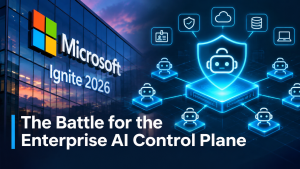
Microsoft’s announcements at Ignite 2026 reveal an ambitious effort to establish a common control plane for enterprise AI agents. Across Entra, Defender, Sentinel, Purview, Intune, and Agent 365, Microsoft is connecting identity, access, risk assessment, and security operations to govern agents as they interact with enterprise systems.
Microsoft’s reach across enterprise identity, endpoints, applications, cloud infrastructure, and security operations gives it access to telemetry and enforcement mechanisms that few competitors can match. Bringing these capabilities together could allow organizations to assess agent risk and intervene more effectively, although extending that control beyond Microsoft’s own ecosystem presents significant challenges.
Extending Identity Security to Autonomous Agents
Microsoft’s Entra announcements address a fundamental requirement for agent governance: establishing distinct identities for agents and controlling their access to enterprise resources.
New Agent ID capabilities, in preview, extend identity management to discovered local agents, initially including GitHub Copilot CLI and Claude Code. Microsoft is also expanding agent-aware network controls through Entra Global Secure Access, including an MCP Firewall (in preview) designed to govern access to MCP servers, tools, and resources.
Assigning an identity to an agent establishes accountability, but does not guarantee appropriate behavior. An agent may have legitimate credentials and approved permissions yet execute an inappropriate action based on incomplete context or flawed reasoning. Effective governance must therefore account for how permissions are delegated, whether access remains appropriate as tasks evolve, and how quickly that access can be revoked.
These requirements are shaping investments across the identity security market. SailPoint’s Agentic Fabric emphasizes continuous access governance, runtime authorization, and privilege management, for example, while Okta is advancing agent-to-agent authorization, short-lived credentials, and runtime enforcement through its Agent Gateway. Microsoft is pursuing similar objectives through Entra and its broader security portfolio. Each approach will need to demonstrate that it can enforce appropriate access as agents interact with different tools, applications, and other agents.
Dynamic Agent Risk in Microsoft Agent 365, now in public preview, could help inform these access decisions by combining signals across identity, access, data, endpoints, cloud, and network environments. Microsoft named Check Point, Cyera, Darktrace, and Zenity as partners whose signals can inform the assessment through Microsoft Sentinel. The test will be whether these risk assessments can inform timely decisions to restrict or revoke agent access as behavior and operating conditions change, without unnecessarily disrupting legitimate activity, especially as agents’ behavior and operating context evolve.
Security Operations Becomes an Execution Layer
Microsoft is also advancing its strategy for consolidating security operations and automating response. Core capabilities of its Integrated Security Operations Center are now generally available, bringing Defender and Sentinel closer together. Microsoft Perception, also generally available, introduces specialized security agents and coordinated playbooks for investigation, threat detection, vulnerability assessment, and remediation.
Microsoft reports that Perception’s Triage Agent can now cover approximately 80% of alerts in a typical Defender queue. While that suggests significant automation potential, Microsoft will need to demonstrate a high degree of investigation accuracy, especially as it connects security intelligence directly to enforcement. This is already taking shape through capabilities such as vulnerability shielding, currently in preview, which is designed to deploy temporary protections to vulnerable systems. Microsoft Perception is generally available, but its vulnerability remediation capability in Intune is in limited public preview. The agent prepares a remediation plan, and IT approves patch deployment.
Microsoft is not alone in pursuing this approach. Notably, CrowdStrike has advanced its multi-agent SOC strategy through Charlotte AI, emphasizing specialized security models, shared operational context, and coordinated investigation and response. CrowdStrike brings deep security telemetry, threat intelligence, and response capabilities, while Microsoft draws on its presence across enterprise identity, applications, cloud infrastructure, and security operations. Both are developing platforms that can interpret risk and execute responses with less human intervention. The competitive question concerns which can assemble the context needed to make reliable security decisions and execute effective responses, while giving enterprises sufficient visibility and control over those actions.
Security agents responsible for investigating threats, modifying access policies, and initiating remediation may themselves require privileged access to critical enterprise systems. Their permissions, autonomy, and oversight therefore demand the same scrutiny as those of the agents they are tasked with securing. Enterprises need to establish which actions these security agents can execute independently, when human approval is required, and how their decisions can be audited or reversed. Who governs the agents responsible for governing other agents?
The Challenge of Operational Accountability
Preventive controls have limitations when an AI agent takes an authorized action with unintended business consequences. An agent might use legitimate permissions to modify thousands of customer records, change product pricing, or execute transactions based on an incorrect interpretation of its instructions. Identity systems may establish which agent acted, while security telemetry can help reconstruct its activity. Organizations must still determine which changes were appropriate, identify downstream consequences, and restore a trusted business state without reversing legitimate operations.
Research conducted by theCUBE Research and Qualitate underscores this preparedness gap. Among 25 enterprise security and technology leaders interviewed, 20 reported having AI agents in production, yet only four had tested their response to an AI-agent incident. While the qualitative sample is limited, the findings suggest that organizations may be deploying agents faster than they are validating their ability to recover from agent-related failures.
Microsoft has an opportunity to connect these requirements through its extensive enterprise footprint. Doing so will require deeper integration between security controls, application context, and operational recovery processes.
theCUBE Research Perspective
Microsoft’s Ignite announcements reflect a broader convergence of identity security, security operations, and AI governance. The company is positioning itself to play a central role in how enterprises evaluate risk, authorize actions, and execute security responses.
This strategy puts pressure on independent vendors to demonstrate the value of their intelligence and enforcement capabilities within increasingly integrated security architectures. Vendors that can provide visibility and control across competing platforms may have an advantage where enterprises are reluctant to depend on a single provider.
Microsoft also faces a difficult technical and operational challenge. As security agents gain authority to modify access policies, contain threats, and initiate remediation, enterprises will need evidence that their decisions are reliable, explainable, and reversible when necessary. The extent to which Microsoft can deliver that assurance will influence how much operational authority customers are willing to delegate to its platform.