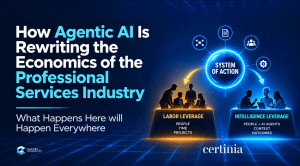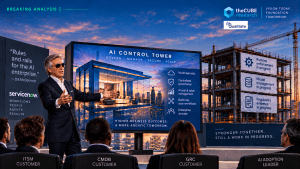
What happens here will eventually happen everywhere.
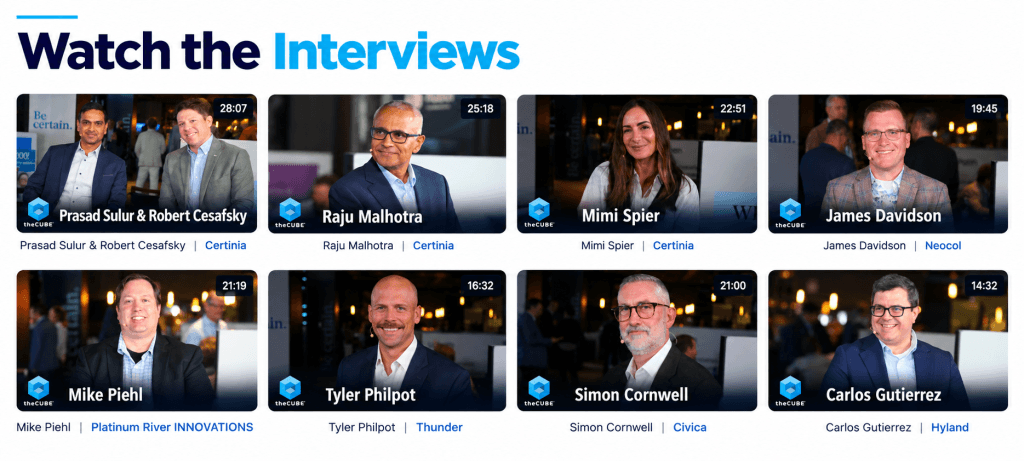
Hear directly from industry leaders on how new digital labor business models are transforming the economics of professional services.
Economics Takes Center Stage
For much of the past two years, the enterprise AI conversation has centered on technology: foundation models, copilots, agents, orchestration frameworks, trust and governance, and increasingly decision intelligence. But in professional services, the conversation is shifting to something more consequential.
It is becoming a discussion about business models and economics.
Across a series of recent conversations with CEOs, CIOs, professional services executives, and consulting leaders, a remarkably consistent picture emerged. AI is no longer simply helping individuals perform existing work faster. It is beginning to reshape how services firms scope engagements, price work, deploy talent, transfer knowledge, manage risk, and ultimately define what clients are buying.
James Davidson, CEO of Neocol, captured the moment succinctly: “Professional services is having a moment, and we’re really having to rethink our business model top to bottom. Traditionally, we’ve been a time-and-materials, labor-based consulting business. But clients want quicker, faster, cheaper. We’re seeing the business model of professional services changing in front of our eyes.”
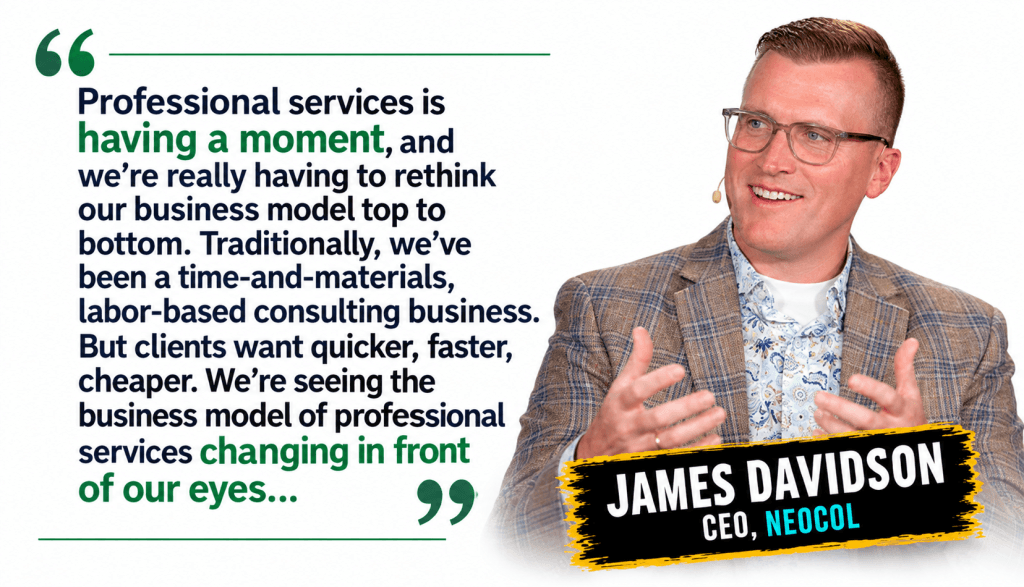
His observation reflects a broader shift now visible across the industry, from a model historically built around labor, utilization, and billable hours toward one increasingly built around intelligence, judgment, speed, and predictable outcomes.
This makes professional services one of the most important industries to watch in enterprise AI.
Why? The reason is structural. Professional services outcomes are collaborative, knowledge-intensive, and economically measurable across the entire value-creating lifecycle. We also know that projects change continuously across phases and holistically. Scope evolves, growing, shrinking, and expanding. Clients make new requests. Resources shift. Financial constraints matter.
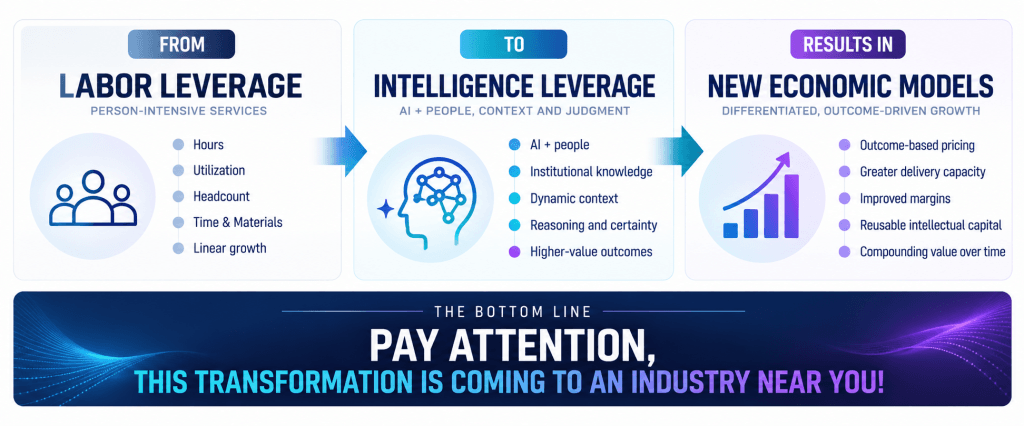
And the outcomes ultimately depend on people making consequential judgments in context. The result is a shift from a labor-leveraged model to an intelligence-leveraged model.
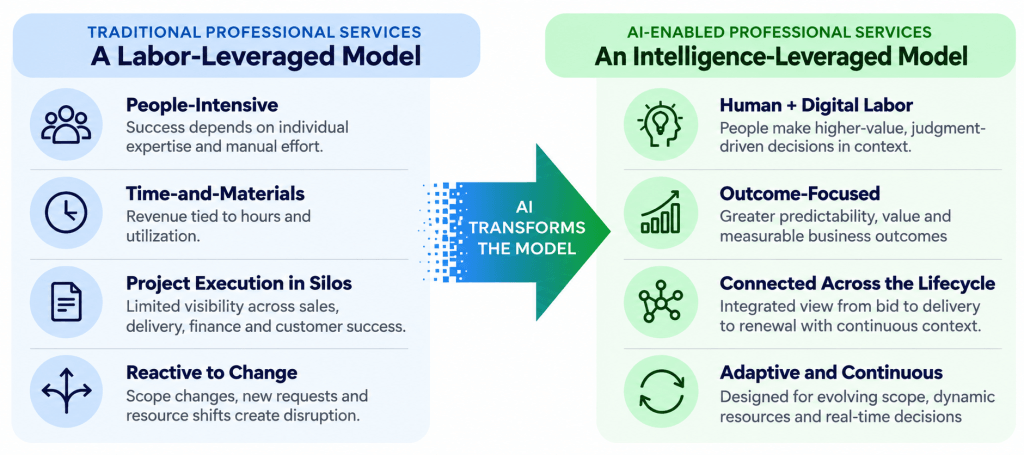
As we argued in both our April and July research, professional services may therefore be among the first major knowledge-work sectors to undergo a wholesale digital-labor transformation, shifting competitive advantage from labor leverage toward intelligence leverage.
What happens here is unlikely to stay here.
From AI Tools to Systems of Action
The first phase of AI use cases was largely designed to drive individual productivity. Draft something faster. Summarize a meeting. Generate code. Search documents. Produce a proposal.
The next phase is materially different.
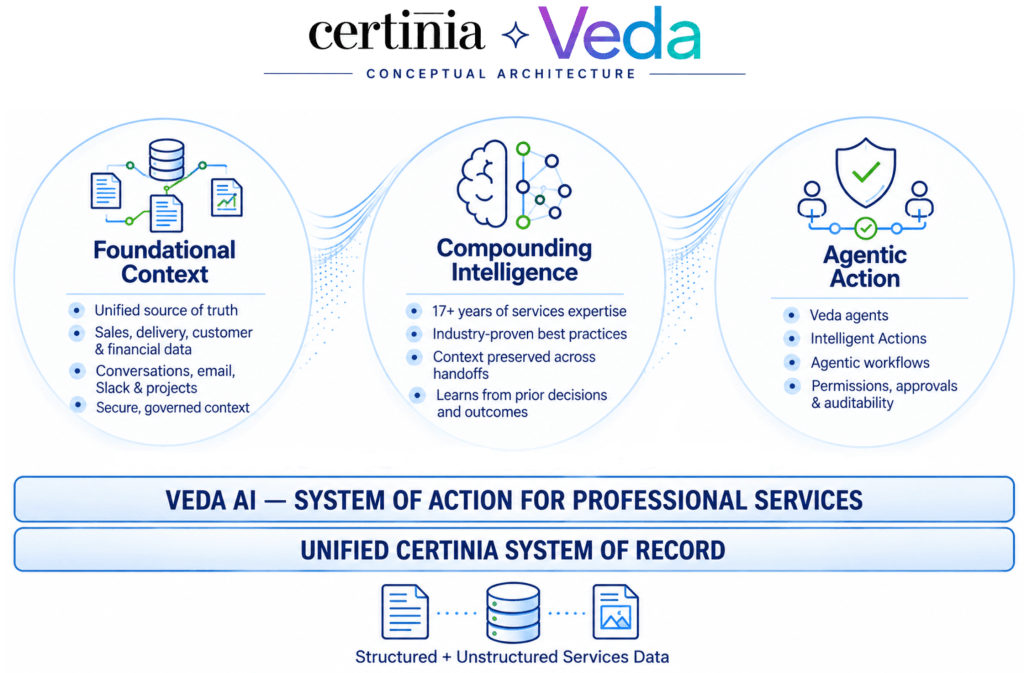
Leading professional services organizations are beginning to redesign their operating platforms around what Certinia, a leader in AI solutions for professional services organizations, describes as a System of Action: an AI-native operating layer that connects what the organization already knows, what is changing inside an engagement, how similar situations have produced outcomes in the past, and what people or agents should do next.
That distinction matters because professional services does not operate through static workflows. Scope changes. Client conversations alter requirements. Delivery decisions affect staffing, margin and revenue. The context surrounding a project can shift with a meeting, a document, a Slack message or a client request.
Raju Malhotra, Certinia’s chief product and technology officer, described the architecture as three reinforcing elements: foundational context, compounding intelligence, and agentic action: “The system of action, for us, really means those two layers that we talk about, foundational context and compounding intelligence. The third part of it, the action part of the system of action, is the coordinated agentic actions.”
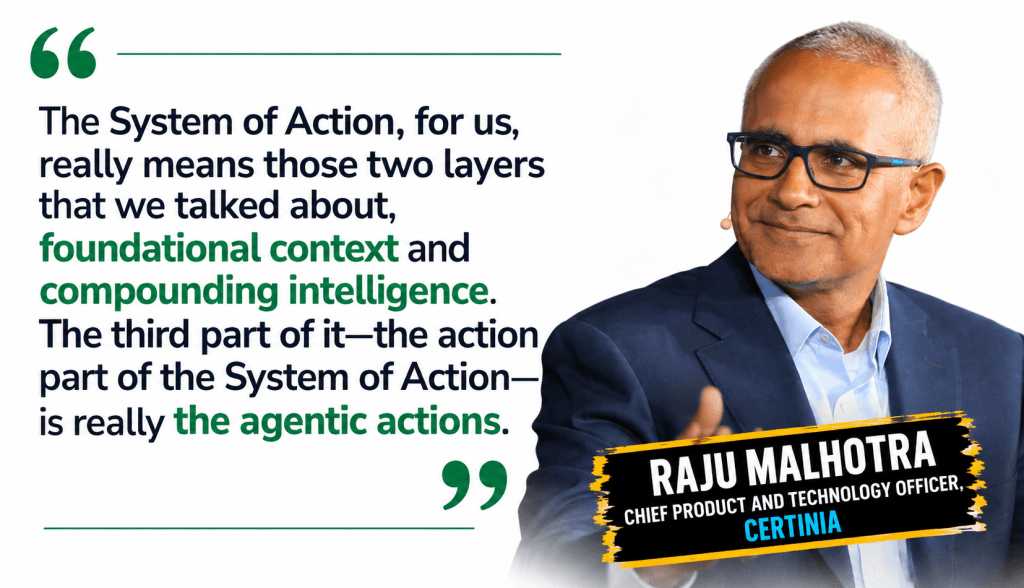
The foundation is increasingly broad. It includes traditional structured operational data as well as the unstructured information where project reality often resides: meetings, email, collaboration tools, documents, decisions, metadata, and telemetry. Malhotra argues that this context provides the “ground truth” on which more consequential AI decisions can be made.
The next layer is more consequential: compounding intelligence. Rather than treating each engagement as an isolated event, the system can preserve policies, methods, institutional knowledge, prior decisions and eventually evidence about which actions produced which outcomes.
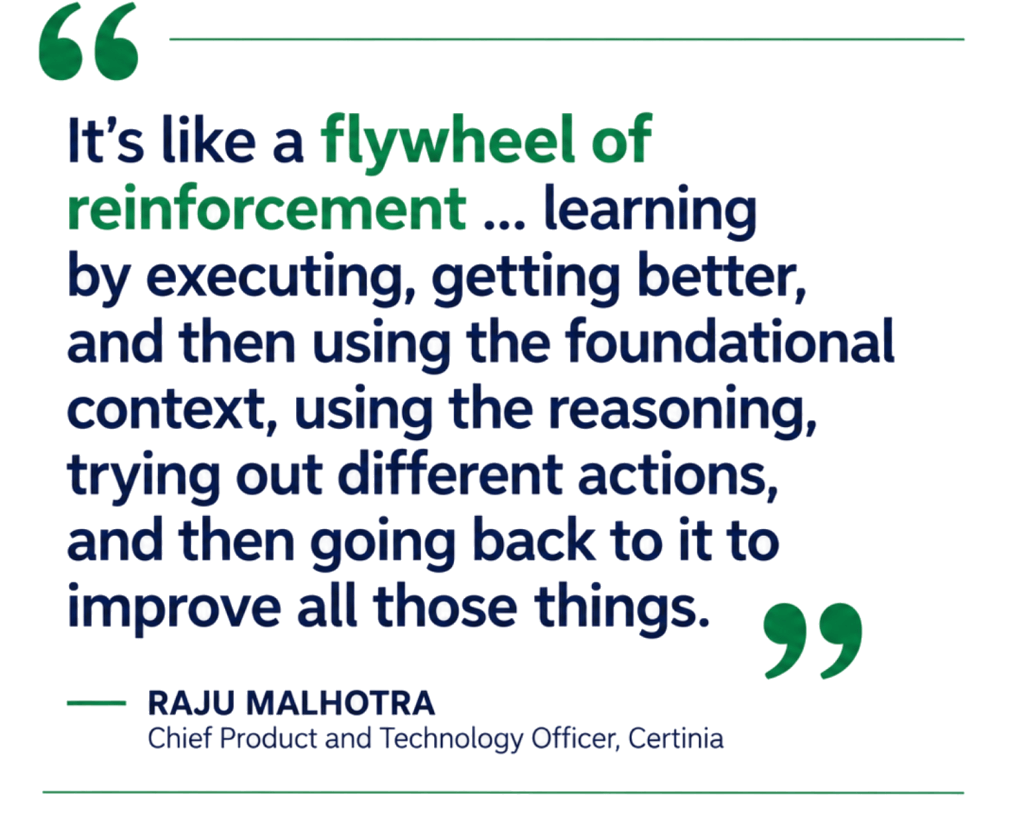
Malhotra described it as a reinforcement flywheel: “It’s like a flywheel of reinforcement … learning by executing, getting better, and then using the foundational context, using the reasoning, trying out different actions, and then going back to it to improve all those things.”
That is the architectural change to understand and watch.
The industry is moving from systems that primarily record work to systems that automate work to systems that increasingly learn how better outcomes are produced and help humans and agents act accordingly, in the context of every input and output.
Our April research characterized the frontier as the shift from workflow automation toward trusted agentic orchestration.
By July, that research thesis had already expanded into a continuous project context, institutional knowledge, and context-aware decision intelligence.
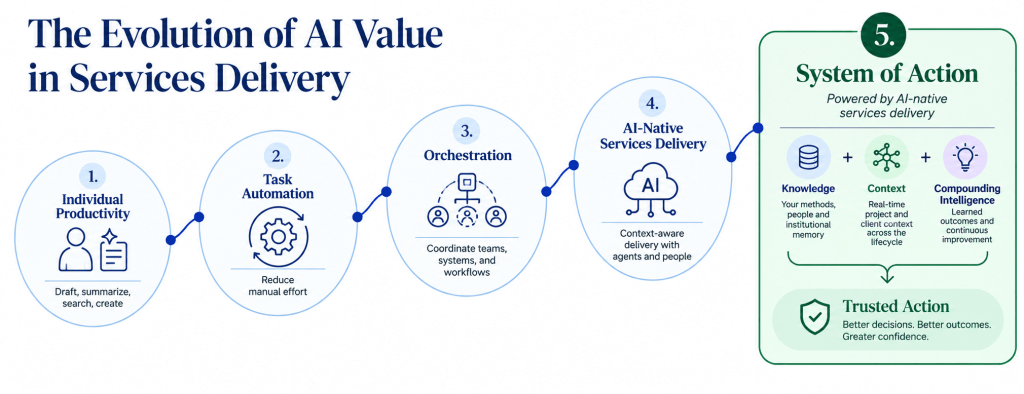
A useful way to express the progression is:
Productivity → Automation → Orchestration → AI-Native Services Delivery → System of Action
The final stage powered by AI-native services delivery, where institutional knowledge, changing context and learned outcomes continuously inform what happens next. That is where the value of compounding outcomes becomes the foundation of a new economic model.
This is not primarily a technological evolution. It is the operating foundation required for the economic changes that will eventually reshape every industry, not just professional services.
The Shift Beyond Productivity
Once AI moves into the operating model, the economic consequences become tangible.
Mike Piehl, CEO of Platinum River Innovations, described an AI-enabled delivery model in which internal delivery costs have fallen enough to improve margins while enabling projects that previously would have been uneconomic. Lower client prices and faster time to value are not simply producing savings; they are creating budget capacity for additional services.
That is beginning to challenge one of consulting’s most durable conventions: time-and-materials pricing.
Piehl deliberately moved his firm towared-bid engagements early in its AI transformation—something he said consultants historically would have “run from … like the plague.” Greater delivery predictability allows the firm to absorb more of the execution risk instead of automatically transferring that uncertainty to the client.
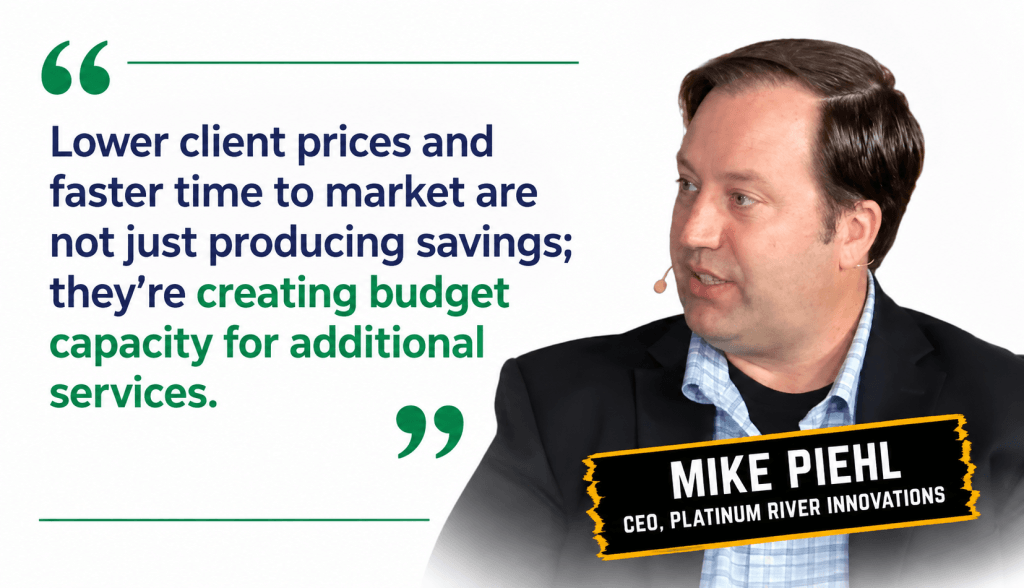
The economic logic is straightforward. If AI allows a services organization to deliver the same outcome in dramatically fewer hours, a business model based primarily on selling those hours eventually becomes self-defeating.
Tyler Philpot, the vice president of solution architecture at Thunder, put the issue in similarly practical terms: if a firm becomes twice as productive while continuing to monetize primarily through time and materials, it risks cutting the revenue associated with the work it has just made more efficient.
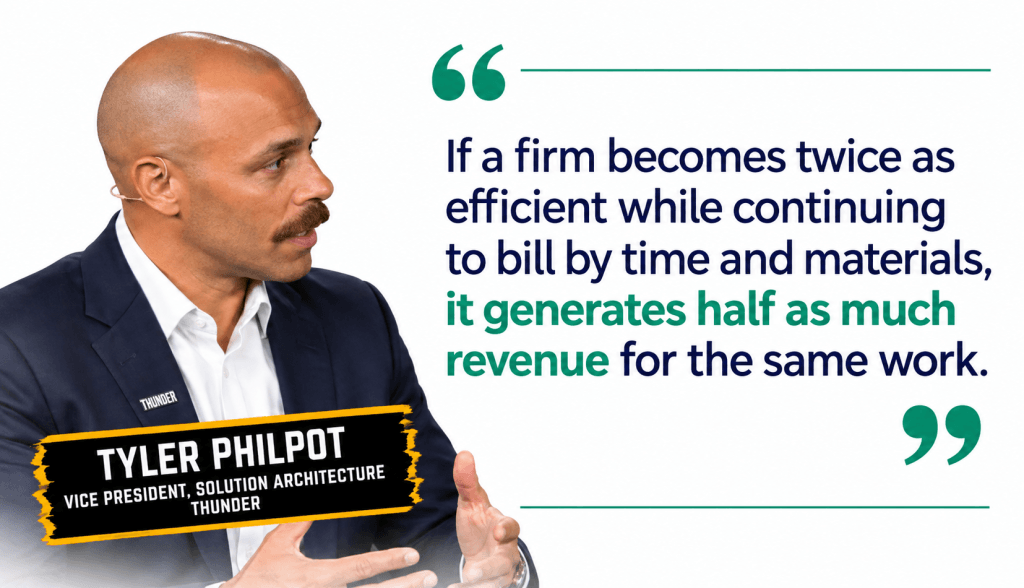
This is why the shift is broader than productivity.
AI is beginning to change what is sold, how it is priced and who carries delivery risk.
That shift has implications beyond pricing. As AI takes on more of the execution work, firms must rethink how they measure productivity, structure incentives, protect margins, and allocate risk between provider and client. The operating model begins to shift away from monetizing effort and toward monetizing confidence in the outcome.
Certinia sees the same transition developing across its broader customer base. Prasad Sulur, Certinia’s chief business officer, argues that the economics increasingly point toward a blended model of human and digital labor, with more fixed-bid and outcome-oriented approaches replacing traditional billable-hour assumptions: “In the future it’s going to be people plus AI cost. It’s going to be outcome-based. It’s going to be fixed bid.”
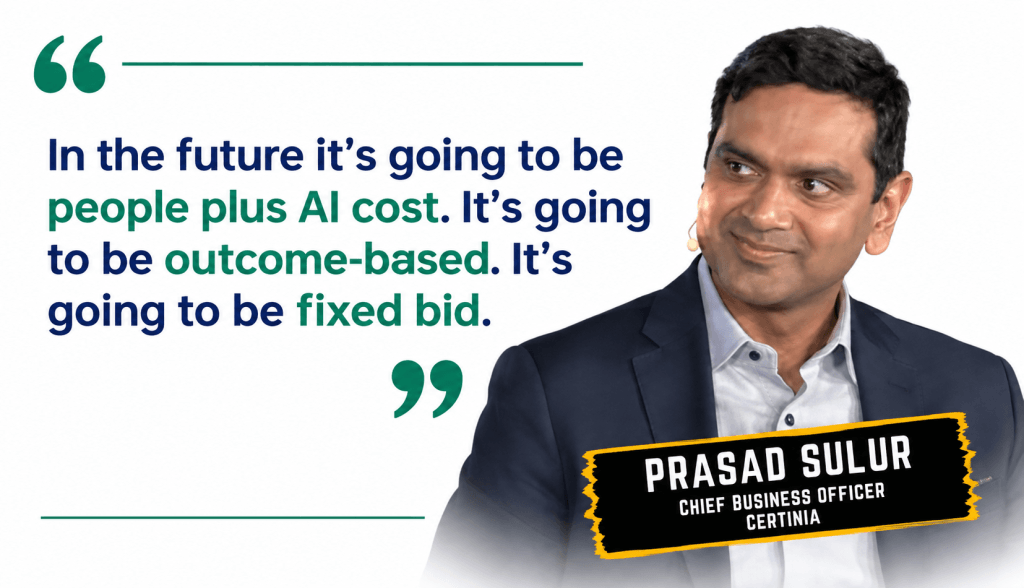
The takeaway: AI does not merely make the traditional services model more efficient. It is beginning to make parts of the traditional model economically obsolete.
The Labor-Demand Paradox
The business-model shift is also producing one of the most counterintuitive effects in professional services: greater AI productivity does not necessarily translate into lower labor demand.
The conventional assumption is straightforward: if AI reduces the number of hours required to complete an engagement, firms should need fewer people. Several leaders we interviewed are seeing something different.
Mike Piehl describes it as a labor-demand paradox.
“The labor demand on an individual project is coming down. However, because the overall price points are coming down as well and the value delivery is going up, it actually means that we have more client demand as a result. So more projects coming in, and the net effect is we need more people.”
That is the key economic point.
AI can reduce the amount of labor required to deliver one engagement while simultaneously increasing the total market for that work. Lower prices make previously uneconomic projects viable. Faster delivery creates additional capacity. Stronger outcomes stimulate follow-on work. The productivity dividend can therefore expand demand rather than simply eliminate supply.
James Davidson and Tyler Philpot echoed the changing nature of professional services roles: role expansion. Davidson described consultants moving from narrow, specialized “I-shaped” roles toward broader “T-shaped” roles, while Philpot emphasized that architects, developers, and analysts remain essential but increasingly work alongside digital labor across more projects. The common thread is not job elimination, but role expansion: professionals are being asked to contribute across a wider range of activities, apply more judgment, and create more value per engagement.
James Davidson and Tyler Philpot echoed the changing nature of professional services roles: expansion.
Role expansion. Davidson described consultants moving from narrow, specialized “I-shaped” roles toward broader “T-shaped” roles, while Philpot emphasized that architects, developers, and analysts remain essential but increasingly work alongside digital labor across more projects.
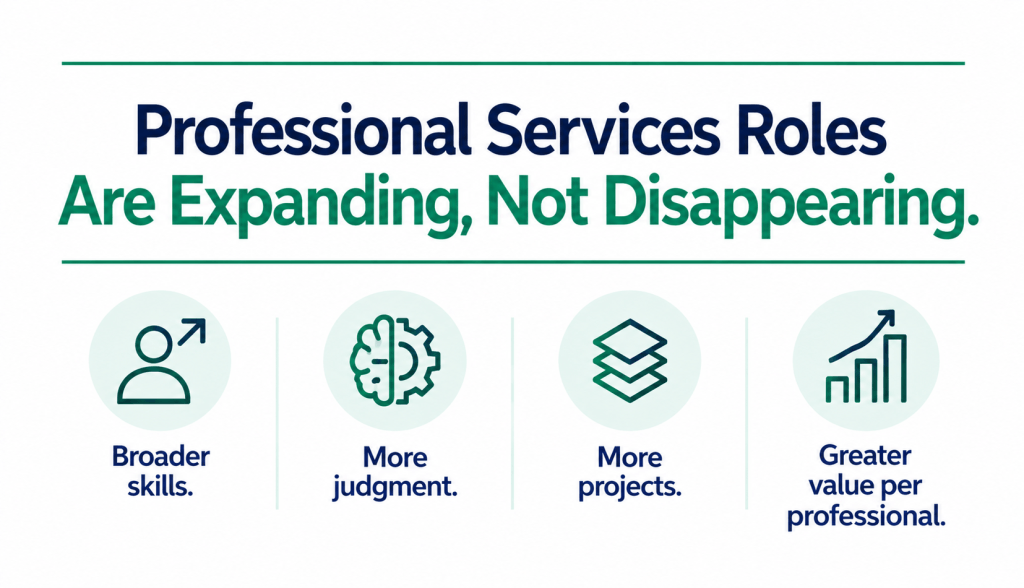
The common thread is not job elimination, but role expansion: professionals are being asked to contribute across a wider range of activities, apply more judgment, and create more value per engagement.
AI is changing the economic contribution expected of each professional.
This does not mean every professional-services role remains unchanged. Administrative work is being compressed. Skills will shift. Some roles will combine, and new disciplines will emerge.
But the early signal is important:
The emerging pattern is not fewer people doing the same work. It is fewer human hours per engagement, more engagements overall, and higher-value work per professional.
Be Certain
As AI moves deeper into the operating model of professional services, certainty becomes a differentiator. The reason is simple: the consequences are becoming more material. Drafting a proposal with a probabilistic model is one thing. Making a staffing decision, changing project scope, committing revenue, generating an invoice, or acting inside a regulated environment is another.
The more consequential the action, the more confidence the business needs in the context, reasoning, controls, and outcome behind it.
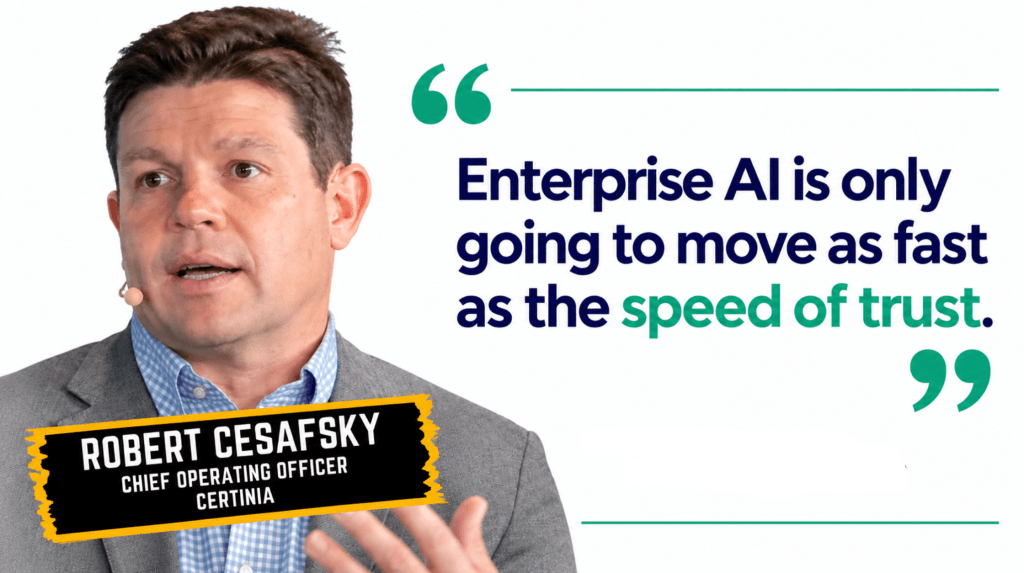
Robert Cesafsky, Certinia’s chief operating officer, framed the issue in terms of trust. Enterprise AI, he argued, “is only going to move as fast as the speed of trust.” For services organizations, that means AI cannot simply be useful; it has to be dependable enough to operate inside real business processes where financial, regulatory, and reputational consequences matter.
That is also why Certinia’s Be Certain theme is more than a branding message. It reflects a broader shift in enterprise AI from experimentation toward accountable execution.
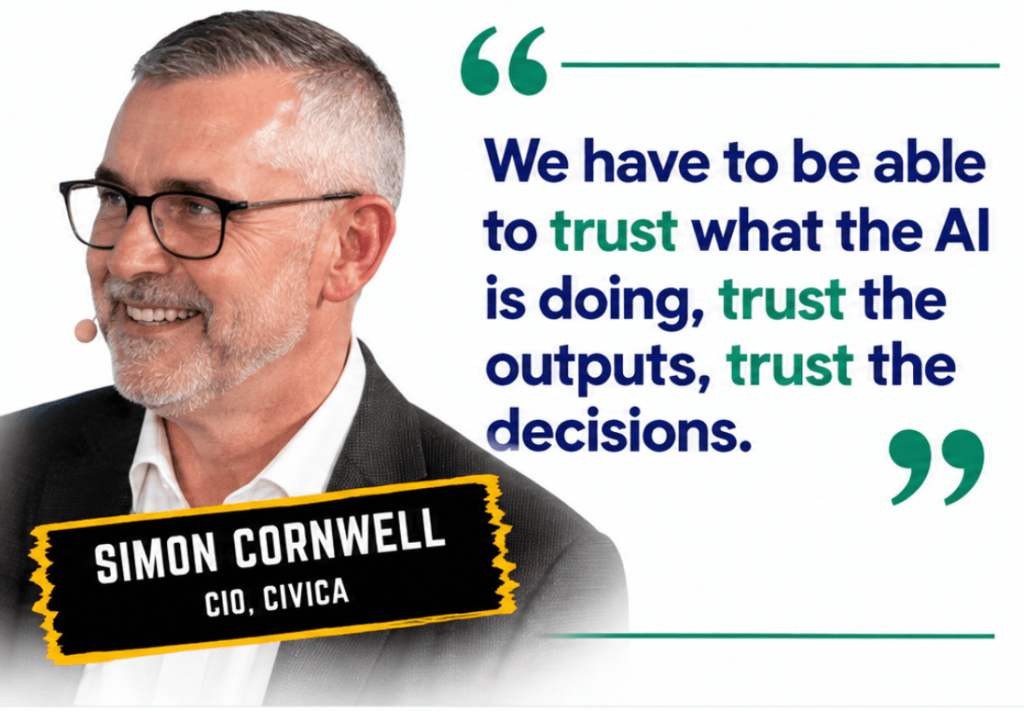
Simon Cornwell, CIO of Civica, reinforced that point from the perspective of highly regulated public-sector environments. His standard is straightforward: “We have to be able to trust what the AI is doing, trust the outputs, trust the decisions.”
That trust increasingly depends on the architecture underneath the action.
Foundational knowledge establishes what the organization knows. Current context explains what has changed. Compounding intelligence adds the accumulated policies, methods, decisions, and lessons learned from prior work. Reasoning connects those elements to the decision at hand. Governance and human oversight determine whether the resulting action can be trusted.
The chain increasingly looks like this:
Knowledge → Context → Judgment → Certainty → Action → Outcome
And as outcomes feed back into the system, that certainty can improve over time. As certainty grows, the higher quality and greater the outcomes.
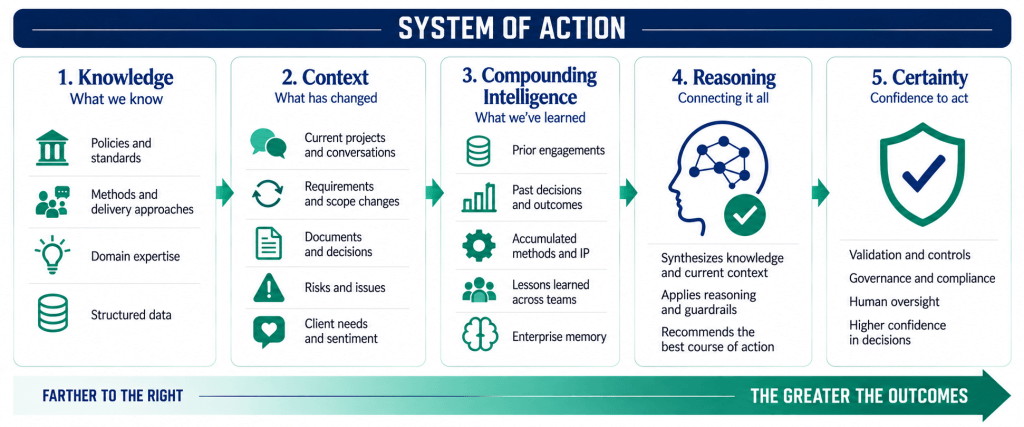
This is where the idea of a System of Action becomes economically important. It is not simply about enabling agents to do more work. It is about creating the conditions under which people and AI can take more consequential actions with greater confidence.
The more consequential the action, the more valuable certainty becomes.
Economic Transformation @ Speed
The pace of change in professional services is becoming as important as the change itself. What is evolving is not simply the technology stack, but the economics of how services are sold, staffed, delivered, and monetized.
In April, our research characterized the leading edge of professional services AI as the shift from workflow automation toward trusted agentic orchestration and digital labor. By July, our updated research found that the frontier had already expanded toward AI-native services delivery, where persistent context, institutional knowledge, and context-aware decision intelligence begin to improve how teams make and coordinate consequential decisions.
Only a few months later, the market is moving again—toward broader Systems of Action that combine knowledge, continuously changing context, compounding intelligence, reasoning and certainty.
The progression is striking:
Automation → Orchestration → Context-Aware Intelligence → Systems of Action
Each stage expands the economic potential of AI:
- Automation reduces effort.
- Orchestration coordinates work.
- Context-aware intelligence improves decisions.
- Systems of Action rewrites outcome economics.
Certinia Veda AI perfectly illustrates that acceleration. Launched as an agentic AI platform for professional services, Veda initially combined packaged agents with Intelligent Actions to automate and orchestrate work. Within months, Certinia expanded Veda from 10 packaged agents and 64 Intelligent Actions to 24 agents and 135 actions while simultaneously broadening the platform toward AI-native services delivery and a larger System of Action model.
The important signal is not the feature count. It is the changing role of the platform itself.
Veda is evolving from helping automate and coordinate work toward a business model operating layer that can increasingly understand project context, preserve institutional knowledge, learn from prior outcomes, apply reasoning, and help people and agents act with greater confidence.
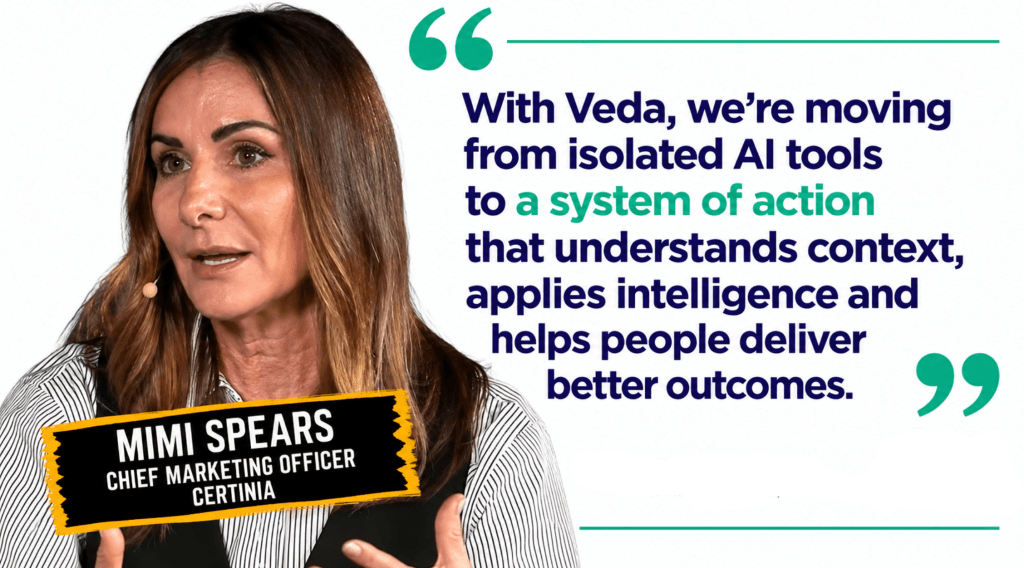
Mimi Spier, Certinia’s CMO, described the shift in equally fundamental terms: “Certinia is going through a major evolution, we’ve become a System of Action. And with our tremendous investment in AI, we are really a new company.” She framed the broader objective as helping customers reach “the other side of the next generation service economy.”
That evolution is occurring at the same time professional services firms are rethinking fixed-bid economics, labor models, delivery capacity and the value of human judgment. Technology innovation and economic innovation are therefore beginning to reinforce one another.
For services leaders, the implication is threefold:
(1) AI transformation can no longer be planned on multi-year cycles.
(2) The technology frontier is moving in quarters
(3) The economic model is shifting at an equal pace.
Collectively, this represents a mindset shift from agentic AI technology to digital labor transformation.
AnalystANGLE
What happens here will happen everywhere.
The professional services industry is not necessarily unique; it’s simply ahead of the enterprise AI maturity curve by the nature of the work it performs.
The industry is unusually exposed to the forces now reshaping knowledge work:
- large amounts of digital information
- constantly changing context
- collaborative decision-making
- heavy dependence on human judgment
- consequential outcomes
- measurable economics
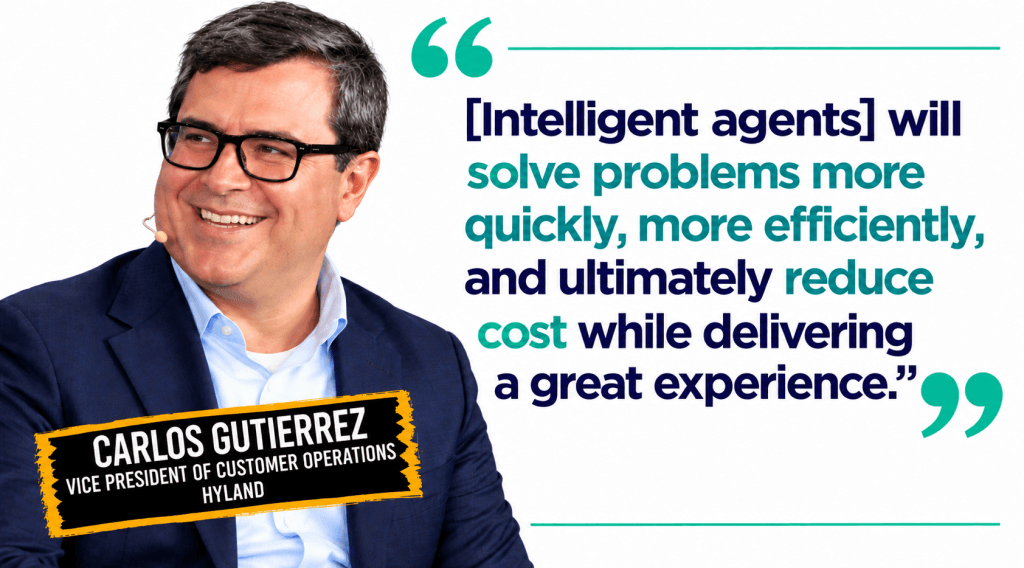
Carlos Gutierrez, vice president of customer operations at Hyland, sees the same shift playing out across knowledge work more broadly. His point is that the value of AI increasingly comes not from simply retrieving information, but from understanding context, connecting signals across the enterprise, and helping people take action at scale. Looking ahead, he expects intelligent agents to become pervasive across professional services, helping organizations “solve problems more quickly, more efficiently, and ultimately reduce cost while delivering a great experience.” That is the broader economic signal: as AI becomes embedded across workflows, its value increasingly comes from expanding capacity, lowering the cost of delivery, and improving outcomes—not simply making individual workers more productive.
That makes professional services an important proving ground for what happens after AI moves beyond individual productivity. The pattern now emerging is broader than consulting.
Labor Leverage → Intelligence Leverage → New Economic Models
First, AI reduces the cost and time required to perform tasks. Then organizations redesign workflows around that new productivity. Roles expand and change. Pricing models begin to shift. Institutional knowledge becomes reusable. Context becomes an operating asset. And as AI takes on more consequential work, certainty, governance, and human judgment become more valuable.
Eventually, competitive advantage moves from simply having access to skilled labor toward how effectively an organization combines people, digital labor and accumulated intelligence to produce outcomes.
That pattern should be watched carefully across legal services, financial services, healthcare, engineering, IT operations, marketing and other knowledge-intensive industries.
The important lesson is not simply that agents will become more capable, more collaborative, and able to help humans make more consequential decisions.
It is what happens after they do.
Watch what happens when lower delivery costs drive more demand, not fewer jobs. When time-and-materials economics give way to fixed-price or outcome-oriented models. When expertise stops disappearing at the end of a project and begins compounding across the enterprise. When people spend less time producing artifacts and more time applying judgment. And when confidence in the action becomes as important as the intelligence behind it.
Professional services is already beginning to show those second-order effects.
What is happening here is unlikely to stay here.

📩 Contact Me 📚 Read More AI Research 🔔 Subscribe to Next Frontiers of AI Digest