This research brief examines how Certinia’s acquisition of Moonnox advances Veda from agentic workflow orchestration toward an AI-native services delivery platform. It explores how continuous project context, compounding institutional knowledge, human-guided judgment, and governed actions can help professional services firms escape the micro-productivity trap, improve trusted outcomes, and shift from labor leverage to intelligence leverage.
Watch the CUBE Conversation
Executive Brief
This research brief examines Certinia’s July 2026 acquisition of Moonnox and its significance for expanding Veda’s system of action into AI-native services delivery. The acquisition extends Certinia beyond operating the services business into the dynamic environment where services are actually delivered—bringing meetings, documents, conversations, decisions, and changing client requirements into Veda’s trusted system of action.
- Professional services has reached a new inflection point. Firms face rising expectations, margin pressure, and resistance to paying for work AI can accelerate, while isolated AI usage creates a micro-productivity trap of fragmented context and inconsistent outcomes. The next stage requires shared intelligence that improves how teams understand, decide, and act.
- Moonnox accelerates a strategy Certinia had already established with Veda. It adds continuous delivery context, persistent knowledge, and services-specific intelligence—helping Certinia move beyond orchestrating work toward improving how engagements are collectively delivered.
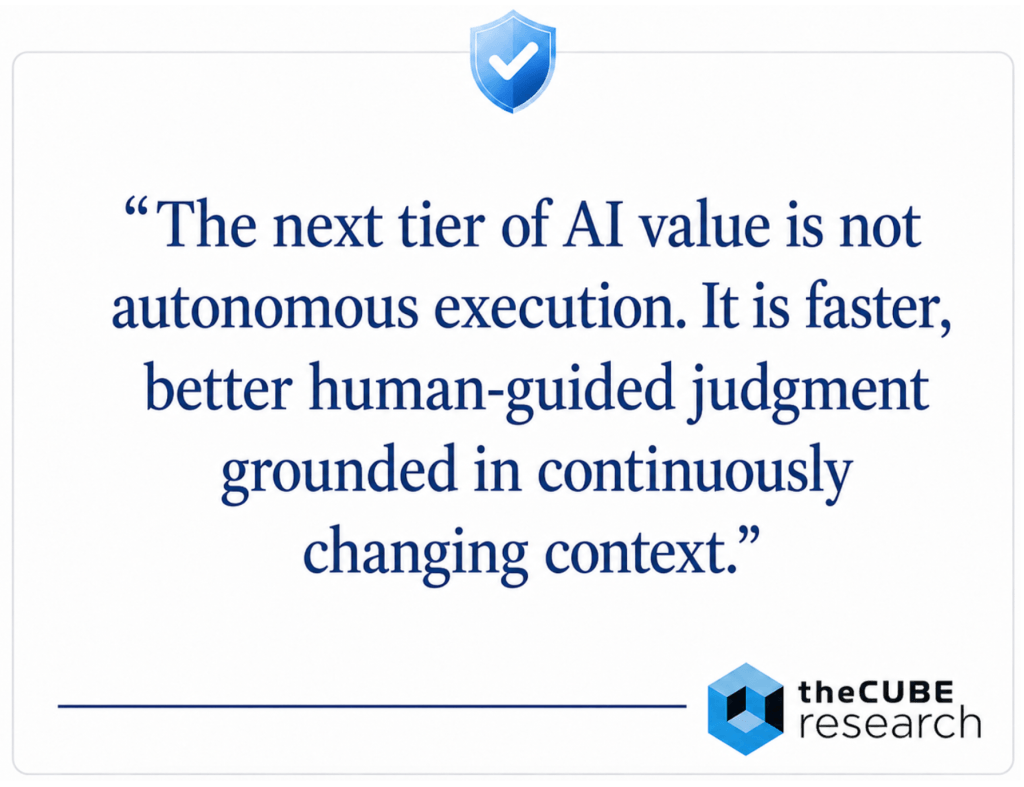
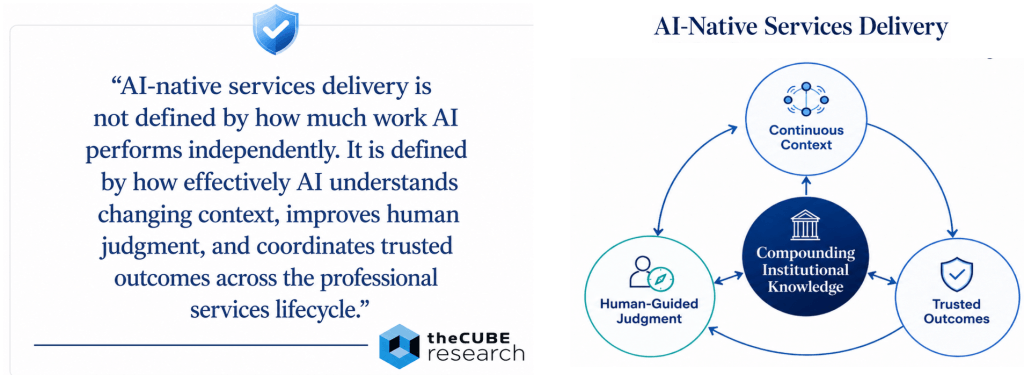
- AI-native services delivery is defined by context and judgment—not autonomy alone. Its value lies in understanding changing conditions, surfacing consequences, strengthening human judgment, and coordinating outcomes. In professional services, where the underlying product is accountable judgment, this distinction is critical.
- The potential of AI-native services delivery is transformational. By combining a governed system of action, continuous project context, and human-guided judgment, it creates a continuous intelligence loop: what the organization knows, what changed, why it matters, and what should happen next.
- The economic opportunity extends beyond productivity. AI-native services platforms can improve handoffs, planning, risk detection, margins, and delivery precision while shifting the model from labor to intelligence. As engagement patterns become reusable, they compound in value with every project that strengthens the next.
AnalystANGLE: We view professional services as a leading indicator of where enterprise AI is heading because it combines knowledge-intensive work, dynamic context, collaborative decisions, measurable economics, and human accountability. Certinia’s acquisition of Moonnox meaningfully advances Veda from a trusted system of action toward a context-aware platform for continuously improving how services are delivered. Clients should approach this as an operating-model transformation, not another collection of productivity tools. If Certinia executes well, Veda could become an important blueprint for translating digital labor into economic outcomes.
The New Strategic Divide
Enterprise innovation has always moved in cycles, but AI is compressing those cycles to an unprecedented degree. New models, agent frameworks, orchestration methods, and data architectures are advancing so quickly that capabilities considered leading-edge only months ago can become baseline expectations almost overnight.
This is creating a new strategic divide.
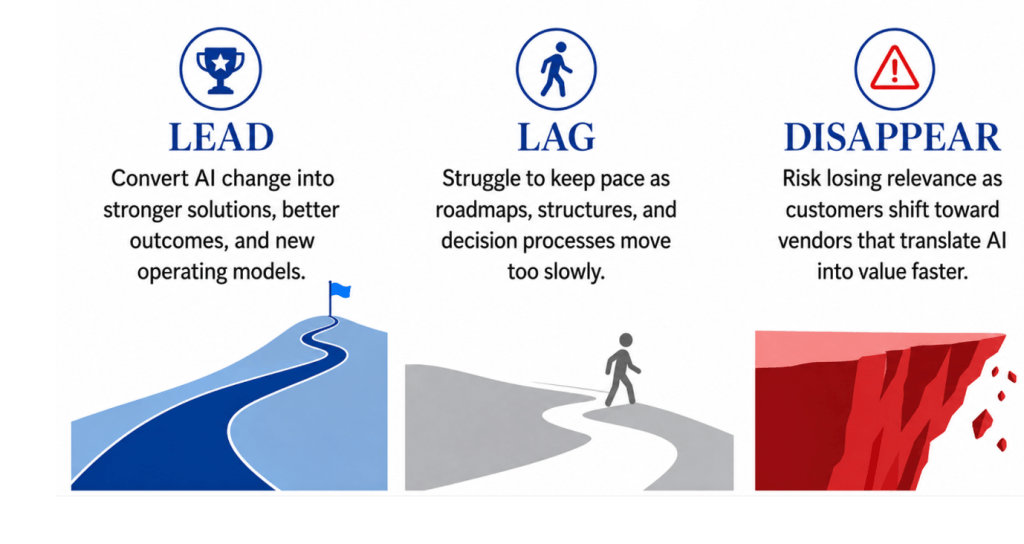
On one side are companies that can convert rapid technological change into outcomes and new operating models. In the middle are those who struggle to keep pace. On the other side are companies losing relevance as customers migrate to vendors that can turn AI advances into value more quickly.
The challenge is especially acute for enterprise software providers. They often possess deep domain expertise, customer relationships, trusted systems of record, and mature governance. These are significant advantages. But they also carry the weight of complex portfolios and crowded roadmaps. Even strong engineering teams may struggle to absorb every important innovation while continuing to advance core platforms.
This is why the traditional build-versus-buy debate is becoming less useful. In the AI era, the more important question is how vendors combine internal development, ecosystem partnerships, customer-led experimentation, and targeted acquisitions to stay ahead of rapidly changing market requirements. Increasingly, acquisition is becoming the cornerstone of the new innovation strategy, not a substitute for it.
Certinia’s acquisition of Moonnox reflects this new innovation model. Moonnox accelerates a capability area that Certinia had already identified as strategically important: bringing real-time, unstructured project context into Veda’s trusted system of action, which we examined in our earlier research on the platform. By rapidly integrating Moonnox’s in-market agents, specialized expertise, implementation experience, and proven customer patterns, Certinia strengthens its position on the right side of the strategic divide in professional services.
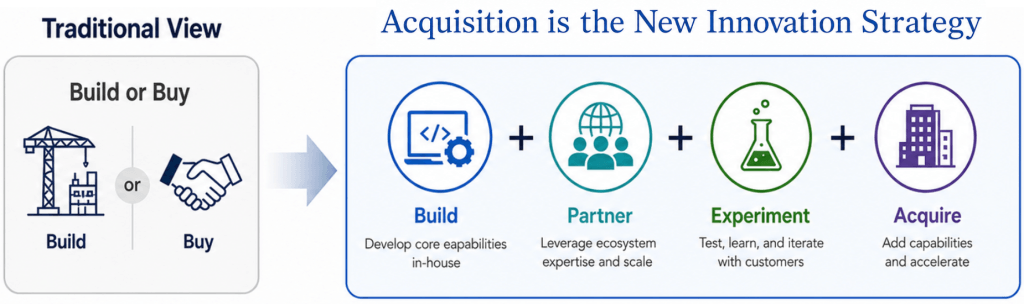
This is becoming a broader rule in enterprise AI competition. The companies that lead will not necessarily be those that invent every capability themselves. They will be those that recognize what matters early and build or acquire it quickly before the market shifts again.
In professional services, the urgency is particularly significant. AI is not only changing how software is built. It is changing how services are sold, staffed, delivered, and monetized. The firms that keep pace will help redefine the economics of services delivery. Those that do not may discover that incremental improvement is no longer good enough.
The Professional Services Inflection Point
The new strategic divide is becoming especially visible in professional services, creating another major inflection point in the market. Client expectations are rising, project conditions are changing continuously, and firms are under pressure to deliver better outcomes in less time without compromising quality, trust, or accountability. For services firms, staying on the right side of the divide is no longer about adopting more AI tools. It requires rethinking how institutional knowledge, human judgment, workflows, and AI come together across every engagement.
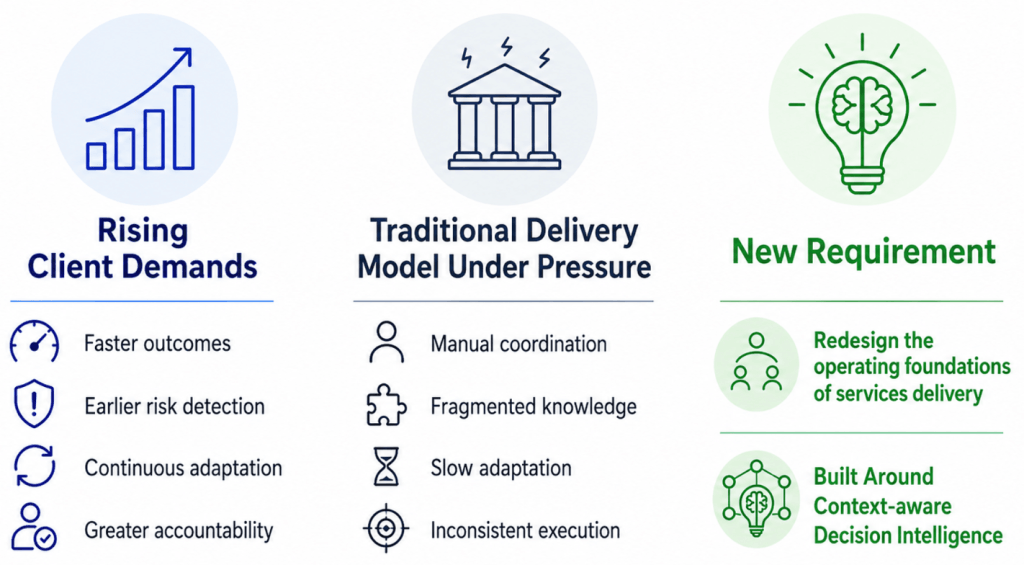
This is a difficult challenge because professional services is fundamentally knowledge work, not standardized execution. Every project brings together shifting requirements, complex workflows, commercial commitments, resource constraints, financial trade-offs, client sentiment, and professional accountability. Value is created by continuously interpreting changing conditions and applying experience to determine what happens next.
In other words, the underlying product is accountable judgment.
Importantly, AI is not reducing the importance of human judgment. It is increasing it.
As AI generates more analysis, recommendations, content, and possible actions, the constraint shifts from producing information to determining what is correct, material, appropriate, and safe to act upon. Professionals must still decide which trade-offs are acceptable, how client commitments should be interpreted, when exceptions require intervention, and who remains accountable for the outcome.
The organizations pulling ahead are therefore not simply adopting more automation tools. They are redesigning the operating foundations of services delivery so that better context, institutional knowledge, and human accountability are available when decisions are made. Accenture’s analysis of more than 2,000 AI projects found that organizations combining workflow reinvention, dynamic workforce adaptation, and human-agent collaboration were 2.5 times more likely to achieve improved results. The implication is clear: the differentiator is the ability to embed AI into the way knowledge, decisions, workflows, and accountability move through the organization.
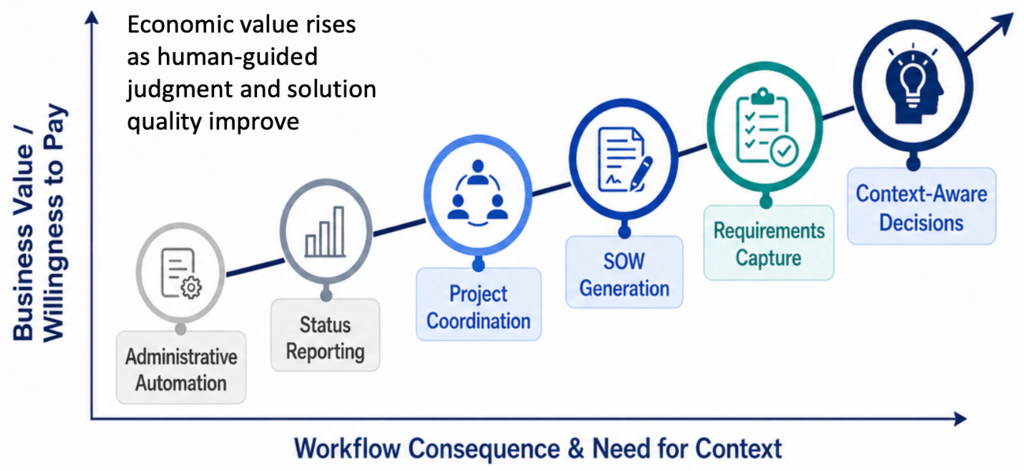
In that context, professional services illustrates a broader evolution in enterprise AI value:
- Individual productivity: AI helps a professional draft, summarize, search, analyze, or prepare.
- Task automation: AI completes predefined activities faster and reduces administrative effort.
- Orchestration: AI coordinates work across agents, teams, systems, and project stages.
- Context-aware decisions: AI understands changing conditions to improve human judgment.
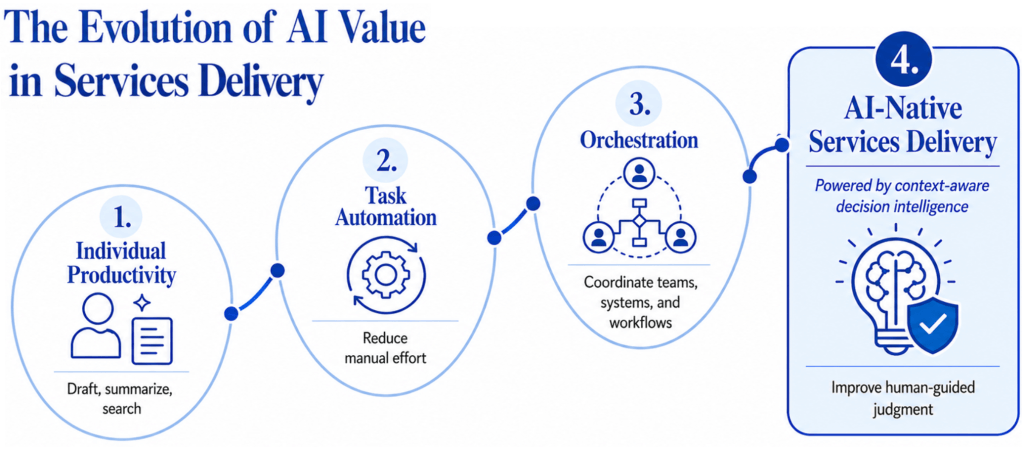
The first three stages primarily improve how work is performed. The fourth improves the quality, consistency, and adaptability of the outcome. Context-aware decision intelligence maintains continuity across changing requirements, conversations, documents, project phases, financial conditions, and prior decisions. It helps professionals understand not only what changed, but why it matters, what consequences may follow, and where human intervention is required.
This is why autonomy is the wrong primary measure of progress. In consequential professional work, clients are buying more than speed or output.
They are buying confidence, predictability, accountability, and trust. The firms delivering the greatest value will be those that redesign how services are sold, staffed, delivered, governed, and assured while preserving human responsibility for the judgments that matter.
Automation changes the cost of work. Context-aware decisions change the quality of outcomes.
The next frontier of professional services is therefore not an individual productivity model. It is a collective operating model in which project teams continuously share context, apply institutional knowledge, and coordinate decisions as conditions change. These new sources of value promise to create a new sphere of competitive advantage in AI-native service delivery.
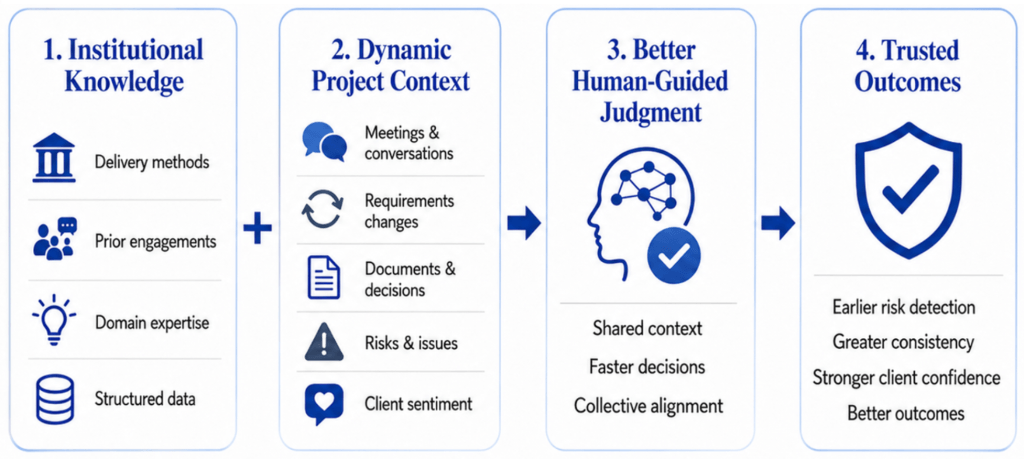
That requires more than isolated AI tools and automation platforms. It requires a platform that unifies structured enterprise data with the continuously expanding body of unstructured project information—meetings, documents, conversations, decisions, and client signals—to create trusted context at the point of decision and propagate it across the full project lifecycle.
The real opportunity is therefore not individual AI productivity, but collective, context-aware services delivery—AI value rises when institutional knowledge and changing project context come together to improve human judgment.
The Micro-productivity Gap
Most services firms still begin their AI journey at the individual level. Professionals use general-purpose assistants, coding tools, and homegrown agents to summarize meetings, draft proposals, conduct research, build analyses, generate code, automate status updates, and accelerate routine delivery work. Some teams connect these tools into basic workflows. The gains can be real, but they often remain localized.
This creates the micro-productivity trap: organizations become highly AI-active without necessarily becoming AI-productive at the project or team level.
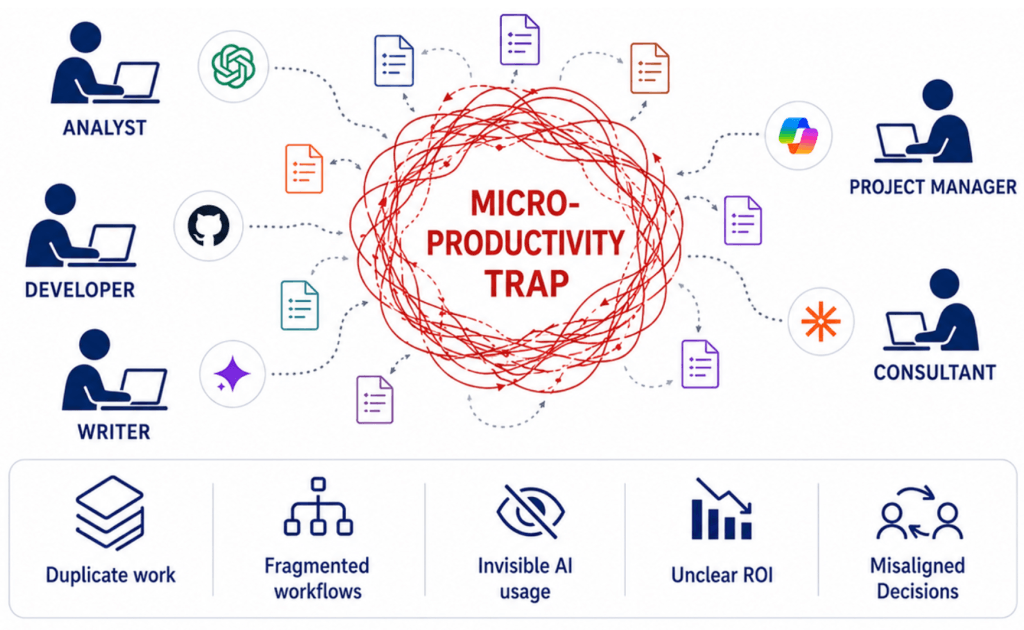
The problem is that firms are optimizing for the wrong unit of outcome. Individual speed matters, but enterprise value depends on how effectively knowledge, decisions, workflows, and accountability are coordinated across an engagement. A faster draft, analysis, or code artifact has limited value if it duplicates existing work, relies on outdated context, conflicts with another workstream, or fails to reflect the latest client decisions.
AI-assisted software development provides an early warning. Duplication has reportedly risen by as much as 4x, workflows have become more chaotic, and AI usage is increasingly invisible to managers, while services delivery teams struggle to connect all the dots across the services lifecycle.
The same pattern is emerging across other aspects of the services delivery lifecycle.
At scale, this can result in inconsistent quality, duplicated effort, weak governance, and project delays. Valuable practices remain trapped in personal tools, local automations, and employee experience rather than becoming reusable institutional intelligence. Firms may be able to measure individual productivity, but may struggle to demonstrate improved delivery quality, faster delivery, stronger margins, or better outcomes.
The strategic question therefore shifts from:
- How can every professional use AI to work faster and better?
- To how can a firm use AI to create a system of outcomes?
This can only happen if a firm embeds its institutional knowledge, evolving project context, and leading practices into a shared system of contextualized intelligence and coordination that improves collective outcomes at scale. The objective needs to shift to operationalizing a firm’s expertise across the organization while removing the friction that prevents people from making higher-value judgments in the context of the collective project.
The bottom line: micro-productivity accelerates isolated activity. AI-native services delivery coordinates and compounds intelligence across the entire project team, anchored in institutional knowledge and shared context.
Beyond Agentic Orchestration
Orchestration in services delivery is necessary, but it is not the destination. Coordinating agents, teams, systems, and workflows can improve work execution, but it does not automatically ensure that AI-assisted project teams share the same knowledge, interpret changing conditions consistently, or make aligned decisions. Without those capabilities, orchestration may simply automate fragmented work and not address the micro-productivity trap.
Moving beyond orchestration requires a shared foundation of institutional knowledge built through the continuous integration of two forms of data sources. Structured data represents the formal operational record maintained across professional services. Unstructured data captures what happens in the channels where daily work actually occurs: meetings, Slack and Teams conversations, email, documents, evolving requirements, commitments, decisions, risks, and client sentiment. It is often where the latest reality of engagements resides.
Bringing these sources together enables three new agentic capabilities that distinguish AI-native services delivery:
- Compounding institutional knowledge: Leading practices, prior engagements, templates, decisions, lessons learned, and operational data become reusable organizational intelligence based on a system of outcomes.
- Continuous, context-aware decision intelligence: What changed, why it matters, which dependencies are affected, and what consequences may follow. It makes the situational context available at the point of decision.
- Governed collective action: People, agents, teams, and workflows operate from the same trusted context while respecting permissions, policies, approval thresholds, auditability, and human accountability.
Collectively, these capabilities give services professionals shared situational awareness and context. Agents can draft SOWs, recommend configurations, generate status reports, coordinate kickoff and staffing, sequence dependencies, track progress, and recommend replanning as scope changes. The leap beyond orchestration occurs when these activities no longer operate as isolated automations but continuously draw on current institutional knowledge and project context to coordinate decisions and actions across the engagement.
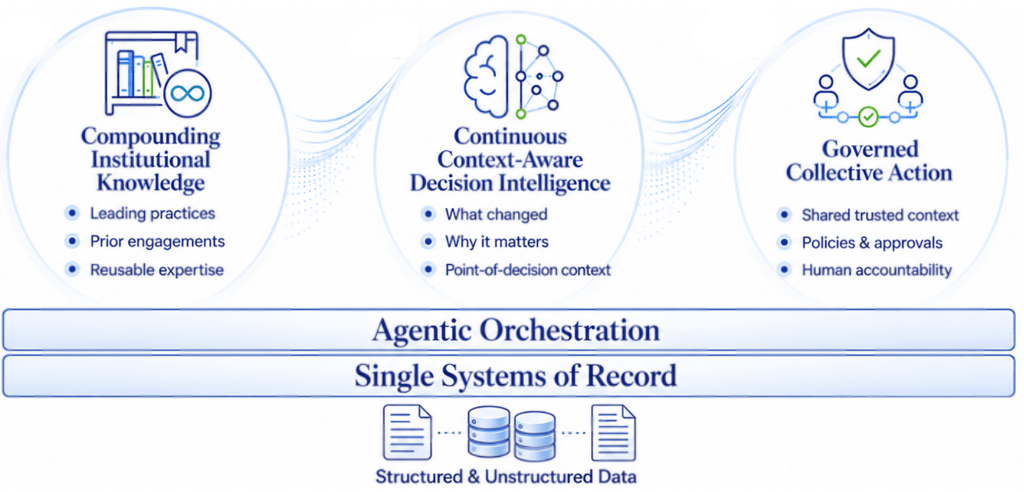
This is why AI-native services delivery platforms are transformational. They turn structured records and unstructured work into trusted context at the point of decision, enabling project teams to understand, decide, and act in unison. This is the level of innovation Certinia is seeking through its acquisition of Moonnox. Certinia provides the deep, structured foundation of Professional Services, Customer Success, and Financial Management; Moonnox brings the missing half: capturing the unstructured reality—the emails, chats, and calls—where delivery actually happens. Together, they fuse everything a services business knows with everything their teams do, moving Veda beyond orchestration toward context-aware, AI-native services delivery.
Moonnox Extends Certinia’s Advantage
Certinia’s vision for Veda did not begin with the Moonnox acquisition. As outlined in our April 2026 research, Veda was conceived as a trusted system of action for professional services, combining deterministic business controls, specialist agents, intelligent actions, workflow orchestration, and continuous context across the services lifecycle. Its strategic intent was to maintain a consistent thread of actionable intelligence from opportunity through staffing, delivery, financial management, customer success, and renewal.
That foundation anticipated the evolution toward a true AI-native services delivery platform. Certinia recognized that automation and orchestration alone would not transform an industry built on shifting project conditions, collaborative knowledge work, and consequential decisions. Veda would also need to continuously preserve context, compound institutional knowledge, and govern how humans and agents act on that intelligence.
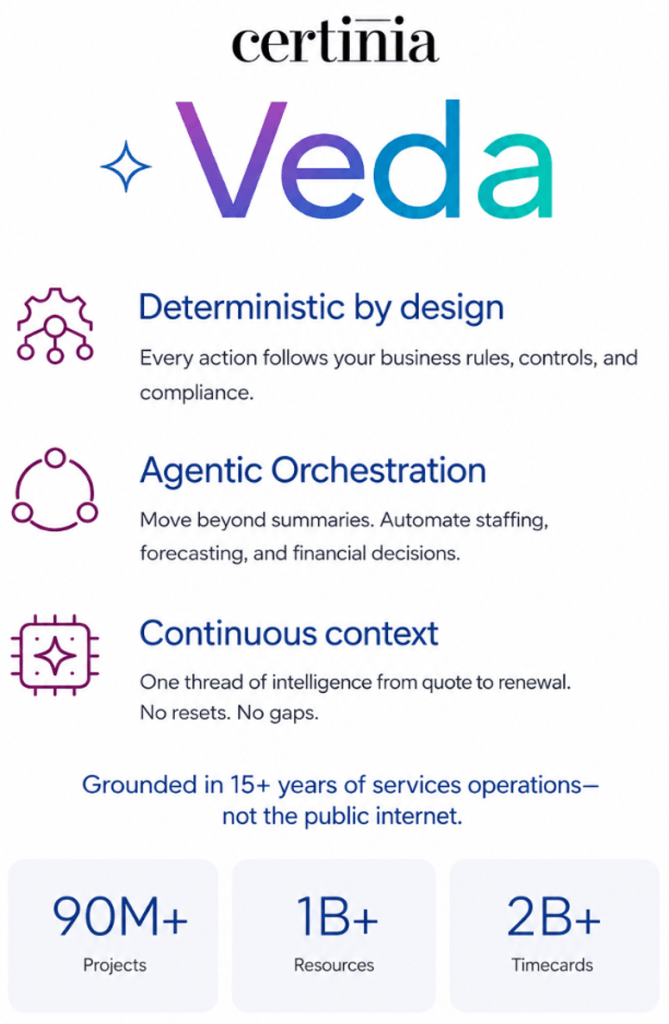
The acquisition of Moonnox accelerates Certinia’s strategy.
Moonnox is an early-stage, AI-native platform purpose-built for professional services delivery. Founded by former consultants, the company was created to solve a problem the team had experienced firsthand: valuable knowledge leaving with individuals, delivery quality varying across teams, and professionals losing time stitching together tools that lacked a complete understanding of the engagement. Its stated mission is to provide the infrastructure for complex delivery work while amplifying human expertise—not replacing it.
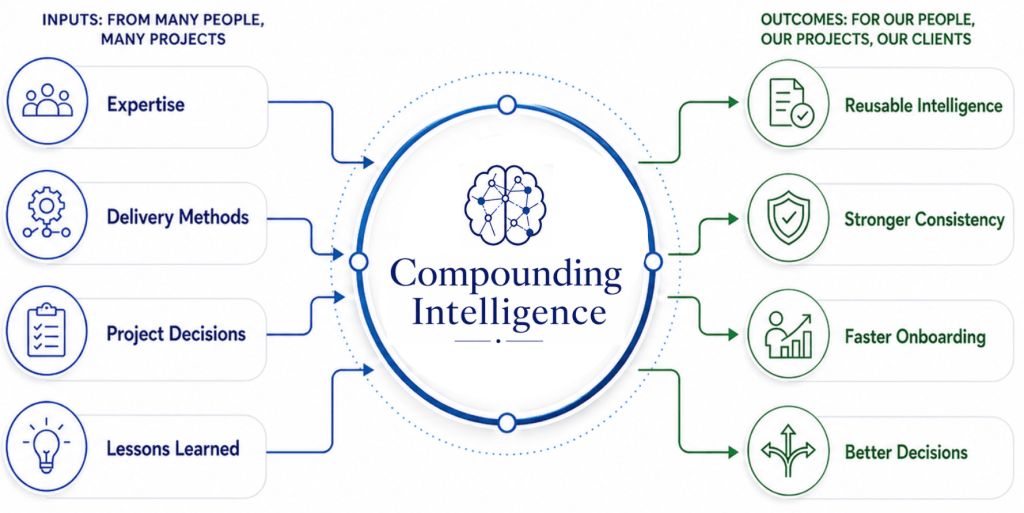
Moonnox’s strategy is built around turning individual expertise into persistent collective intelligence. At the center of this strategy is compounding intelligence, which captures the persistent organizational intelligence created when a firm codifies not only what its people know, but how they think, decide, and deliver—capturing methodologies, decisions, project patterns, and delivery experience so that the intelligence generated by one engagement can strengthen the next.
By capturing and building this intelligence across projects, Moonnox turns services delivery from a series of disconnected engagements into a continuously learning organizational asset.
In its framing, AI is the tool, but compounding intelligence is the durable advantage because it preserves differentiated expertise, improves consistency, and delivers that intelligence within the workflows where work is done.
Technically, Moonnox (now part of Veda) fuses structured and unstructured project information into knowledge graphs that generate contextual insights, delivery assets, and best practices. These new capabilities to accelerate services delivery are powered by a set of foundational master agents and out-of-the-box agents, with capabilities that include:
- Seamless Sales, Handoff & Alignment: Accelerates deal wins and streamlines the critical handoff from opportunity to execution by automatically crafting tailored proposal responses, generating polished Statements of Work directly from sales context, and orchestrating a seamless kickoff. This ensures delivery teams start with perfect alignment, actionable deal strategy, and no information loss.
- Precision Scoping & Planning: Converts complex customer requirements into actionable blueprints. By automatically translating high-level business needs into practical solution architectures and structured, phased implementation roadmaps, this capability slashes planning time and ensures immediate alignment on project scope.
- Frictionless Operations & Delivery: Drives day-to-day delivery velocity by keeping project teams unblocked and on track. It provides an on-demand universal assistant that manages daily tasks, instantly transforms meeting conversations into clear summaries, and continuously analyzes communication to elevate team performance.
- Margin Protection & Risk Management: Protects project margins and portfolio health by providing proactive, executive-level visibility. It executes automated scope scans, generates real-time sentiment scoring, and instantly translates complex system assessments into actionable roadmaps, allowing PMO leaders to steer projects before risks become realities.
- Value Capture & Knowledge Transfer: Captures the total value of every engagement by automatically drafting comprehensive retrospectives and shaping project outcomes into compelling customer success stories. It seamlessly organizes delivery data and lessons learned into a searchable, firm-wide knowledge base, scaling your best practices for future wins.
Moonnox goes far beyond simple document generation. It features persistent context, knowledge-graph technology, delivery-specific agents, and seamless integrations with your everyday workflow tools.
This matters because project management is rarely clean: conversations are fragmented, requirements conflict, documents become outdated, and client expectations often shift before formal records can catch up.
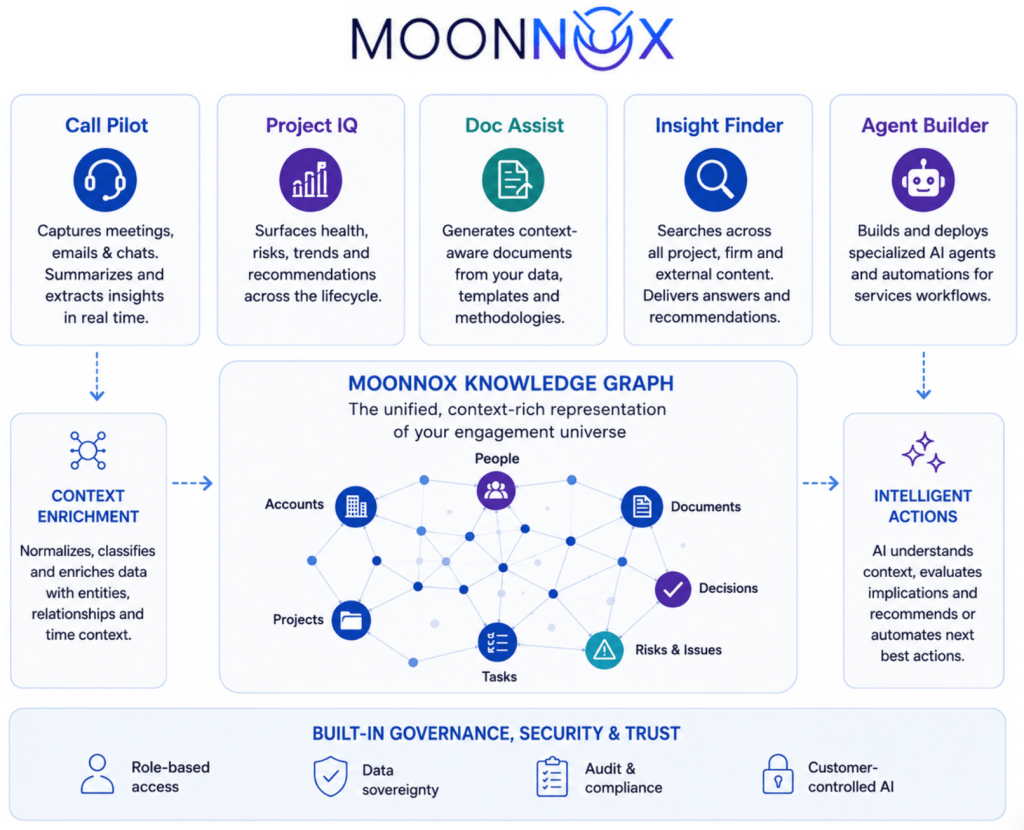
Moonnox carries intelligence across the full engagement lifecycle, ensuring that requirements, decisions, risks, methods, and lessons persist as work moves across people, systems, and project stages.
This expands Veda’s advantage. Veda already orchestrates services operations through specialist agents, Intelligent Actions, business rules, and governed workflows; Moonnox enriches the continuously updated situational context required to make that orchestration more informed, adaptive, and valuable.
For example, consider a client introducing a new requirement during a project meeting. With Moonnox (expanding Veda), the discussion is captured and linked to the approved scope, prior decisions, project documents, and delivery methodology. Veda then assesses the implications for staffing, schedule, costs, revenue, and margin. Intelligent Actions recommend appropriate updates, a professional reviews consequential changes, and the formal project system of record remains aligned with the latest delivery reality.
The resulting architecture brings together three complementary layers.
- Certinia Unified System of Record: Professional Services, Customer Success, and Financial Management applications provide the unified system of record built on Salesforce.
- Continuous, Trusted System of Context: unstructured context, knowledge graph, memory, and services-specific intelligence generated from meetings, documents, communications, and project activity.
- Veda System of Action: connects these sources through a suite of agents, Intelligent Actions, permissions, governance, and workflow orchestration to operate the business and accelerate delivery while updating and maintaining the system of record.
Together, they create a continuous services-intelligence loop:
What the organization knows → what changed → why it matters → what should happen next.
This architecture enables Certinia’s platform to maintain continuity from opportunity through renewal, propagate changing context across workstreams, actions across sales, staffing, delivery, finance, and customer success, and preserve human accountability for decisions.
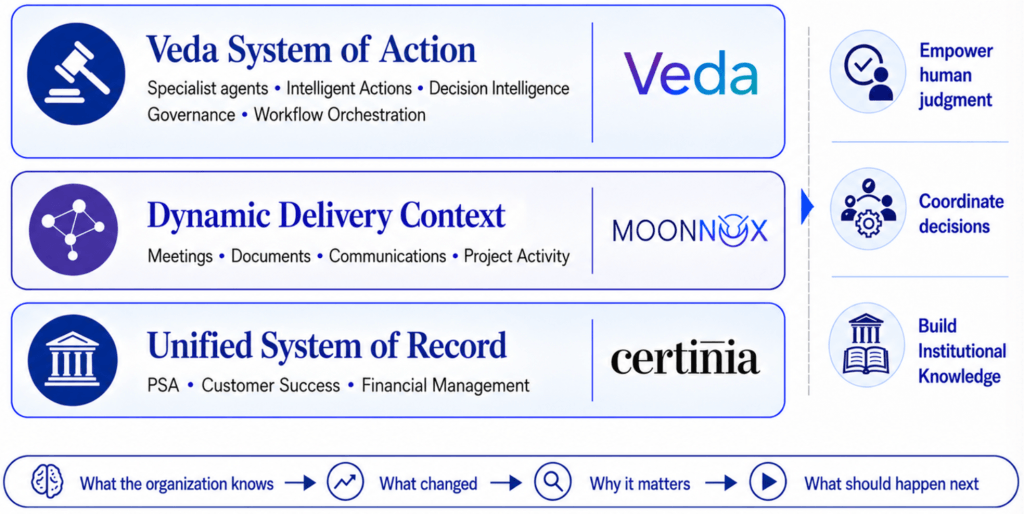
In effect, the platform reflects how a services business is operated and how its work is actually delivered, building institutional knowledge along the way. And, importantly, delivers on the promise of an AI-native Services Delivery platform:
Veda System of Action + Context Intelligence = AI-Native Services Delivery
Early customer successes illustrate the capabilities that are now available in Veda:
- Spaulding Ridge reportedly reduced solution-architecture drafting time from about 80 hours to under 20.
- Neocol deployed an SOW-drafting workflow across its sales organization in nine days.
- Thunder identified projects that looked healthy in formal reporting but carried underlying delivery risks.
These examples demonstrate three dimensions of the opportunity: accelerating high-value deliverables, operationalizing AI across teams, and surfacing contextual risks that structured reporting alone may miss.
This indicates that the strongest early value lies in workflows such as handoffs, requirements capture, SOW generation, coordination, and reporting—repetitive enough to automate yet consequential enough to require trusted, context-aware judgments. As AI shifts from saving time to supporting higher-value work—thereby increasing adoption, pricing power and margin impact—that is where AI-native services platforms create an economic advantage, not simply another layer of micro-productivity.
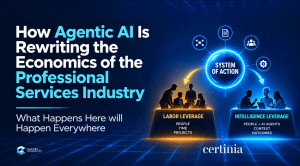
More strategically, professional services may be among the first major knowledge-work industries to undergo a wholesale digital labor transformation. Its economics are directly tied to human capacity, utilization, delivery speed, and the number of hours required to produce an outcome. As AI agents assume more coordination, analysis, documentation, and workflow orchestration, the traditional leverage model can evolve into a hybrid workforce in which digital labor scales institutional knowledge while human professionals focus on judgments and relationships.
Said another way, the competitive advantage shifts from labor leverage to intelligence leverage.
This shift to AI-native services delivery changes the economic equation, translating into increased top-line growth, improved efficiency, and compressed revenue leakage.
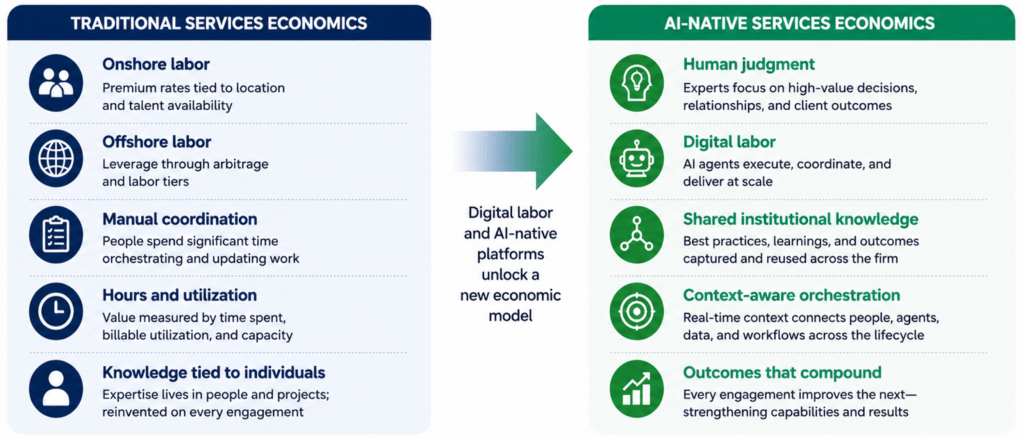
What Certinia envisions may very well become the foundation for a new economic model in professional services, in which successful outcomes become reusable building blocks and the organization’s capacity to deliver value compounds over time.
AnalystANGLE – Our View
We have been closely tracking the professional services market because we view it as a leading indicator of where enterprise AI is headed. This industry combines collaborative knowledge work, rapid change, consequential decisions, measurable economics, and high accountability. As a result, it may hold the keys to responsibly unlocking AI’s economic impact and digital labor potential across the enterprise.
Against that backdrop, Certinia’s acquisition of Moonnox marks a meaningful advancement of the strategy established with Veda. The objective is to complement automation with the core economic levers Certinia has consistently emphasized: helping firms staff effectively, deliver with greater precision, and serve clients more profitably. Moonnox strengthens that proposition by connecting Certinia’s structured services data, scalability, intelligent actions, and governance with Veda’s system of action and the context in which project realities change.
For clients, start with consequential outcomes—faster time to value, earlier risk detection, or revenue expansion—and identify the knowledge, decisions, and workflows required to produce them. Measure improvements in outcome quality, consistency, and economics, not merely documents generated or hours saved.
For Certinia, four priorities stand out.
- Integrate Moonnox into Veda as a coherent context and intelligence layer, powered by expanding their portfolio of AI specialist agents and intelligent actions, rather than as a separate set of modules.
- Ensure recommendations and actions are traceable so users understand what changed, which evidence informed the response, and how governance was applied.
- Substantiate the new services economics through repeatable customer benchmarks spanning growth, delivery efficiency, margin protection, and customer value. Bring to life the systems of outcome concept.
- Expand Veda’s decision-intelligence capabilities by deepening its knowledge-graph foundation and then progressively incorporating causal inference and scenario (“what if”) analysis.
Collectively, these capabilities will further expand on the advantage Certinia has created with its AI-native services delivery because, after all, professional services is judgment-intensive knowledge work with real consequences. Certinia can help users understand not only what changed but also why it changed, what consequences may follow, and which actions are most likely to improve outcomes.
If Certinia executes well, Veda can evolve from a system that helps firms deliver services into one that continuously transforms how organizations operate and deliver higher-quality outcomes.

📩 Contact Me 📚 Read More AI Research 🔔 Subscribe to Next Frontiers of AI Digest