Just last week, Apple announced a desktop computer.
By Wednesday morning, LinkedIn had decided it was a sovereignty milestone.
One post put it plainly: “Sovereign AI went from being just a goal to something you can actually buy. Your data, your models, your agents, all in your own building.” Seventy-nine reactions and climbing. [1]
Here’s the thing. Apple never said the word. Not once, across all three announcement releases. [2][3][4] What Apple said was this:
“Mac Studio lets users run massive models entirely on device with complete privacy — without counting tokens or worrying about rising cloud costs.” [2]
Read that last clause again. That isn’t a privacy pitch. That’s Pillar 5. A trillion-dollar hardware vendor just made the financial sovereignty argument on a product page — and the market handed them a crown they never asked for, in under 24 hours.
So let’s grade it properly.
First, three things everyone got wrong
The Mac mini can’t cluster. The viral posts say the new mini links machines over Thunderbolt 5. The M6 mini is Thunderbolt 4 — “Three Thunderbolt 4 (USB-C) ports.” Only the M5 Pro gets TB5, and Apple’s clustering sentence is explicitly TB5-gated. Apple names RDMA for Mac Studio only, never the mini. [3][5]
The 512GB machine doesn’t exist yet. $5,499 buys you 96GB. 256GB is $9,499. The half-terabyte config everyone is picturing has no published price and ships “late October.” As AppleInsider put it: “Apple does not quote a price yet, either.” [2][6][7]
The headline demo ran on hardware nobody can buy. Footnote 22: four preproduction 512GB machines, full-mesh, Thunderbolt 5 and RDMA. Roughly $70,000 of kit that ships in two months. And the “3x faster inference” claim? Same footnote. Same test. Not two proof points — one. [8]
Sovereignty discourse is now outrunning spec sheets by about 19 hours.
Now the flowers — and they’re deserved
Apple did something nobody else has done, and I want to be unambiguous about it before I get to the limit.
They created a category that didn’t exist: personal sovereignty.
Until this week, a solo practitioner had no sovereign option. Neither did a journalist protecting sources, a lawyer under privilege, a two-person clinic, or a single cleared analyst. Their choice was someone else’s meter, or nothing.
Apple built a third door, and priced it below a used car.
- A 671B model now runs on a desk, off a normal wall outlet. That was science fiction eighteen months ago. [9]
- 1.2TB/s of bandwidth in a 480W envelope is real engineering, not marketing. Nobody is close at this form factor. [2][10]
- It clears Territorial, Legal and Financial cleanly at small scale. Sovereign cloud doesn’t. Confidential computing doesn’t. A capped enterprise agreement doesn’t.
And on Pillar 5 specifically — the one everyone assumes it fails — it passes.
My own standing rule says a hosted frontier model in the request path auto-fails Financial. Not because it’s expensive. Because someone else sets the number. Flip that logic, and the Mac clears it: nobody else sets your unit cost. Google’s published January 2027 price increase — Gemini 3.7 Flash going “$0.75 through December 31, 2026. $1.50 starting January 1, 2027” — can’t touch you. [11] And nobody can deprecate a model sitting on your own disk.
For one person, this is the real thing.
The scorecard
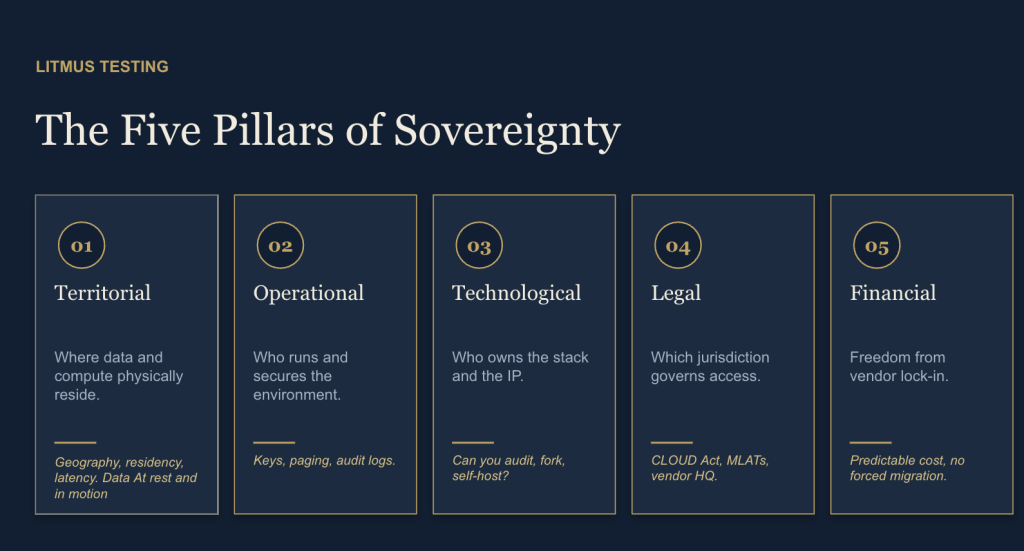
Here’s where it gets interesting. I ran the litmus test twice — same hardware, same software, same building. The only variable is how many people it has to serve.
| Pillar | Litmus test | 1–5 seats | 50+ seats |
|---|---|---|---|
| Territorial | Where do data and compute physically reside? | ✅ Pass — everything on the box, in your building. | ✅ Pass — unchanged |
| Operational | Who runs and secures it? Keys, paging, audit logs. | ✅ Pass — you hold the keys, you are the operator. | ❌ Fail — no BMC, no out-of-band recovery, no audit logging, no redundancy, 2-VM tenancy ceiling. |
| Technological | Who owns the stack? Can you audit, fork, self-host? | ⚠️ Conditional — weights, GGUF and llama.cpp are portable; MLX is MIT and now runs on CUDA. Metal is absolute. | ⚠️ Conditional — unchanged. This pillar doesn’t care how many seats. |
| Legal | Which jurisdiction governs access? | ✅ Pass — no request path leaves the premises. | ✅ Pass — unchanged. |
| Financial | Freedom from lock-in. Predictable cost, no forced migration. | ✅ Pass — nobody else sets your unit cost. | ❌ Fail — the solitude premium; unit economics collapse without batching. |
4 out of 5 at one seat. 2 out of 5 at fifty.
Same box. Same software. Same room. Nothing changed except the number of people who needed it.
That’s the whole story, and it’s the first time I’ve seen a product where the score moves that far on seat count alone. Notice which two pillars flip — Operational and Financial. Territorial and Legal are physics and geography; they don’t care about headcount. Technological is a property of the software stack. But Operational and Financial are both scale properties, and both break at the same threshold, for the same underlying reason.
Which is worth explaining, because it’s one reason, not two.
Then it stops. And the reason is the same reason it’s expensive.
Here’s the mechanism almost nobody has written about.
Generating a token means reading the model’s weights out of memory. At batch size one, you read every weight to produce one token. A hosted provider batching 64 requests reads those same weights once and gets 64 tokens out of the same pass.
Their cost per token is roughly yours divided by the batch size.
That’s arithmetic on identical silicon. Not cheaper hardware. Not procurement leverage. Not margin. And it isn’t a subsidy waiting to be withdrawn — hosted open-weight inference already prices near marginal cost. Llama 3.3 70B retails at $0.32 per million output tokens. [12]
You’re not paying an Apple premium. You’re paying a solitude premium.
And here’s why that matters far beyond the invoice: batching is also what lets a machine serve many people. Same mechanism. So an architecture that can’t batch is simultaneously expensive and single-user. One flaw, two symptoms.
The numbers:
- Mac Studio M3 Ultra: 84.09 tok/s for one user. 24.93 tok/s each at eight. A 70% collapse. [13]
- One batched H100: 1,850–2,780 tok/s aggregate. [14]
Roughly, one datacenter GPU absorbs the concurrent load of a dozen Mac Studios. A thousand knowledge workers at 5% concurrency is fifty simultaneous sessions. The Mac’s curve fell apart at eight.
Unified memory gives you capacity. It does not give you concurrency. You can hold a 671B model on your desk. You cannot serve it to a company.
Enterprise AI is a concurrency problem wearing a capacity problem’s clothes. Apple solved the visible one.
The part that inverts
This is where the sovereignty conversation usually gets it backwards.
For one person, the Mac is more sovereign and more secure than an API call. One box, one user, nothing on the wire. Both arrows point the same way.
Put thirty of them across a company and the arrows split.
You haven’t built a sovereign platform. You’ve distributed your crown jewels across thirty endpoints that:
- Can’t be isolated — the macOS license caps you at two VMs per host, enforced in code. No real tenancy. No blast radius control. [15][16]
- Can’t be recovered remotely — no BMC, no IPMI equivalent, no out-of-band console. Every incident needs hands on a box under someone’s desk.
- Can’t prove memory integrity — Apple has never claimed ECC on any Apple Silicon spec sheet, and exposes no error counters. [17]
- Can’t fail over — no redundant power, soldered non-serviceable storage. Every node a single point of failure holding sensitive data.
- Can’t be supported — AppleCare for Enterprise starts at “volume-based price tiers starting at 200, 1000, and 5000 covered devices.” Below that, you can’t buy it at all. [18]
A managed GPU environment under your own keys gives back precisely what disappears: hardware-enforced tenancy, ECC and telemetry, redundancy, out-of-band recovery, physical access control, and audit logs.
Those aren’t conveniences. They’re the controls an auditor asks for.
Above a certain size, insisting on desk-side sovereignty buys you a worse security posture, worse availability, worse auditability, and worse economics — all four at once. The sovereign-looking choice becomes the least defensible one.
And it’s worth noting what Apple didn’t build alongside this: they discontinued the Mac Pro — the only rack-mountable, PCIe-expandable Mac — in March. Five months before the market crowned them an AI infrastructure vendor. [19][20]
The Sovereignty Crossover
Three thresholds. They land in roughly the same place.
| Where it sits | What flips | |
|---|---|---|
| Concurrency | ~8 simultaneous sessions | Measured and hard. Past this, add GPUs, not Macs. |
| Cost | Model-class dependent | Beats frontier APIs early. Against hosted open-weight, never — the solitude premium is structural. |
| Governance | When you must prove control | The moment a regulator, auditor or customer needs evidence, the workstation fleet loses to the managed environment. |
Below all three: buy the Mac. Nothing else competes.
Above any one: GPUs and a datacenter — yours, or a sovereign tenancy under your keys — are cheaper, more scalable, and more secure simultaneously.
What this changes in the framework
We’ve been treating sovereignty as a binary property of an architecture. It isn’t. It’s a property of an architecture at a given number of seats.
The litmus test needs a denominator. Not just sovereignty of what — sovereignty for how many.
An architecture that scores 4 out of 5 at one seat and 2 out of 5 at fifty hasn’t passed or failed. It has a seat ceiling — and that ceiling belongs on the scorecard next to the grades. From now on, every vendor I run through the five pillars gets scored with a seat count attached. A grade without a denominator is marketing.
Which gives us the honest verdict:
Apple built personal sovereignty, and built it well. It does not become enterprise sovereignty by buying more of it.
One person gets genuine, defensible sovereignty for $5,499. A hundred people can’t have it on this hardware at any price — and the attempt leaves them less secure, not more.
Sovereignty scales inversely with the number of people who need it.
One footnote, and I’ll let it speak for itself.
In June, Apple extended Private Cloud Compute beyond its own silicon for the first time — “collaborating with Google and NVIDIA to run new Apple Intelligence workloads on Google Cloud.” [21]
The company we crowned this week outsourced its own two months ago.
Where does your estate sit relative to the crossover? That’s a question with a number attached, not an opinion. We run the assessment.
Amit
Amit Eyal Govrin is lead analyst for sovereign AI at theCUBE Research and CEO of Agentcy Labs, which designs and builds sovereign AI platforms for enterprises and governments. His research for theCUBE Research is conducted under theCUBE Research’s editorial standards and is not sponsored or directed by Agentcy Labs. Agentcy Labs may hold commercial relationships with vendors covered in this research.
Sources
- Mark Padginton, LinkedIn, 25 Aug 2026 — post
- Apple introduces new Mac Studio with M5 Max and M5 Ultra — Apple Newsroom, 25 Aug 2026 — link
- Apple unveils a more powerful Mac mini featuring the all-new M6 and M5 Pro — Apple Newsroom, 25 Aug 2026 — link
- Apple introduces M6 and M5 Ultra for a big leap in performance and AI compute — Apple Newsroom, 25 Aug 2026 — link
- Mac mini — Technical Specifications — Apple — link
- You can spend $18,299 on a Mac Studio today, or more in October — AppleInsider, 25 Aug 2026 — link
- Mac Studio M5 Ultra with 512GB RAM coming in October — MacRumors, 25 Aug 2026 — link
- Mac Studio product page, footnote 22 — Apple — link
- 14-Minute Wait?! $10K Mac Studio Crawls with DeepSeek 671B + llama.cpp — Hardware Corner — link
- Mac Studio — Technical Specifications — Apple — link
- Gemini Developer API pricing — Google AI for Developers — link
- Simple Pricing — DeepInfra — link
- Local AI Hardware Performance Benchmarking — Olares, 4 Nov 2025 — link
- Batched H100 throughput, Llama 3.3 70B — derived from published serving benchmarks and provider cost structure; see also NVIDIA DGX Spark In-Depth Review — LMSYS, 13 Oct 2025 — link
- Apple Inc. Software License Agreement for macOS — link
- Virtualisation on Apple silicon Macs: how Apple limits VMs — Eclectic Light Co. — link
- Apple silicon: memory and internal storage — Eclectic Light Co. — link
- AppleCare Professional — Enterprise Support — Apple — link
- Apple confirms Mac Pro is dead, no future models planned — MacRumors, 26 Mar 2026 — link
- Apple discontinues the Mac Pro with no plans for future hardware — 9to5Mac, 26 Mar 2026 — link
- Expanding Private Cloud Compute — Apple Security Research, 8 Jun 2026 — link
Also worth reading: Ana Maria Constantin at The Next Web made the “local inference settles where the data sits, not who supplies the compute” point on announcement day — link. Jeff Geerling’s 1.5TB, four-node RDMA cluster remains the definitive hands-on — link. Max Weinbach at Creative Strategies reached the “only if you already run Macs” conclusion eight months ago — link.