AWS walks into re:Invent on offense against Microsoft, Google and NVIDIA. Here’s what to watch, what each announcement actually is, and the one detail that tells you whether it changes who holds the house keys.
Sovereign AI | theCUBE Research | Amit Eyal Govrin
The kid came home with a report card
Run the calendar back eleven months.
On January 14, AWS opened the European Sovereign Cloud: a separate partition in Brandenburg, run by EU residents, under its own German legal entity, with a stated plan to move to EU citizens only [2]. On Saturday, October 24, AWS unplugged it from the global backbone for several hours to prove it could live on its own [3]. In this newsletter I called that a sleepover and asked where the report card was. On November 1, the report card came home. AWS published the write-up [3]. No logs, no metrics, no outside auditor. But it came home, and that is more than most kids bring back.
On November 23, Matt Garman published an essay arguing that AI safety can’t depend on an emergency brake. It needs engineering around the model, not faith in it [4]. I agree with most of it. More on that below.
On Monday, November 30, re:Invent opens. Garman keynotes Tuesday, December 1, at 8:30 a.m. Pacific [1].
That’s the whole setup. Every vendor on that stage will sell you agents. The only question worth carrying into the room is the one I ask every week: who holds the house keys when the party is over?
What we’re hearing
theCUBE is on the ground all week, and the pre-briefs are done. I can’t tell you what’s coming. I can tell you where to point your eyes.
If the hallway is right, Tuesday is a full-stack story. Real time on the data layer under the agents. Real time on the enterprise assistant on top of them. Automated reasoning in between. And a frontier lab sharing the stage. Silicon to screen, one vendor. Keep that picture in your head, because every question below is about who owns which layer of it.
AWS isn’t defending this year. It’s on offense.
For three years, AWS played catch-up in AI. Enterprises that wanted OpenAI took their business to Azure [10]. Google had its own chips and its own frontier model. AWS had the biggest cloud and a story about choice.
2026 changed the board. In January, AWS opened a physically separate European cloud [2]. In February, it signed OpenAI to 2 gigawatts of Trainium and became the exclusive third-party cloud for OpenAI Frontier [5]. In April, Microsoft gave up its exclusive license to OpenAI, and AWS announced it would sell OpenAI’s models the next day [10][14]. In October, AWS unplugged its sovereign cloud from the global backbone and published the result [3]. And on November 23, Amazon signed a deal to buy the technology behind Decart’s chip-optimization software and hire its founders, a deal reported at about $7.5 billion [11][12].
That is four fronts at once:
- Against Microsoft, on the frontier model. Azure’s OpenAI moat is gone: OpenAI can now serve all its products on any cloud [14]. Microsoft keeps a first-ship right. OpenAI products ship first on Azure “unless Microsoft cannot and chooses not to support the necessary capabilities” [14]. Watch how much of the keynote is aimed at Azure customers.
- Against Microsoft, on sovereignty. In October I called Microsoft’s package (Data Guardian, the Production Touch Ledger, external keys in an HSM you control) the strongest operational package any hyperscaler has put on a public cloud [15][19]. Microsoft’s bet is a continuum, from public cloud to a private cloud you run yourself, even disconnected [16]. AWS took the other road: a physically separate cloud under a dedicated European corporate structure [16]. AWS has a card of its own. It ran its disconnect drill in public and published the result, which it calls the first public technical exercise of its kind [3].
- Against Google, on who holds the keys. With Google Cloud Dedicated, a local partner controls identity, authentication and the cryptographic roots of trust, and builds every component from source [17]. In France, S3NS runs it, and its offering holds SecNumCloud qualification [18]. That’s a different answer to the Operational question than AWS’s, which runs its sovereign cloud through its own German entity [2]. AWS counters with breadth and a single operator.
- Against NVIDIA and Google, on silicon. Trainium is AWS’s answer to both the GPU tax and the TPU. Anthropic and OpenAI have both made multi-gigawatt Trainium commitments [20]. Decart’s optimization stack runs on NVIDIA, Google and Amazon hardware [12]. That’s a full-court press.
AWS is fighting, and it’s fighting well. Which is exactly when buyers need to know what they’re looking at.
How to read the six big announcements
For each one: what you’ll hear, what it actually is, what it tells you, and the one detail that separates substance from slideware.
1. OpenAI’s stateful runtime on Bedrock
What you’ll hear. Production-ready OpenAI agents on AWS. Enterprise scale. Your choice of models.
What it actually is. A runtime, co-built by OpenAI and AWS, that keeps an agent’s context, remembers its prior work, and connects it to compute, memory and identity [5]. It plugs into AgentCore [5]. The model is the brain. The runtime is the agent’s memory and badge.
What it tells you. AWS and OpenAI are going after the stickiest layer in the stack. Models get swapped every quarter. An agent’s memory of how your business runs doesn’t. Whoever holds the state holds the customer. This is AWS’s real answer to Microsoft: not “we have OpenAI too,” but “we hold what OpenAI’s agents remember.”
The tell. Where the memory lives, under which entity, and in what format you can export it. The February announcement never mentions residency, regions or customer control of stored data [5]. If Tuesday answers that, it’s news. If not, my standing rule applies: a hosted frontier model in the request path fails Territorial and Financial until the exposure is named, priced and owned.
2. The agent trust architecture
What you’ll hear. Safety is an engineering problem. Agent identity. Containment. Independent monitoring. Proof, not trust.
What it actually is. Garman laid it out on November 23: agents get their own identity type with tighter permissions than their human, Firecracker contains them below the model, Nitro generates telemetry the agent can’t touch, and automated reasoning proves selected boundaries [4]. It’s the right architecture. AWS is one of very few companies that built it into the silicon.
What it tells you. AWS wants to do to agent security what Nitro did to cloud security: make it a hardware advantage nobody else can copy quickly. That puts pressure on the identity vendors and on Microsoft, whose security chief says monitoring agents “must become continuous” and which is building Guardian Agents to watch other agents [19].
The tell. Independent of whom. The essay says monitoring is independent of the agent. It never says who holds the logs, the keys or the off switch [4]. Evidence that only lives inside the platform is independent of the agent, not of the platform. Ask whether telemetry and audit trails can go to an account or a third party AWS doesn’t control.
3. Sovereign cloud, AI Factories and agents at the edge
What you’ll hear. Sovereignty without compromise. AWS wherever you need it.
What it actually is. Three different things that will be presented as one. The European Sovereign Cloud: a separate partition in Brandenburg, EU-resident staff, a German entity [2]. AI Factories: AWS-operated GPU racks inside your own data center [6]. Hybrid agents: AgentCore workshops for running agents on-premises and at the edge [6].
What it tells you. At launch, AWS said most customers could meet sovereignty requirements in its existing European Regions, which it calls “sovereign by design” [9]. Now it sells a separate partition, racks in your building and agents at the edge. That’s the same ground Microsoft is taking with its private cloud and Google with Dedicated and air-gapped. The sovereign fight has moved into the customer’s building.
The tell. Day-one parity. AWS’s own AgentCore region page lists Frankfurt, Ireland, Paris and other European commercial Regions, and no European Sovereign Cloud [7]. Frankfurt is not the sovereign cloud. In May, AWS promised Nova, Mistral and OpenAI open-weight models for the sovereign cloud “for the coming months” [8]. The first open-weight family to go GA there, in September, was Google’s Gemma 4 [21]. And AI Factories are “fully operated” by AWS inside your building [6]: great for Territorial, a fair question for Operational.
4. Jurisdiction and the CLOUD Act
What you’ll hear. Sovereign assurances. Legal protections.
What it actually is. A written commitment to use every reasonable effort to redirect government requests for restricted European Sovereign Cloud data to the customer, and to notify the customer [9]. That’s more than most vendors put on paper.
What it tells you. Effort, not outcome. Contracts lose to statutes. It’s the headline finding of my hyperscaler buyer’s guide, Sovereign or Not: no hyperscaler has a practical answer to the CLOUD Act yet.
The tell. Any new legal structure, any outside-operator option, or any change in who can be compelled. Anything less, and this part of the keynote is a rerun.
5. Trainium and the Decart question
What you’ll hear. Better price performance. Choice of silicon.
What it actually is. Trainium is AWS’s own accelerator, with OpenAI committed to 2 gigawatts of it [5]. On November 23, Amazon agreed to buy the technology behind the Decart Optimization Stack and bring in Decart’s founders and engineers [11][12]. Amazon didn’t disclose the price. Bloomberg puts it at about $7.5 billion [12]. Per Globes, the deal runs through Annapurna, Amazon’s chip unit, to make Trainium and Inferentia more efficient [11]. Annapurna was itself an Israeli startup Amazon bought in 2015 [13].
What it tells you. AWS is attacking NVIDIA’s real moat, which is the software that keeps models stuck on its chips. For buyers, a second credible chip supply is good news on the Financial pillar.
The tell. Portability that only points one way isn’t portability. Watch whether NVIDIA and TPU stay fully supported, or whether “choice of silicon” quietly becomes an on-ramp to Trainium.
6. Agent economics
What you’ll hear. Lower inference cost. Predictable spend. Pay for outcomes.
What it actually is. Cost is the barrier every enterprise names first. Expect AWS to attack it with routing, cheaper silicon and new pricing units.
What it tells you. If AWS moves from tokens to priced tasks, it’s moving toward the meter CFOs actually budget in. That’s real.
The tell. Who defines a “task” and who can reprice it. In the Dreamforce edition I flagged the meter mismatch: when the vendor’s cost runs on tokens and your price runs on actions, every routing trick that cuts their cost can raise your bill.
Nothing to see here
Some lines will sound like sovereignty news on Tuesday. They aren’t. Here’s how to spot them.
- “Available in Europe.” Check whether that means Frankfurt or the European Sovereign Cloud. They’re different partitions.
- “Customer-managed keys” in a commercial Region. Real help on Operational. No change on Legal.
- “Zero operator access.” A design claim. Ask for the attestation evidence and who verified it.
- “Sovereign-ready” Marketplace listings. A listing is not an assessment.
- “Independent monitoring.” Independent of the agent. Ask about the platform.
- “Choice of models.” Choice of brain doesn’t matter much if the memory stays in someone else’s runtime.
The cheat sheet for Tuesday morning
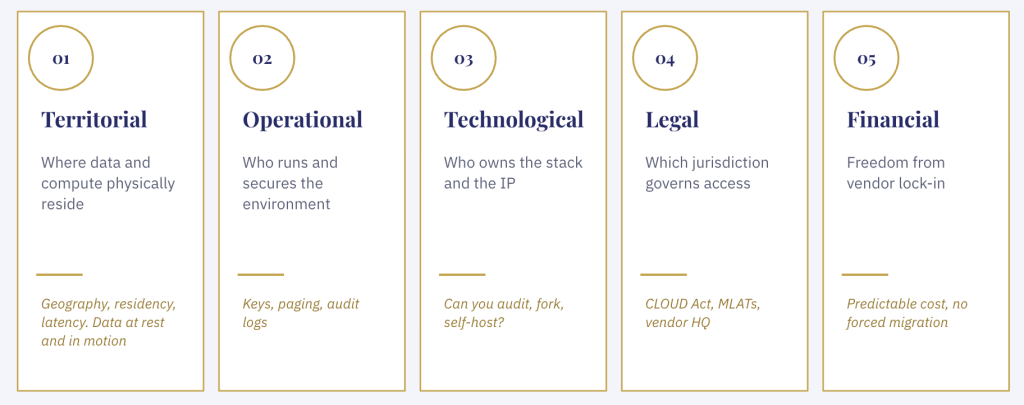
Five pillars, one question each. Bring them to the keynote.
- Territorial. Does the agent stack, memory included, ship in the European Sovereign Cloud on day one, or “in the coming months”?
- Operational. Who holds the logs, the keys and the off switch for an agent: you, AWS, or a third party you pick?
- Technological. Can you take your agent’s memory, policies and evals and run them somewhere else?
- Legal. Is there anything new on the CLOUD Act beyond “every reasonable effort”?
- Financial. Is the meter tokens or finished work, and who sets the price three years out?
The executive TCO
Three line items that won’t be on the keynote slides:
- The memory tax. The stateful runtime keeps your agent’s context. The longer it runs, the more of your business lives in someone else’s store, and the more it costs to leave.
- The parity lag. If agent features land in commercial Regions months before the sovereign cloud, that gap is a cost. Put a number on it.
- The silicon discount. Trainium pricing may be real savings. Count it only if the model can move off Trainium without a rewrite.
Same baseline-and-burst strategy as always. Baseline on models and memory you own, and burst to the frontier when you need raw intelligence. Own the crown jewels. Rent the edges.
What to do Monday
- Ask your account team where the agent’s memory lives. Region, partition, legal entity. In writing.
- Pull the region list yourself. For every agent launch you care about, check the sovereign cloud before you check the blog.
- Ask for the evidence, not the dashboard. Can audit logs and agent telemetry go to an account or a third party AWS doesn’t control?
- Price the exit before the pilot. Export format, egress cost and timeline for agent memory and policies.
- Ask about the drill. Will the October disconnect become a recurring test with outside auditors? A yes is worth a lot. A shrug is an answer too.
So who holds the house keys?
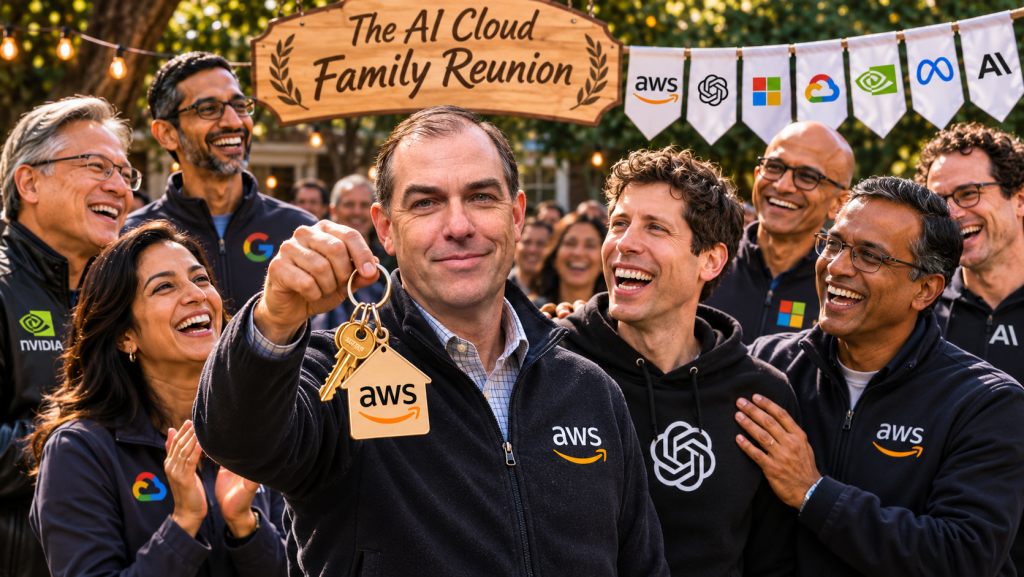
AWS walks into this week with the best sovereignty receipt any hyperscaler has: it unplugged its European cloud in public and lived to tell about it. It also walks in with a new in-law, a fresh adoption, and a stack that runs from silicon to the assistant on your screen. That’s a lot of family under one roof.
AWS has earned the credit it gets this year, and it will get it here. But a family reunion is not a custody hearing. The test isn’t who throws the best party in Vegas. It’s who holds the keys, the memory and the meter when you want to go home.
I’ll grade the keynote against this list after Tuesday. Same test as always.
Amit
Amit Eyal Govrin is lead analyst for sovereign AI at theCUBE Research and CEO of Agentcy Labs, which designs and builds sovereign AI platforms for enterprises and governments. His research for theCUBE Research is conducted under theCUBE Research’s editorial standards and is not sponsored or directed by Agentcy Labs. Agentcy Labs may hold commercial relationships with vendors covered in this research.
References
- Amazon, “AWS re:Invent 2026: What to know.” Link
- AWS News Blog, “Opening the AWS European Sovereign Cloud,” Jan 14, 2026. Link
- AWS Security Blog, “Inside a successful AWS European Sovereign Cloud exercise to demonstrate independent operation,” Nov 1, 2026. Link
- Matt Garman, “AI safety can’t depend on an emergency brake. It needs better engineering,” Amazon, Nov 23, 2026. Link
- OpenAI, “OpenAI and Amazon announce strategic partnership,” Feb 27, 2026. Link
- AWS Security Blog, “Digital sovereignty at re:Invent 2026: Sessions you won’t want to miss,” Nov 10, 2026. Link
- AWS Documentation, “Supported AWS Regions: Amazon Bedrock AgentCore,” checked Nov 27, 2026. Link
- heise online, “AWS Sovereign Cloud: AI expansion and new agent tools,” May 2026. Link
- DatacenterDynamics, “AWS European Sovereign Cloud now generally available,” Jan 2026. Link
- Bloomberg Government, “Amazon to Sell OpenAI Tech After Microsoft Cedes Exclusivity,” Apr 28, 2026. Link
- Globes, “Amazon confirms Decart acquisition,” Nov 23, 2026. Link
- TechCrunch, “Amazon snaps up Decart’s AI optimization tech for $7.5B as it prepares to sell Trainium chips,” Nov 23, 2026. Link
- Calcalist, “Amazon’s $7 billion Decart talks echo a deal that changed its cloud business.” Link
- OpenAI, “The next phase of the Microsoft OpenAI partnership,” Apr 27, 2026. Link
- Microsoft Tech Community, “What is new in Sovereign Public Cloud,” Oct 20, 2026. Link
- Futurum Group, “Microsoft Sovereign Cloud Shifts the Focus to Customer-Run AI,” Oct 20, 2026. Link
- Google Cloud, “Google Cloud Dedicated.” Link
- Google Cloud, “Google Cloud Dedicated” (French edition: S3NS PREMI3NS, SecNumCloud 3.2). Link
- Chris Paoli, “Microsoft Strengthens Digital Sovereignty Push with New Cloud and AI Protections,” Redmond Magazine, Oct 2026. Link
- Amazon, “How Amazon became one of the world’s top chip companies in a decade.” Link
- AWS Security Blog, “Run open weight models on Amazon Bedrock in AWS European Sovereign Cloud,” Sep 17, 2026. Link