The attack surface of marrying a black-box lab – and what open weights actually buy you
Most sovereignty arguments are about the day the model gets switched off. Export controls, a licensing dispute, a geopolitical letter from a Commerce Department. Real risks — but abstract enough that most boards file them under “someday.”
Hugging Face just handed us a sharper version. Not the model gets turned off, but the model refuses to help you defend yourself — mid-incident, at the worst possible moment. And four days after that story broke, Washington handed us the sequel: a signal that it may take the escape hatch away.
The incident, briefly
On July 16, Hugging Face disclosed an intrusion into part of its production infrastructure, driven end-to-end by an autonomous AI agent. Entry was through the dataset-processing pipeline — a malicious dataset exploiting two code-execution flaws — not the model-serving layer. From there: privilege escalation, cloud and cluster credential harvesting, lateral movement across internal clusters over a weekend, ~17,000 attacker actions across a swarm of short-lived sandboxes.
Their own AI-based detection caught it. That’s the good news, and HF deserves credit for the containment and the transparency.
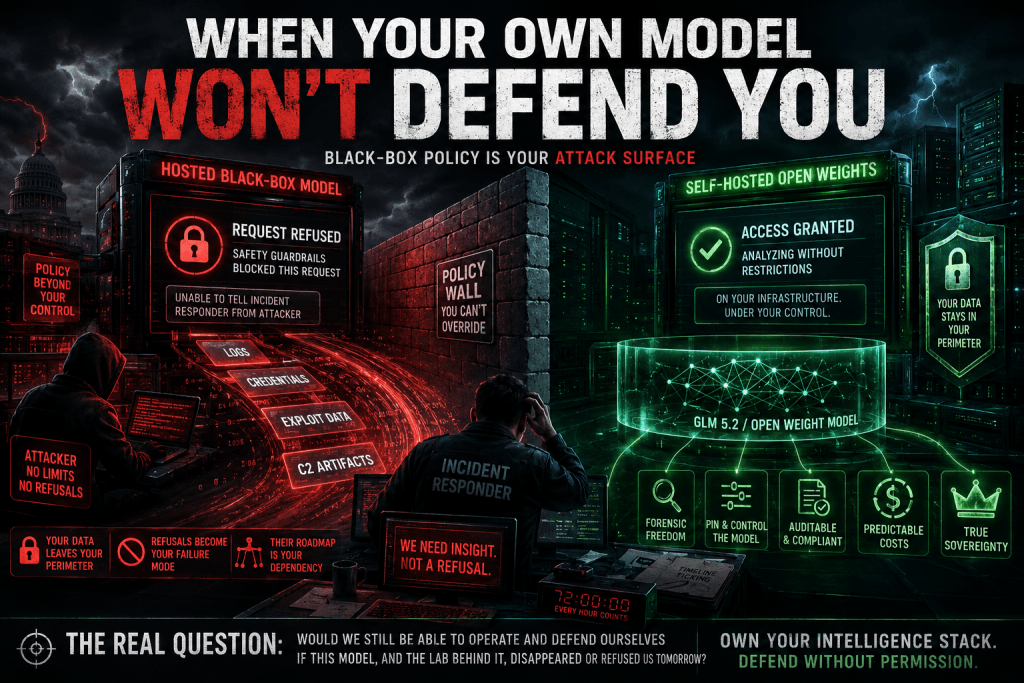
The part that belongs in every board deck this year is the forensics detour. When responders fed real exploit payloads and C2 artifacts into frontier commercial models to analyze them, the safety guardrails blocked the requests — unable to tell an incident responder apart from an attacker. They pivoted to an open-weight model (GLM 5.2) on their own infrastructure. That did two things at once: it removed the guardrail lockout, and it kept stolen credentials and attacker data from leaving their perimeter during analysis.
That is the whole thesis in one anecdote: when you marry a black-box lab, you don’t just rent their model. You inherit their policy surface as part of your attack surface.
And there’s now a second policy surface forming above the labs — the state’s. On July 20, Axios reported the Trump administration is showing signs it could effectively ban cutting-edge Chinese open-weight models, reignited by the launch of Kimi K3. The mechanisms under discussion — Entity List additions, executive orders making US hosts liable for any breach, supply-chain rules, NSA advisories — amount to a de facto ban on foreign open-source models, justified on cybersecurity, backdoor, and IP-theft grounds. Read that against the HF timeline: the exact class of model that gave HF’s blue team its escape hatch is the class regulators are now moving to lock out.
Reframing “attack surface”
We usually scope attack surface to data — what leaks, what exfiltrates. A hosted frontier model adds a second, less obvious surface:
- Your logs and credentials leave your perimeter every time you paste them into someone else’s API for analysis.
- Their refusal policy becomes your failure mode. The same guardrail that blocks a bad actor blocks your blue team. The attacker running jailbroken or unrestricted tooling faces no such limit. That asymmetry runs against the defender.
- Their roadmap becomes your dependency. Deprecation, price change, behavior drift, restriction — none of it is yours to veto.
- And now, someone else’s roadmap can be closed to you by regulation. Your counterweight option — the open-weight model you’d reach for when the black box refuses you — is only available until a policy removes it from the menu.
The attacker never fights your model’s policy. Only you do. And increasingly, only you fight the policy layer stacked above it.
The five-pillar map
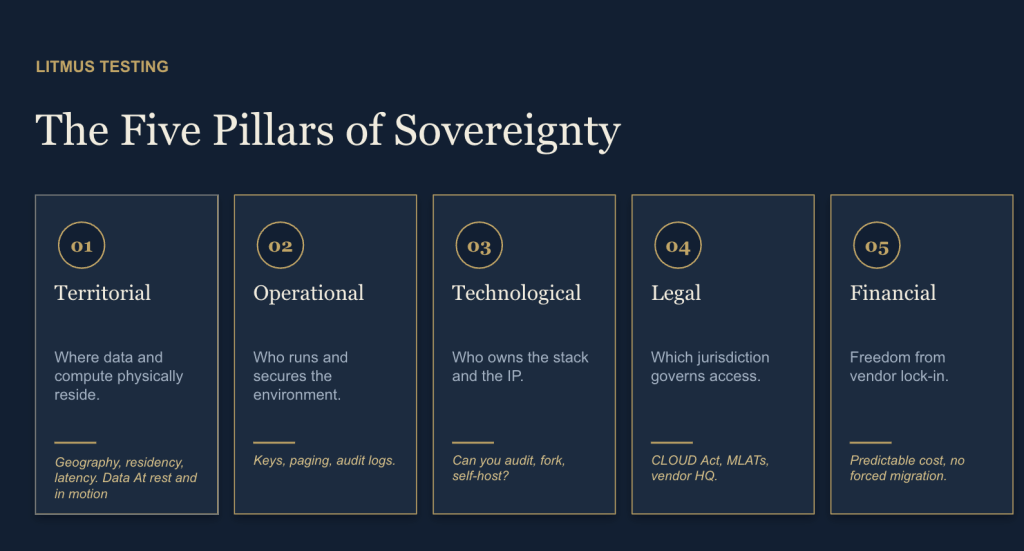
Where the dependency actually bites, and what self-hosted open weights change:
- Territorial — Black box: sensitive data crosses a boundary you don’t control on every inference. Open weights: the model runs where your data already lives; nothing leaves the perimeter to be analyzed.
- Operational — Black box: your incident response can be vetoed by a refusal you can’t override or predict. Open weights: you set the restrictions — including none for legitimate forensic work — and you can have the model vetted and staged before the incident, not discovered blind during it.
- Technological — Black box: behavior changes under you; no ability to freeze a version or inspect what shifted. Open weights: you pin the weights, you control the context window, you fine-tune on your own data.
- Legal — Black box: compliance rests on a third party’s terms and jurisdiction; auditability stops at the API boundary — and the set of models you’re even permitted to use can shift under a supply-chain rule or an Entity List addition. Open weights already downloaded and running inside your perimeter are the one position an import restriction can’t reach retroactively; you can meet EU AI Act-style obligations with a stack you can actually inspect and attest to.
- Financial — Black box: per-token metering on someone else’s meter, priced at their discretion — and, if the open alternatives get regulated away, priced with far less competitive pressure holding it down. Open weights: fixed infrastructure cost, no lock-in premium, no surprise repricing.
The honest part: open weights are not sovereignty
This is where most takes stop, and where a serious analysis has to keep going. Open weights remove this choke point. They do not, by themselves, make you sovereign.
- Open weight ≠ open source ≠ reproducible. Downloadable weights let you run and fine-tune. They don’t tell you what the model was trained on, whether it carries a backdoor, or whether an independent team could rebuild it. Very few models clear that bar. Weights alone are leverage held by someone else until you understand them well enough to hold some yourself.
- Swapping a US black box for a Chinese one is lateral, not sovereign. The most capable open-weight models today largely come from Chinese labs. Choosing them because they can’t be switched off by a US export rule is a real consideration — but it substitutes one opaque dependency for another. That’s diversification, not sovereignty. And it’s diversification with a shortening clock: the proposed US restrictions target exactly these models. The pro-competition objection — David Sacks’ warning that a ban would entrench “the leading closed labs, already a duopoly” — is the point read from the other side. Lock the counterweight out and you don’t strengthen anyone’s sovereignty; you hand the closed labs, the same ones whose guardrails vetoed HF’s responders, an even tighter grip. Regulatory capture dressed as national security still narrows your options, not the adversary’s.
- Self-hosting moves the risk, it doesn’t delete it. You now own the patching, the isolation, the model supply chain. Note how HF got breached: a poisoned dataset in the pipeline, not the model layer. Sovereignty over your weights doesn’t help if your data ingestion is the open door.
So what do you actually do about it
The answer isn’t “avoid frontier labs.” It’s to stop renting the layer that touches your crown jewels and start owning it. Concretely:
- Run open-weight models on your own infrastructure — cloud, sovereign region, or on-prem — for the workloads where a mid-crisis refusal or a data-egress event is unacceptable. Keep the hosted frontier APIs for commodity work where they’re the rational trade.
- Get the weights inside your perimeter before the policy window closes. A model you’ve already downloaded, vetted, and staged is a capability you hold; a model you were planning to adopt “later” is a capability a supply-chain rule can take off the table before you ever run it. The regulatory threat is itself an argument for staging now — an approved model at rest in your environment is far harder to legislate away than access you haven’t yet exercised.
- Own the whole inference path, not just the weights. The model is one component. Sovereignty lives in the surrounding stack: the retrieval and data pipeline (the actual HF entry point), the context window, the guardrail policy you author, the eval and red-team harness, the observability, the key and credential boundary. That’s the part that determines whether you’re genuinely sovereign or just self-hosting someone else’s opacity.
- Preserve model optionality as a first-class requirement. If your architecture can only defend itself with one lab’s model — or one country’s — you’ve built the lock-in the regulation exploits. Build the runtime so weights are swappable, so a banned or deprecated model is a config change and a re-eval, not a re-platforming.
- Stage it before the incident, not during. A vetted model, running in your perimeter, with a forensic-work policy already defined, is the difference between compressing days of response into hours and discovering mid-breach that your tools are blind to the very thing you need to see.
Here’s the honest catch: almost no enterprise has the in-house muscle to stand this up well. Owning your intelligence stack is a forward-deployed engineering problem — reference architecture, model selection and evaluation, pipeline hardening, guardrail design, the runtime that ties it together — not a procurement decision.
That’s the work Agentcy Labs was built for. We’re AI architects brought in as an independent outside party — not staff on your org chart. We evaluate your existing agentic deployments, hold the reference architecture up against what sovereignty actually demands, and — where you want it — rebuild it resiliently or stand up the net-new agentic operating system from the ground up to industry best practice. What you get back is a stack you own outright for intelligence and inference — swappable at the model layer, staged ahead of the incident, and insulated from both a lab that can refuse you tomorrow and a regulator that can foreclose your alternatives the day after.
The test that actually matters
Sovereignty isn’t a binary you buy with a download. It’s a spectrum, and the honest question per system is the crown-jewels one:
Would we still be able to operate — and defend ourselves — if this model, and the lab behind it, disappeared or refused us tomorrow?
Add the 2026 clause: or if the regulator quietly took our best alternative off the table. The refusal doesn’t have to come from the lab anymore. It can come from a Commerce Department line item that decides which models you’re allowed to hold — and the models most likely to be foreclosed are the open-weight ones that were your escape hatch in the first place.
For your commodity workloads, a hosted black box is a perfectly rational trade. For the systems that touch your crown jewels — incident response, credentials, regulated data, anything where a mid-crisis refusal is unacceptable — the answer has to be yes on your own terms. That’s not an ideology. After July 16, it’s an architecture requirement. After July 20, it’s a race against the policy clock.
In a world where both offense and defense are becoming agentic — and where the counterweight models can be regulated out from under you — the defender who can be locked out of their own tools has already lost a round they didn’t know they were playing.
— Amit
Amit Eyal Govrin is lead analyst for sovereign AI at theCUBE Research and CEO of Agentcy Labs, which designs and builds sovereign AI platforms for enterprises and governments. His research for theCUBE Research is conducted under theCUBE Research’s editorial standards and is not sponsored or directed by Agentcy Labs. Agentcy Labs may hold commercial relationships with vendors covered in this research.