

Here is a fun weekend read for all of you fans of Sovereign AI.
On 18 August, at the government complex in Jongno-gu, Vice Minister Ryu Je-myung announced which teams would carry South Korea’s national AI model forward. SK Telecom, Upstage and LG AI Research advanced. One team was cut.
The team that was cut had the best model.
Motif 3 is a 314-billion-parameter model designed and pretrained from scratch. It scored 47 on the Artificial Analysis Intelligence Index, tenth in the world and the strongest non-Chinese open model anywhere. The three survivors scored 37, 35 and 31.
Ryu was asked about this directly. His answer is worth reading twice. AAII accounts for only 25 of the 100 points, he said, and across the remaining 75, weighted toward usability and practicality, Motif scored lower than the others.
So a government running a sovereignty program explained that world-class independent capability is worth a quarter of the sheet.
Motif Technologies is a startup of roughly twenty-five people, a subsidiary of the infrastructure firm Moreh, with about $17 million raised. By its own account, it trained Motif 3 on 768 B200S for somewhere around $15 million of compute, including the failed runs. Its stated design philosophy is refusing to borrow architectures from foreign open-source models.
Korea eliminated it, and then Korea lost it. More on that at the end.
Seven months, two opposite definitions
To understand what actually happened in August, you have to look at January.
In the first round, Naver Cloud was cut. Not on score. Naver’s performance was good enough to place it in the top four. It was cut on 독자성 (independence, after its technical report showed that HyperCLOVA X SEED 32B Think had used the vision encoder and weights from Alibaba’s Qwen. The ministry had defined the program as in-house design through pretraining, with weights initialized from scratch as the minimum bar, and judged that Naver fell short on technical, policy, and ethical grounds simultaneously.
Sit with that for a second. Naver is the company that spent two years evangelizing sovereign AI, exporting the concept to Saudi Arabia, building the national argument that Korea needed its own stack. It was disqualified from Korea’s sovereignty program for insufficient sovereignty.
Seven months later, the criteria inverted.
In January, you were out because you borrowed. In August, Motif was out because building everything yourself produced something that 185 members of the public and 49 startup executives found less pleasant to use than a chaebol product.
In January, sovereignty meant provenance. In August it meant polish. Nobody wrote down which one it was before the submissions arrived, so the definition moved to fit whoever was standing in front of it. That is not a sovereignty program. That is a procurement process wearing one as a costume.
Real estate, and the rounding error
Here is the part that should stop every policymaker reading this.
Korea’s AI data center pillar is over one thousand trillion won, roughly $650 billion, targeting 8.4GW by 2029 and 18.4GW by 2035. SK builds five gigawatts, GS two point four, Naver one. Groundbreaking in the first half of 2028. It is one of the largest infrastructure commitments in Korean history, and it is real, funded and underway.
The national AI foundation model program, the thing that makes any of that concrete sovereign rather than merely domestic, is about $350 million.
At program rates, the buildout costs roughly $35 million per megawatt. Run the numbers from there.
The entire national model competition, every team, every round, every GPU hour, is worth about ten megawatts. Out of eighteen thousand four hundred. Five hundredths of one percent of the concrete.
Motif 3, the best non-Chinese open model in the world, cost less than half a megawatt.
Naver is building a single one-gigawatt site at Sejong. At program rates, that one building is worth roughly one hundred times the entire competition Naver was disqualified from.
And then there is the number that writes itself. Korea’s national AI model program is $350 million. Korea’s investment obligation to Washington under the tariff agreement is $350 billion, roughly 82 percent of its foreign reserves, capped at twenty billion a year and still not fully placed. Same three digits, three orders of magnitude apart. Korea will spend a thousand times more securing its tariff rate than securing its own model.
None of this is a Korean pathology. Every sovereign AI program I have looked at budgets the same way, because buildings are legible to treasuries and model weights are not. Gigawatts photograph well. You can cut a ribbon on a data center. You cannot cut a ribbon on a set of weights you control.
But the ratio is a symptom. The disease is upstream.
What the scoring actually bought
The second round was scored 40 points on benchmarks, 35 on expert review, 25 on user evaluation. Final composite: SK Telecom 70.6, Upstage 69.9, LG AI Research 69.0, Motif 65.8. Under five points separated first from last.
Motif took 27.1 on expert review and 14.1 on user evaluation. Last in both. The expert panel was ten external reviewers from industry, academia, and research institutes. The user evaluation split into 49 AI startup executives and 185 randomly selected members of the public.
Motif’s objection asked one question that the ministry has still not answered plainly: was the user evaluation blind? Because if it was not, then 185 citizens were handed four chatbots, three of which carry the logos of SK, LG and a well-funded national champion, and one of which came from a company nobody has heard of. Brand recognition is not a sovereignty metric. It is the opposite of one. It measures precisely the incumbency that a sovereignty program exists to route around.
There is one more detail, and it is the one I cannot get past. During the evaluation, Motif received a written question asking whether foreign capital or overseas entities were among its major shareholders.
Consider the shape of that. The program requires open-sourcing the result. The whole point is that the weights become a public asset. Yet the state’s evaluators asked the most technically independent team in the field to account for its cap table. Suspicion of foreign capital, applied to the one company that refused to borrow foreign architecture.
The team that walked
On 18 August, Motif’s CEO said the company accepted the result and had no plans to appeal. Disappointing, he said, but the industry has work to do.
On 26 August, it filed a formal objection anyway. Not to be reinstated. Motif stated explicitly that the objection was not about its own selection, and that it will not participate in the third round regardless of the outcome. It is appealing to force the criteria into daylight, and then leaving.
That is the sentence that should worry every government running one of these programs. Korea did not just eliminate its best model. It lost the team that built it, and it lost them on the way out the door, holding a public demand that the state explain what sovereignty was supposed to mean.
Deputy Prime Minister Bae Kyung-hoon has since suggested the evaluation and competition format may need to be rebuilt. That is a concession, and it arrives after the asset has already decided to leave.
If Motif now raises abroad or builds elsewhere, the suspicion that was put to it in writing becomes self-fulfilling. The state asked whether foreign capital was involved, and then made staying domestic economically irrational. There is no version of that story where Korea comes out ahead.
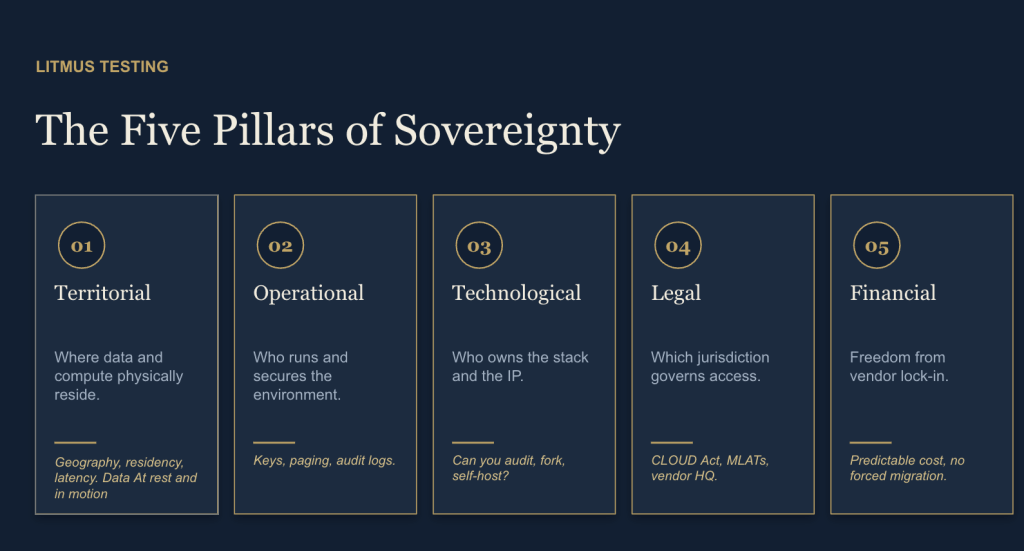
Against the five pillars
Territorial. Passes on concrete, fails on control. Much of the 18.4GW is expected to be sold to American labs. Hosting someone else’s hosted model is tenancy, not residency.
Operational. The failure point. Korea held full operational control of the program and used it to reward incumbency. Opaque expert criteria, non-blind user testing, shareholder nationality questions.
Technological. The one genuine win, traded away. Mandatory from-scratch pretraining is real fork-and-audit sovereignty, and Motif proved it costs a rounding error. Then the definition moved twice.
Legal. Underrated and getting worse. Kimi K3 ships under a bespoke license whose clause 2 requires a separate agreement with Moonshot for any Model-as-a-Service operator whose group revenue passes twenty million dollars over twelve months. That is group revenue, not AI revenue. Every Korean conglomerate clears it before serving a single token, and derivatives inherit the license. Eighteen gigawatts of inference capacity is exactly the business that clause was written for. Open weights are not sovereignty. They are a license somebody else wrote.
Financial. The Nvidia concentration is real, and I think it is an acceptable risk. Korea is buying best-in-class, and against a $350 billion claim on 82 percent of its reserves, vendor exposure is not the largest mortgage on Korean sovereignty and it is not close. Priced, deliberate, defensible. The $350 million is the problem, not the $650 billion.
What this costs you
Korea’s failure was not budgetary. It was definitional. Nobody wrote down what would disqualify a stack before the submissions arrived, so the standard moved twice in seven months and the state ended up eliminating the only entrant that met the original one.
Write the definition first and the capital ratio corrects itself. Once you can state, in advance and in writing, what makes a stack sovereign and what would disqualify it, you stop buying megawatts as a proxy for control and start buying control directly. Most of the enterprises and agencies we assess are somewhere north of 500 to 1 on capacity versus control, and none of them have ever written the number down. Korea’s is roughly 1,850 to 1.
That is a week of work, and it is the cheapest week you will ever spend.
Amit
PS. Korea’s evaluation agency ruled on 10 September. Motif submitted six pages asking what the criteria were. The government sent back one word: dismissed. The reasoning, officials said, would be explained to Motif privately. A sovereignty program asked in public to define sovereignty, answering off the record.
Amit Eyal Govrin is lead analyst for sovereign AI at theCUBE Research and CEO of Agentcy Labs, which designs and builds sovereign AI platforms for enterprises and governments. His research for theCUBE Research is conducted under theCUBE Research’s editorial standards and is not sponsored or directed by Agentcy Labs. Agentcy Labs may hold commercial relationships with vendors covered in this research.