
AI’s value in regulated, high-stakes work depends on reliability and innovation moving together, so that agentic action can be taken with confidence, while humans remain in the loop. This is the premise Appian CEO Matt Calkins’ put forth on stage in front of thousands of his customers across a diverse set of industries. Appian is leaning into a difficult part of enterprise AI with a focus on turning probabilistic output into governed action. In our view, this puts the company on a credible path toward what we would call a System of Agency, even if lacks the deep semantics of a true System of Intelligence. The ultimate destination in our mental model continues to be a real time Digital Twin of an enterprise that can not only determine what happened and why it happened, but also what to do next; and then do it with confidence. While this capability remains aspirational for the industry and will take the better part of the next 4-6 years to play out, Appian is putting its stake in a key piece of the emerging AI software value chain.
Appian’s differentiation and value proposition can be summarized with Calkins’ version of Silicon Valley’s “move fast” mantra. Appian’s unique point of view is deliberately constrained and designed to not break things. He calls it “East Coast AI” – keep it “extremely safe” and validated before deploying AI into anything customers can see. That strategy aligns with the edicts from much of Appian’s customer base – government, regulated industries, and enterprises where reputation and compliance are fundamental.
Appian is betting that “AI done right” gives it’s customers the best path to success over the next decade. While others chase novelty, Appian is deliberately choosing to package AI inside process, governance, and auditable control.
The keynote’s core claim – AI belongs in a process
The keynote’s most important message was that agents need process, without which they become untrustworthy. Calkins argues agents “go off the rails the easiest” without “regulations, the guardrails, the tracking,” and that without the “structure of process,” agents are the first part of AI to “wander off the reservation.” That is a statement maps with what security and risk leaders are telling theCUBE Research i.e. that autonomy without constraints is unadvisable in production systems.
Appian’s approach from our initial review is to combine probabilistic AI with a deterministic layer that makes the work auditable and safe. Calkins explained in his keynote that Appian plays in a world where more “nines” are necessary. In the diagram below – going up the nines scale is directionally proportional to business value – i.e. the more you need reliability, the greater the value of the applications running at that level of trust. That is Appian’s sweet spot.
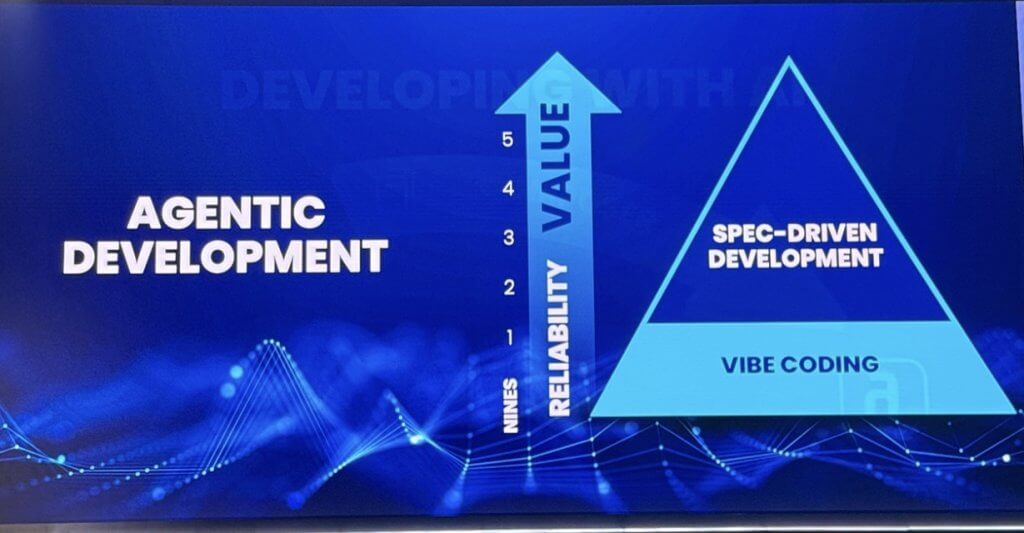
A key nuance in Calkins’ view is where agents belong and where they don’t. Agents are valuable “when you need adaptive intelligence” – when the state space is too large for rules, and decision-making is ambiguous. Everywhere else, according to Calkins, agent’s are more “expensive, slower and less accurate.”
The keynote’s thesis is that processes are the safety rails for agents because they bring determinism to agentic AI.
How Appian operationalizes safe AI
Calkins’ “safe AI” approach is both procedural and reviewable. He describes using AI to modernize legacy applications, but not as a “set and forget” tool. The workflow is to have AI generate the rules, interfaces, and data tables in an auditable format, pause for human review, then let AI build – and iterate with repeated review cycles
That design has two important implications in our view as follows:
- It fits regulated industry requirements, where customers need proof, auditability, and constraints before they enable automation at scale.
- It creates a practical bridge from “assist” to “act,” with human oversight milestones embedded in the workflow – the same way a new employee is supervised before their work impacts client outcomes.
This is a governed path – AI accelerates creation, but humans approve and production remains carefully controlled .
AI is changing the software stack – data fabric + ontology + process logic and a digital twin of the business
The fundamental nature of software is changing. The technology model is tying together probabilistic (generative) technology with deterministic applications. Inside these apps live data, metadata, process knowledge and application semantics. The north star we envision is a true single source of truth, for years an elusive promise of the tech industry. A starting point of this vision is the ability to harmonize disparate data sources. This is where Appian’s Data Fabric caught our attention.
Appian’s data fabric is an integrated, virtualized data layer that connects data across disparate systems, including legacy systems, databases, and APIs – without needing to move or migrate it. While it’s not what we would call a true system of intelligence, it’s a key capability to leverage Appian’s process expertise. By bringing together key elements of data, metadata, and underlying application logic that are trapped inside siloed applications.
Calkins reinforced that “transformation” is the goal, not “paving the cow path” or a simple re-platforming. He cited examples like consolidating hundreds of applications into one and major savings from modernization. The message is the process layer is where you re-engineer work, and the data fabric is how you bridge silos, connect to process logic trapped inside applications; without rebuilding the world.
Bottom line: Appian is working toward building the connective tissue – data fabric + process orchestration – that can support what we call an Enterprise Digital Twin. Appian is only one piece of the puzzle. Its angle is moving from just orchestrating workflows to orchestrating decisions and actions across people, systems, and AI agents. And it emphasizes control and governance, basically, getting to action, but doing it with transparency and trust.
Appian proof point – client-facing outcomes
We tested Appian’s thesis on theCUBE with Mal Cullen, CEO, CIBC Mellon who not only affirmed the importance of combining probabilistic and deterministic systems. He also put forth the view that Data Fabric is crucial to Appian’s value proposition. Cullen described a joint-venture structure where global platforms from parent companies create scale but this limits agility. The decision was to take “more agency over our own data” and “our own technology,” and Appian’s Data Fabric is the mechanism CIBC Mellon used to “connect systems together” while leaving them where they are, so the organization can improve client experience without waiting on changes from the corporate parents.
Cullen made a point that clients don’t care that internal processes are modernized; they care about the experience. As an example, a Canadian regulatory change required transparency around fund costs, and the team built a client-facing application on Appian, co-creating the experience with clients. The claim is they “would never have made” the December 31, 2025 date without doing it on Appian.
This is an important nuance to the common AI narrative that centers solely on “efficiency.” The real value is realized when the platform helps deliver externally visible outcomes under imposed constraints – regulation, deadlines, client trust, and auditability.
Bottom line: The strongest evidence from the customer in theCUBE discussion is not generic or elusive “AI productivity” – it’s delivery against regulatory deadlines with client-facing software.
A Building Block of a Full Stack Digital Twin
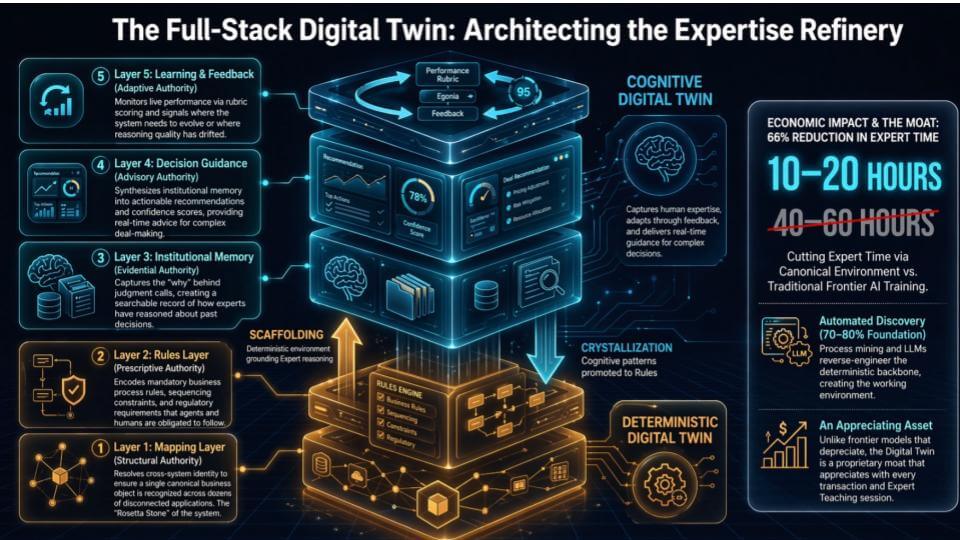
We see Appian’s capabilities as part of our digital twin vision. By combining a fabric that can connect data across systems (without ripping and replacing everything) and enabling governed action, they’re addressing key challenges – i.e. breaking down siloes and enabling trust. Appian, however lacks what we would see as a rich system of intelligence. Appian, from what we can glean, does not possess the rich ontology capability of a Palantir, for example, but it has stronger orchestration capabilities. As such it can support more intelligent and governed action.
Ultimately we envision a full stack digital twin as described below in a graphic from last week’s Breaking Analysis which dove deeply into the topic.
Takeaways for enterprise buyers
Enterprises evaluating Appian’s message at Appian World should test four things:
- Governance mechanics – can the organization explain, audit, and constrain what AI does in production?
- Process redesign vs. automation hand waving – does modernization eliminate bespoke/manual risk, or just speed up the old workflow?
- Data fabric proof – can teams connect systems and use metadata and logic without a multi-year rip-and-replace?
- Agent deployment discipline – is there a clear boundary for “adaptive intelligence” vs. deterministic rules, and is the handoff explicit and auditable?
In our view, the differentiator is not just embedding AI in the product. It’s whether the product turns AI into safe, governed work at enterprise speed.
Quick take
We believe Appian is pushing in the right direction: the company is treating AI as a capability that must be operationalized in product, not PowerPoints. “East Coast AI” is an instructive label because it reflects what real enterprises are forced to do – move deliberately, prove outcomes, and keep trust intact.
The risk in our view is execution at scale. The more Appian succeeds, the more it will be pulled into enterprise-wide ontology and ambitions to stretch data fabric into new territory. That work is critical, difficult, long-cycle, and politically messy inside large organizations. But the CIBC Mellon story shows where the approach can work – i.e. when a platform provides agility, governance, and client-facing delivery under constraints.
Appian is building toward a System of Action posture by grounding AI in process, data access, and governance. It’s early for everyone. The companies that win will be the ones that convert agentic enthusiasm into repeatable, auditable outcomes.
Action item for Appian customers
Pick 1–2 modernization candidates where the business already agrees on the outcome and the workflow already has measurable friction – customer onboarding, case management, claims, service fulfillment, regulatory response. Commit to a 90-day “safe AI” sprint that pairs process redesign with the data fabric connection work, with a clear definition of success (cycle time, error rate, straight-through processing, compliance evidence) and a strong gate before anything autonomous touches production.
We see at least two gotchas to avoid, including: 1) don’t treat data hygiene as a prerequisite that you have to finish before starting – get the connectors and ownership model in place, then let the process instrumentation and AI expose what data actually matters for the outcome; 2) don’t pave the cow path – if the team automates a broken process, they’ll ship poor outcomes faster. Rather force the redesign conversation up front and keep humans in the loop until the audit trail and recoverability are proven.
Watch the full executive discussion with Appian CEO Matt Calkins and Mal Cullen, CEO of CIBC Mellon.
(* Disclosure: TheCUBE is a paid media partner for Appian World. Sponsors of theCUBE’s event coverage do not have editorial control over content on theCUBE, theCUBE Research or SiliconANGLE.)