Palantir and Nvidia shipped the sovereignty playbook as a product. It passes four pillars of sovereignty cleanly. The fifth pillar – sovereignty from vendor lock-in – is the catch. That’s where the argument requires operators to go deeper.
For two years, I’ve argued that sovereign AI is a five-pillar architecture, not a data-residency checkbox. This week, two of the most powerful companies in tech turned that argument into a product, and the loudest CEO in enterprise software went on television and made the case louder than I would have done.
Read part one of our Sovereign AI Series.
On June 29, Palantir and Nvidia shipped a “Sovereign AI Operating System.” It runs Nvidia’s open-weight Nemotron models air-gapped, isolated from any unsecured network, on the customer’s own Nvidia hardware. Agencies train on their own data and keep the resulting model weights, the weights that encode how they actually operate. Palantir’s stack – AIP, Ontology, Foundry and Apollo – handles data authorization, enforced isolation and full auditability. Nvidia’s own framing was the tell: “Open Models, Closed Environments.” The stock rose about 9%.
Two days later, Alex Karp went on CNBC and supplied the color commentary. He called the AI industry “effing insane,” accused OpenAI and Anthropic of levying a “wealth tax on American business,” and dismissed usage-based pricing as “completely wrong.” Underneath the theater was one sentence worth keeping: customers want “control over their compute, their models, their data stack and their alpha… they own the means of production.” All-In built a whole segment around it and titled the episode “AI Sovereignty Wars.” When the diagnosis ships as a reference architecture and goes prime time in the same week, the wave has broken.
So let’s grade it. All five pillars in one infographic, with our ratings below the image:
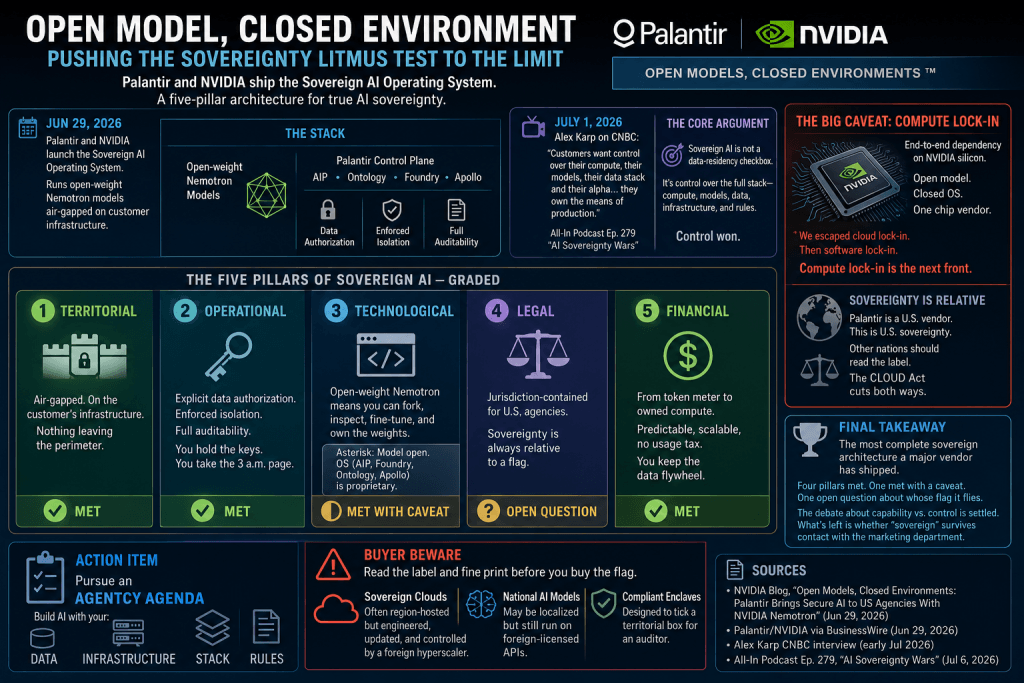
Territorial. Air-gapped, on the customer’s own infrastructure, nothing leaving the perimeter. The pillar everyone leads with, and it’s met. Check.
Operational. Explicit data authorization, enforced isolation, full auditability. You hold the keys, and you take the 3 a.m. page. No foreign-headquartered provider holding your encryption keys under someone else’s employment law. This is the pillar most “sovereign” deployments quietly fail, and Palantir built its entire control layer around passing it. Check.
Technological. With open-weight Nemotron, you can fork what you can read. Inspect it, fine-tune it, own the weights that come out. After years of writing “you cannot fork what you cannot read,” it means something to see open weights deployed into the most sensitive environments in the country. The asterisk: the model is open, the operating system is not. AIP, Foundry, Ontology and Apollo are proprietary Palantir IP. You own the weights, and you license the orchestration. That’s a real upgrade over renting a closed model through a closed platform, but it is not the full-stack ownership that “own the means of production” implies. Apply the first question I always ask a vendor: can you fork the orchestration layer and self-host it without us? For the model, increasingly yes. For the OS, no. Partial check.
Legal. For a U.S. agency, air-gapped hardware and U.S.-owned weights are about as jurisdiction-contained as it gets. But sovereignty is always relative to a flag. Palantir is a U.S. vendor, so this is U.S. sovereignty, which is why it’s being sold to Washington and why a German ministry or a Gulf fund should read the label before assuming “sovereign” means sovereign for them. The CLOUD Act cuts both ways. Caveat emptor.
Financial. Karp’s rant against the token meter is the financial pillar stated at volume. Open weights on your own hardware turn inference into a compute cost, predictable and owned, instead of a usage-based invoice that grows without a ceiling and competes with headcount. The “wealth tax” line is a CFO’s P&L stated as a grievance. Nemotron on your own GPUs is the structural answer, and the data flywheel means you keep the improvement instead of renting it. Uber torched its 2026 AI budget in four months; ask them whether owning the meter beats the token savings. Check.
Four pillars met, one met with a caveat, and one open question about whose flag it flies. That’s the most complete sovereign architecture a major vendor has shipped, and it earns the credit.
But there’s a dependency nobody in the prime-time coverage named, so I will: it’s Nvidia silicon end to end. Open model, closed OS, one chip vendor underneath all of it. We spent a decade escaping cloud lock-in and then software lock-in. Compute lock-in is the next front, and no reference architecture on the market solves it yet. Owning your weights on hardware you can only buy from one company is sovereignty with a very expensive dependency stapled to the bottom.
That caveat doesn’t shrink the moment. When the most aggressive enterprise-AI CEO on the planet recites the five pillars on CNBC and Palantir sells them as a product, the debate about capability versus control is settled. Control won. What’s left is whether “sovereign” survives contact with the marketing department, which is the part I’ll keep grading, pillar by pillar.
Action Item
CEOs and public policy leaders should deliberately and forcefully pursue an “Agentcy Agenda.” This means constructing an AI architecture with your data, your infrastructure, your stack, your rules. Read the label and the fine print before you buy the flag. In other words, buyer beware of purchasing pre-packaged solutions marketed under protective, patriotic, or regulatory banners. This includes: 1) So-called “Sovereign Clouds” (which are often physically hosted in a specific region but fundamentally engineered, updated, and controlled by a foreign hyperscaler); 2) National AI Models, which may have been localized but still run off foreign-licensed APIs; or 3) Compliant Enclaves designed to tick a territorial box for an auditor.
Amit Eyal Govrin is the CEO and Co-Founder of Agentcy Labs, a research and software architecture consultancy firm founded specifically to advance the Sovereign AI agenda — helping regulated enterprises architect AI systems they fully own and control. Prior to Agentcy Labs, he co-founded Kubiya — one of the earliest enterprise agentic AI platforms deployed in production. At Kubiya, he was building agentic frameworks before LangChain existed: state machines for multi-step workflow orchestration and JSON-based function call interfaces before model providers had native function calling. By September 2023, Kubiya was running AI agents in production enterprise environments — real workloads, real governance, real audit trails — before “agentic AI” had entered the mainstream lexicon. He advises on sovereign AI architecture in partnership with Deloitte. He is a Gartner Cool Vendor and Intellyx Digital Innovator, and has covered enterprise AI and cloud infrastructure as an analyst voice at SiliconANGLE and theCUBE.
Sources: NVIDIA Blog, “Open Models, Closed Environments: Palantir Brings Secure AI to US Agencies With NVIDIA Nemotron” (Jun 29, 2026); Palantir/NVIDIA via BusinessWire (Jun 29, 2026); Alex Karp CNBC interview (early Jul 2026); All-In Podcast Ep. 279, “AI Sovereignty Wars” (Jul 6, 2026).