
APEXlang gives leading coding agents a structured application target while Oracle manages the runtime, security and application lifecycle.
It’s well accepted that AI has changed the economics of software development. Code is plentiful. Leading coding agents can generate JavaScript, Python, Java and other software artifacts at remarkable speed at far lower costs. But more code does not necessarily produce better enterprise applications and outcomes.
We believe the enterprise challenge is shifting from code creation to application control. Organizations must determine whether AI-generated applications are secure, explainable, maintainable and consistent with existing governance practices. They must also decide who will maintain the generated software after the initial prototype becomes a production system.
Oracle’s new direction for APEX addresses this problem through architecture rather than through another proprietary AI assistant.
Oracle APEX is a mature application platform, first offered in 2004. The company claims customers have created more than 20 million APEX applications, with thousands of new applications created each day. APEX is included at no additional charge with Oracle Database and can run wherever the database runs, including on-premises systems, Exadata, cloud and multicloud environments.
APEXlang is Oracle’s attempt to extend that established platform into the AI development era.
The bottleneck has moved
The initial value proposition for low-code platforms was development speed. They allowed developers and business users to create applications with less hand-written code.
AI has neutralized that value prop, and in our view, Oracle needed to respond. The reason is that coding agents can now generate conventional applications very quickly, and a developer can describe an application and receive large amounts of working code within minutes. Vibe coding can get to prototype very quickly.
However, this creates a new problem.
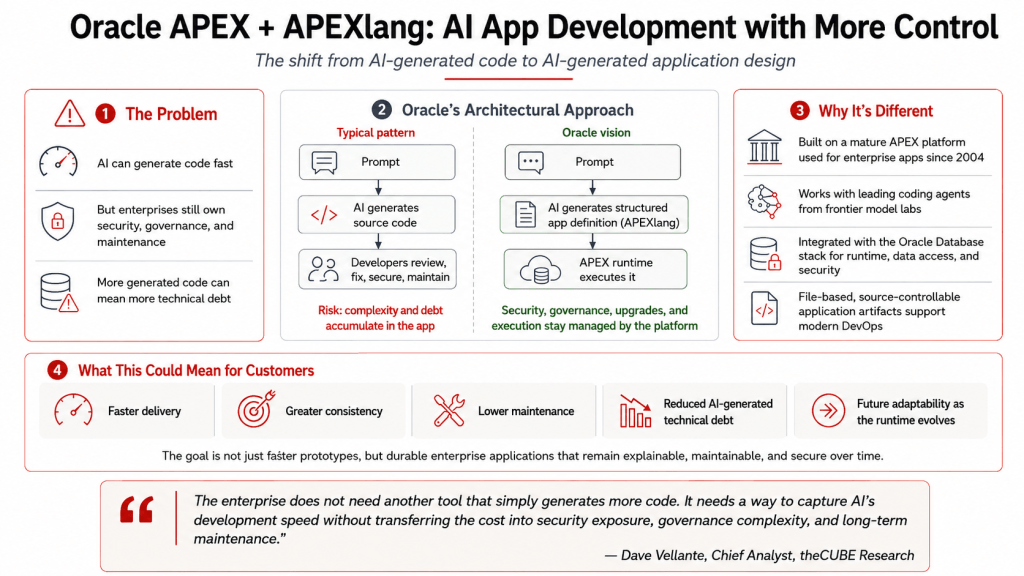
The generated code can include many libraries, frameworks and implementation choices. It can also create a unique software artifact that no other organization has tested. The application may work today, but enterprises remain responsible for security reviews, software updates, dependencies, testing and long-term maintenance.
Oracle’s argument is that the enterprise should not ask AI to generate every implementation detail. Instead, the AI should generate a structured definition of the application. The APEX runtime should then manage how the application executes.
This is the central idea behind APEXlang.
A coding agent can generate the application definition, but it does not need to decide how every chart, report, form, link or security control is implemented. Those complex functions remain part of the APEX engine and should ideally be abstracted. Oracle’s bet is that this approach reduces the volume of application-specific code and separates the application’s business definition from many of the underlying implementation details.
Oracle is not trying to outbuild the model labs
As George Gilbert says, there are more coding agents than fleas on a camel’s back. One of the more important aspects of Oracle’s strategy is what the company is not doing. Oracle specifically is not positioning APEXlang as a closed interface to an Oracle-only coding assistant. It expects developers to use leading external coding agents such as Claude, Codex, Cursor and any other leading tools that may emerge.
This is a sound and differentiable decision, in our view.
The frontier model companies are investing heavily in reasoning, code generation and agent-based development. Oracle does not need to reproduce that investment. Nor does it need to compete on the frontier of coding tools. It is investing capex elsewhere. Oracle can instead provide those agents with a well-documented application target and a proven execution environment.
According to Oracle, developers can use an AI agent to request changes such as:
- Add a chart
- Change a pie chart to a stacked bar chart
- Translate an application into Spanish
- Add a field and connect it to the correct application components
- Create an interface to analyze Oracle data
The coding agent generates the APEXlang definition. The APEX compiler checks the result. When the compiler identifies an error, the agent can correct the definition and try again.
Developers can also use the legacy APEX builder, an external coding agent or tools such as Visual Studio Code. The resulting application artifacts can use the same source control, review and CI/CD processes that enterprises already apply to conventional software.
The presumed benefit is that this AI-assisted development preserves professional software engineering practices.
The Oracle stack is the primary differentiation
Support for external coding agents is important, but it is only one of the differentiators Oracle is marketing. Perhaps a more significant advantage for Oracle customers is the connection between APEX, Oracle Database and Oracle’s security capabilities.
Our understanding is APEX runs within the Oracle Database environment and uses SQL to access data. According to Oracle, this architecture allows APEX applications to inherit database capabilities such as identity-aware access, data masking, virtual private database policies and application-level security controls.
Oracle also claims user identity and application identity can be passed to the database. The database can then determine whether a specific user, operating through a specific application, has permission to access particular data. This does not make every generated application secure by default. Developers can still create poor SQL, make unsafe external calls or design applications with excessive permissions. But the architecture improves the risk profile.
With arbitrary code generation, the AI may also generate much of the security implementation. With APEXlang, ostensibly more of that responsibility stays in the platform and database layers. Oracle can patch and improve those layers without requiring the enterprise to regenerate every application.
This becomes especially relevant with Oracle Autonomous AI Database Serverless. Oracle can update the database and APEX runtime as part of the managed service. Applications can receive platform improvements and security updates without requiring developers to rewrite the application definition.
This is not a complete answer to agentic risk
There are clear limits to APEX that enterprise customers should be aware of. In particular, APEX is primarily an application development, data access and visualization platform. It is not intended to solve every security problem associated with autonomous agents.
An APEX application can call an external REST API. That API can connect to an agent with broad permissions. In such a case, the enterprise still needs controls for prompt injection, unauthorized actions, sensitive data disclosure and excessive agency.
Oracle can govern which application data is sent to a model and provide controlled data-access paths. But customers remain responsible for the broader agent architecture and for the permissions granted to external services.
This limitation is important. It also sharpens our view of Oracle’s positioning. APEXlang does not need to solve every part of the AI stack to provide value. It needs to solve a specific problem well – i.e., the creation of secure, data-centric enterprise applications on Oracle infrastructure.
The ultimate test is business intent
Generating a valid application definition is impressive, but we’re left wanting more. An important development in the industry is whether the system can convert user intent into explainable and repeatable business logic. Currently, this is not Oracle’s objective with APEXlang. It’s unclear how this user surface will interact with Oracle’s backend graph engines, Fusion Intelligence or its AI Data Platform.
A coding agent may understand a request such as “add a chart.” It is more difficult to determine whether the agent selected the correct business metric, used the correct data, applied the correct security policy and produced an interface that users can understand. And even more difficult to capture the tacit knowledge that lives inside an enterprise and embed that knowledge into an ontology.
Oracle said it is addressing this issue through reference applications, user-interface patterns, examples and updated agent guidance. The company also acknowledged that this work is not complete. Customers and partners can add their own standards, application patterns and design preferences.
That limits the scope of APEX, but at some point, we expect Oracle to present a more comprehensive view of how its user-surface tools interact with the backend and how the backend learns from the reasoning traces of humans.
Regardless, the long-term value of AI development will not come from the number of applications an agent can generate. It will come from the quality and business relevance of those applications.
Our assessment
AI has made code generation abundant. The harder problem is to turn that output into applications that an enterprise can secure, govern and maintain over time. Oracle is building on a platform with more than two decades of production use. APEXlang gives leading coding agents a structured application target, while the Oracle stack manages the runtime, data access, security and lifecycle. That is a credible architectural posture, especially for organizations with significant Oracle estates. The key test is whether it can translate business intent into explainable, durable applications beyond faster prototypes. If Oracle proves that outcome, APEXlang could materially improve the economics of enterprise application development without creating another wave of AI-generated technical debt.
Oracle’s advantage is strongest in enterprises that already use Oracle Database and have important data governed within the Oracle stack. For these organizations, APEXlang can connect leading coding agents to a mature application platform without requiring Oracle to control the model or agent experience.
The approach also provides an answer to one of the largest emerging problems in enterprise AI development – i.e., how to gain the speed of AI-generated software without accepting unlimited implementation complexity.
We believe the market is moving toward structured generation. AI agents will remain responsible for understanding instructions and creating application definitions. Trusted platforms will remain responsible for execution, security, data access and lifecycle management. Oracle APEX has spent more than two decades building the second part of that equation. APEXlang is the mechanism that connects it to the first.
The opportunity is credible. The architecture is differentiated. But the proof will be whether enterprises can still understand, secure and maintain that application years after the first prompt.
Action item
Chief AI officers and application leaders should not measure AI-assisted development by prototype speed or lines of code. Measure whether the platform produces applications that teams can review, secure, govern, upgrade and maintain. We believe Oracle customers should run a controlled APEXlang pilot on a data-centric workflow with real security requirements. Use the coding agent that developers already prefer. Then compare the result with a conventional AI-generated application across delivery time, review effort, security exceptions, upgrade hassles and long-term maintenance cost.
We recommend requiring source control and human approval throughout the promotion process of development, test and production. Keep your eye on the strategic objective of increasing delivery speed while maintaining or improving quality, without creating new technical debt. Oracle’s claim is notable, but customers should make the architecture prove itself against that standard.