
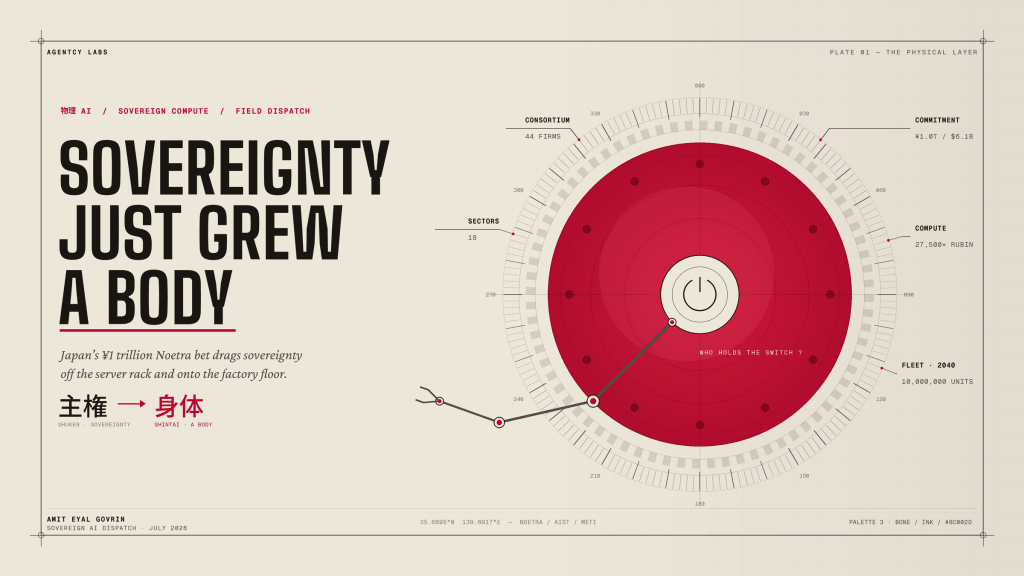
Japan’s ¥1 trillion Noetra bet isn’t a model play. It’s an industrial-base play — and it drags the sovereignty argument off the server rack and onto the factory floor.
Every sovereign-AI story this year has been an argument about bits. Where the data sits. Who holds the weights. Which jurisdiction can subpoena the logs. All important, and all strangely bloodless. This month Japan changed the subject to atoms, and said the quiet part of the sovereignty thesis out loud: if AI runs the machines that run your economy, then renting that intelligence from four labs across the Pacific stops being a procurement question and becomes a national-security exposure.
Here’s what happened. Tokyo stood up Noetra — a consortium anchored by SoftBank, Sony, NEC and Honda, in partnership with the national lab AIST — to build a homegrown multimodal foundation model. On June 30, Noetra’s proposal on “Physical AI Foundation Technologies” was selected under NEDO’s robotics-and-physical-AI program, and METI Minister Ryosei Akazawa put real money behind it: ¥387.3 billion ($2.4B) this fiscal year, roughly ¥1 trillion ($6.1B) over five years. The 2040 target is enormous — around 10 million AI-equipped robots across 18 sectors, inside a broader ¥10.5 trillion (~$65B) physical-AI push that sits within PM Takaichi’s ¥370 trillion, 14-year strategic-sectors plan.
Notice what Noetra is not doing. It isn’t trying to out-GPT OpenAI. Akazawa was direct about where Japan’s edge lies: elder care, disaster response, manufacturing lines, the decommissioning of Fukushima. Physical data, in domains where Japan already owns the real world — Japanese firms hold roughly 70% of the global industrial-robotics market. That reads the second wave more clearly than most Silicon Valley cap tables have. The first wave was capability. This one is control — and control gets concrete when the endpoint is a robot arm on a production line rather than a chatbot in a browser tab.
There’s a longer memory driving this, too. Japan has been here before — on top. At its 1980s peak, Japanese firms held roughly half of the global semiconductor market and as much as 80% of the world DRAM market; six of the ten largest chipmakers on earth were Japanese, and Japanese brands owned the living room, from the Walkman to the VCR. Then came the lost decades. By the late 2010s, Japan’s share of global chips had slid below 10%, ceded to Silicon Valley, Taiwan and South Korea. Read Noetra against that backdrop and the ambition sharpens: this isn’t only a hedge against foreign AI, it’s a bid to reclaim a seat at the center of the technology world that Japan once held and watched slip away. Physical AI is simply the arena where Japan’s surviving advantages — robotics, precision manufacturing, decades of industrial data — still compound. A country doesn’t commit ¥1 trillion and a 2040 horizon to catch a trend; it does that to reclaim a birthright.

Run it through the five pillars
Failure in any one breaks the chain.
1. Territorial — the compute and the data live in Japan. A ¥1 trillion commitment buys domestic infrastructure, a national lab as co-architect, and a corpus drawn from Japanese factories, hospitals and disaster zones. This is where everyone starts, and Japan clears it. But clearing Territorial is a quarter of the exam, not a passing grade.
2. Operational — who can turn your factory off? Noetra’s president, SoftBank executive Hironobu Tanba, put the operational case more plainly than most vendors will: “Dependence on overseas LLMs carries serious risks related to business continuity itself. For example, if an AI is controlling a manufacturer’s production line, and its use is suddenly restricted due to changes in foreign laws or international affairs, the factory’s lines could be shut down.” That’s the 3 a.m. pager question raised to the level of a national industrial base. If a foreign vendor can idle your production line in response to a foreign export order, you don’t operate that line — you license the right to run it until someone else changes their mind.
3. Technological — own the model, own the weights. A homegrown multimodal model means the IP for how Japan’s machines perceive and reason is inspectable, forkable, and Japanese. A proprietary model API baked into a robotics stack just relocates vendor dependency from the cloud to the shop floor, where it’s harder to migrate, not easier. The roadmap is explicit about the direction: a reasoning model in FY2026, an omni-modal model (text, image, video, audio) by FY2028, and “Real-world Native AI” with spatial awareness by FY2030. The honest asterisk: the silicon underneath is overwhelmingly Nvidia’s — the national compute build alone runs on about 27,500 Nvidia Rubin GPUs. Sakana AI, one of Japan’s brightest sovereign hopes, counts Nvidia among its investors. Model-layer sovereignty riding on someone else’s chip layer is real, but it’s sovereignty with an asterisk, and the asterisk is worth naming.
4. Legal — jurisdiction as business continuity. Tanba framed the legal pillar from the importing side, which is where most Western coverage never looks. The CLOUD Act problem — U.S. law reaching data anywhere on earth — reads very differently from Osaka. For Japan, “which jurisdiction governs access” isn’t a compliance footnote; it’s whether an American or Chinese policy shift can stall a Japanese factory. Sovereignty here is chosen deliberately and enforced architecturally, because the alternative is running your industrial base on someone else’s legal calendar.
5. Financial — the pillar Japan is most likely to fumble. Domestic doesn’t mean cheap. Sakana’s Fugu reportedly runs up to five times the cost of Claude Opus 4.8 and about 4.5× slower on equivalent tasks. Graded on token price, Noetra loses. But cost sovereignty was never about being cheap — it’s about being in control. A ¥1 trillion public subsidy is Japan choosing to own its AI cost curve rather than rent it from a meter someone else controls. Predictable and owned beats cheap-but-someone-else’s-switch — a trade the Uber team that torched its entire 2026 AI budget in four months on Claude Code would take today.
So is this real, or a combine with a press release?
Fair question — Japan has shipped that movie before. The honest answer sits in one unglamorous engineering problem: Noetra has to pool proprietary industrial data across roughly 44 rival companies — spanning automotive, electronics, logistics, telecom, IT and finance — to train a shared model without commoditizing the trade secrets that make each of them competitive. Solve that, and Japan hasn’t just built a foundation model; it’s built a reference architecture for how a whole economy owns its intelligence. Fumble it, and it’s ¥1 trillion of very sophisticated theater.
Tokyo itself hedged the bet: only the first two years of funding are locked, with everything after running through an annual stage-gate review. Either way, the map just got bigger. Bits were round one. Japan is playing for atoms.
Agentcy — your data, your infrastructure, your stack, your rules. Now with robots.
The territory is forming. We’re mapping the physical layer next.
Sources & further reading
Primary announcements
-
- METI / NEDO selection of Noetra under the physical-AI program — The Japan Times, “Japan announces aid for domestic AI development project” (Jun 30, 2026)
-
- “Japan Government, Industrial Leaders and NVIDIA Launch the World’s First National AI Infrastructure” — GlobeNewswire (Jul 16, 2026)
Coverage & analysis
-
- “Japan rallies tech-giant alliance to build sovereign AI” — Asia Times (Jul 2, 2026) — source for the Tanba quote and the ~44-company figure
-
- “Japan plans sovereign AI model and 10 million AI robots” — The Japan Times (Jul 1, 2026)
-
- “Japan’s answer to its worker shortage: An AI model for 10 million robots” — AI News (Jul 2026)
-
- “Japan targets $65bn in public-private physical AI investment by 2040” — Nikkei Asia
-
- “Takaichi Unveils Unprecedented $2.3 Trillion Japan Spending Plan” — Bloomberg (Jun 24, 2026)
Supporting references (the asterisks)
-
- Sakana Fugu vs Claude Opus 4.8 cost/latency comparison — MindStudio
-
- “Sakana achieves frontier performance with new Fugu multi-model system” — VentureBeat
-
- “Uber burned through its entire 2026 AI budget in four months” — Fortune (May 26, 2026)
Historical context (the “reclaiming” arc)
-
- “Semiconductor industry in Japan” — Wikipedia — ~50% global chip share and majority DRAM control at the 1980s peak; six of the world’s top ten chipmakers Japanese by 1989; sub-10% by the late 2010s
- “The lost 30 years: The decline of Japan’s semiconductor industry” — Network World
Amit Eyal Govrin is the CEO of Agentcy Labs and a Principal Analyst at theCUBE Research
Metadata
-
- Word count: ~1,050
-
- Estimated read time: 7 minutes
-
- Category: Sovereign AI / Industrial Policy
-
- Series: The Sovereignty Pillars
-
- Primary tags: #SovereignAI #PhysicalAI #Noetra #Japan #IndustrialPolicy
-
- Secondary tags: #SoftBank #Nvidia #FoundationModels #Robotics #CLOUDAct #SakanaAI #METI #SupplyChainSovereignty
-
- Key entities: Noetra · AIST · SoftBank · Sony · NEC · Honda · METI · NEDO · Ryosei Akazawa · Hironobu Tanba · Sanae Takaichi · Sakana AI · Nvidia
-
- Key figures: ¥1T / $6.1B (5-yr) · ¥387.3B / $2.4B (FY2026) · 10M robots / 18 sectors by 2040 · ¥10.5T / ~$65B physical-AI push · ~27,500 Nvidia Rubin GPUs · ~44 participating companies · ~70% global industrial-robotics share (today) · ~50% global chips / ~80% DRAM (1980s peak) → sub-10% (late 2010s)