
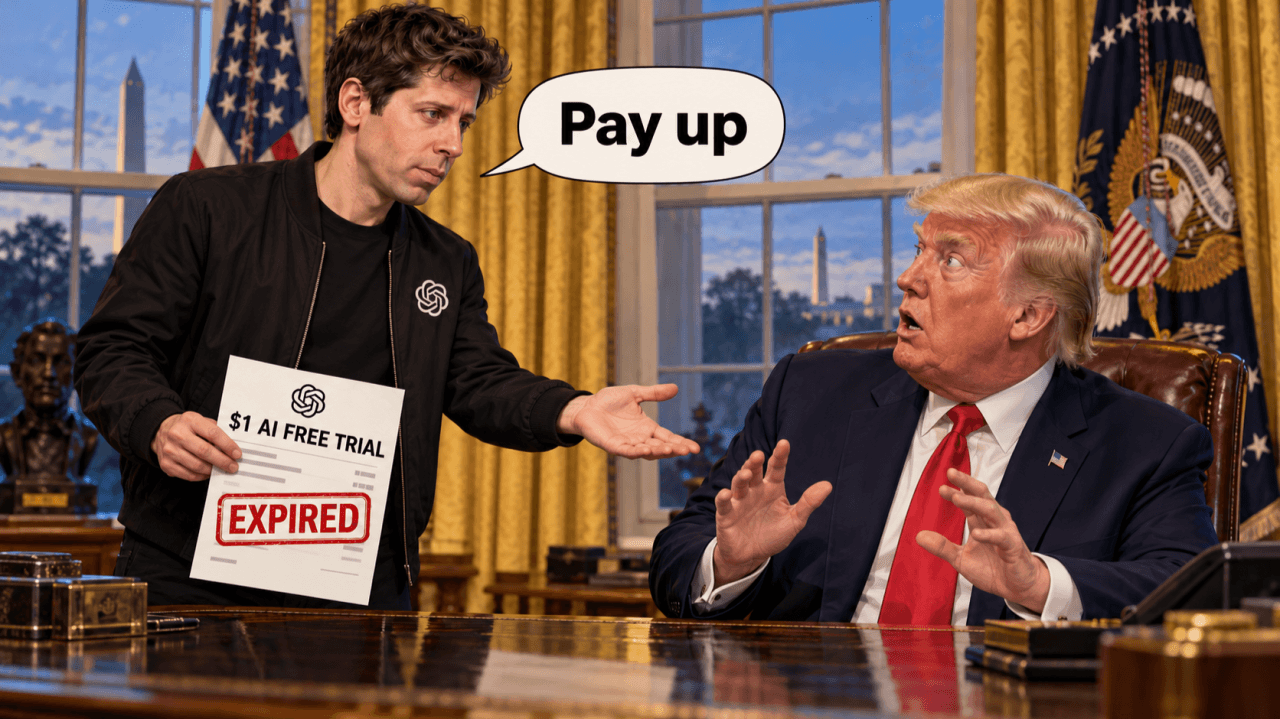
For fourteen months, the US government bought frontier AI for a dollar. On October 1, the dollar became a meter. If the biggest buyer on earth got the introductory rate, guess what your ministry is getting.
The promo code
I want to lay out the sequence, because the sequence is the story.
August 6, 2025. OpenAI joins GSA’s OneGov program and offers ChatGPT Enterprise to every participating federal agency for $1 for one year. Then, “for an additional 60-day period,” unlimited use of its advanced models [1].
Even the free trial came with a free trial.
August 12. Anthropic matches it: Claude, every branch of government, $1 [2]. August 21. Google comes in under both. Gemini for Government, $0.47 per agency [3].
Forty-seven cents. Less than a postage stamp. The most consequential software purchase of the decade cost less than mailing the contract.
That’s not a price war. That’s a land grab, and the land was the federal workforce.
September 10, 2026. GSA announces OpenAI’s new 27-month OneGov agreement, effective October 1 and running through December 31, 2028 [4]. The $15 per user per month platform fee goes to zero. Usage is billed by the token, at 50% off. No minimum order. No spend commitment [4][5]. GSA’s acting FAS commissioner, Laura Stanton, calls consumption-based access “the next logical step” [4].
The next logical step for whom, exactly?
Same article, same week, a GSA director describes the old deals as “limited time offers” [4]. That’s not procurement language. That’s a mattress store on a long weekend.
September 17. Anthropic’s $1 offer gets extended by one month, to October 31 [6]. September 29. Google’s 47-cent deal, which expired September 30, gets extended to November 15. A GSA official explains, in writing, that “OneGov is maturing from short-term promotional pricing” toward direct contracts [7].
Read that twice. Short-term. Promotional. Pricing. The government’s own word for the most important AI deal it ever signed was promo.
October 1. The meter starts.
That’s the whole edition. The dollar was never a price. It was an onboarding cost. And the people who paid it are about to learn the difference between a deal and a dependency.
Picture the gym in January
Every January, a gym somewhere signs up a few thousand people for a dollar. No commitment. Cancel anytime. The card goes on file at the front desk, next to the bowl of free mints.
Nobody reads the contract in January. Everybody reads it in March.
Now scale the gym. Per OpenAI, over one million government employees already have ChatGPT access, and the new deal makes about 23 million public servants eligible: federal, state, local and tribal [4]. That’s not a customer list. That’s a growth plan with a federal seal on it.
Nobody at the front desk lied. The dollar was real. The discount is real. The mints are real. Somebody still has to pay for the treadmill.
Credit where it’s earned
Let’s give credit first, because OneGov did real work, and pretending otherwise cheapens the rest of the argument.
GSA has savings on the record. OneGov says it has saved agencies about $1.68 billion since it started, $1.4 billion of it on AI [4]. That’s buying power used the way taxpayers would want it used.
The new OpenAI terms beat what most enterprises get. Half off token usage. No platform-access fee. FedRAMP-authorized offerings in scope [4][5]. If your account team sent you those terms, you’d forward the email to your CFO with a single word: “Sign.”
And the part I actually like: no spend commitment. No minimum, no take-or-pay, no three-year prepay [4][5]. On paper, any agency can walk out the door tomorrow. Contractually, that’s the cleanest exit clause I’ve seen from a frontier lab this year.
Then you open the workflows.
The contract lets you leave. Your workflows don’t.
Here’s the part nobody said out loud at the announcement.
Fourteen months at a dollar is long enough to do exactly one thing: build habits. A million employees learned the prompts. Agencies wired the model into summaries, case notes, drafts, code. Somebody in every department built a custom assistant and named it after a cat.
None of that shows up in the contract. All of it shows up in the switching cost.
“No spend commitment” doesn’t mean no commitment. It means the commitment moved from the contract to the org chart.
The gym never needed you to sign for a year. It needed you to stop knowing where the other gyms are.
That is not a free exit. That is an exit nobody has the budget to walk through.
Appropriations are annual. Meters aren’t.
Now the arithmetic, because the arithmetic is where the jokes stop.
Under the old deal, cost was fixed and usage was irrelevant. A dollar is a dollar whether you send one prompt or one billion. Under the new deal, cost is usage. Every token, every agent, every retry, every “can you make it shorter.”
The reporter who broke the deal said it plainly: the shift will likely bring higher costs for agencies, which will have to decide whether to keep giving employees access at all [4].
The deal designed to expand access to 23 million people ships with a sentence about who might lose it.
And the meter doesn’t care whether the answer was right. Savan Kong, the Defense Department’s former customer experience officer, wrote the sharpest line of the month in FedScoop on Tuesday [8]. He starts with a story. A special operations analyst reportedly asked a chatbot to interpret a Chinese vessel’s cargo, got back “components for a nuclear weapons program,” and then used AI again to dress the finding up as a formal intelligence report. Armed personnel were reportedly preparing to board. Aircraft were reportedly already in the air. Officials caught it before anyone boarded [8][9].
Then Kong lands it: “A per-token contract bills the tokens behind that report at the same rate as the tokens behind a correct one.” [8]
Sit with that for a second. A wrong answer and a right answer cost the same. A wrong answer that needs a second prompt to sound official costs more.
In August I wrote that your token bill is not your AI bill. Washington just volunteered to find out which one it gets.
Appropriations are annual. Meters aren’t.
Meanwhile, at the other front desk
Here’s the part that should stop every non-US buyer reading this.
Washington isn’t the only member of this gym. OpenAI for Countries had signed eleven countries by January [10]. In Norway and the UAE, OpenAI works with local partners to build the data centers, and then becomes their first customer [10].
So the tenant helps pour the foundation, moves in first, and sets the rent for everyone who follows.
Now look at this week. Bloomberg reports OpenAI is in talks with UAE funds, including Abu Dhabi’s MGX, plus BlackRock, for a $30 billion round. The Gulf funds are reportedly discussing as much as $10 billion between them, at a $1.4 trillion pre-money valuation that OpenAI reportedly set as a fixed price [11][12].
Credit to Abu Dhabi. That is the most sophisticated answer to the Financial pillar I’ve seen this year. If you can’t control the price, buy a piece of the company that sets it.
Most ministries don’t have $10 billion lying around. Your procurement team has a renewal date.
And if Washington, with 23 million eligible seats and the largest procurement office on the planet, got the introductory rate and then a meter, what exactly do you think the introductory rate looks like in Oslo, Tallinn or Seoul?
The month-to-month lease
One more thing, because it made me laugh out loud.
Anthropic extended for a month. Google extended to mid-November [6][7]. Agencies running Claude and Gemini are now running government AI on terms that expire before Thanksgiving.
Nothing says long-term AI strategy like a month-to-month lease.
GSA’s line is that it is “renewing agreements where appropriate” as the offers expire [6]. Fair enough. That is what a market looks like while it reprices. When three suppliers all start at roughly a dollar, the only interesting question is who moves first on the way up.
OpenAI moved first. It just moved at 50% off.
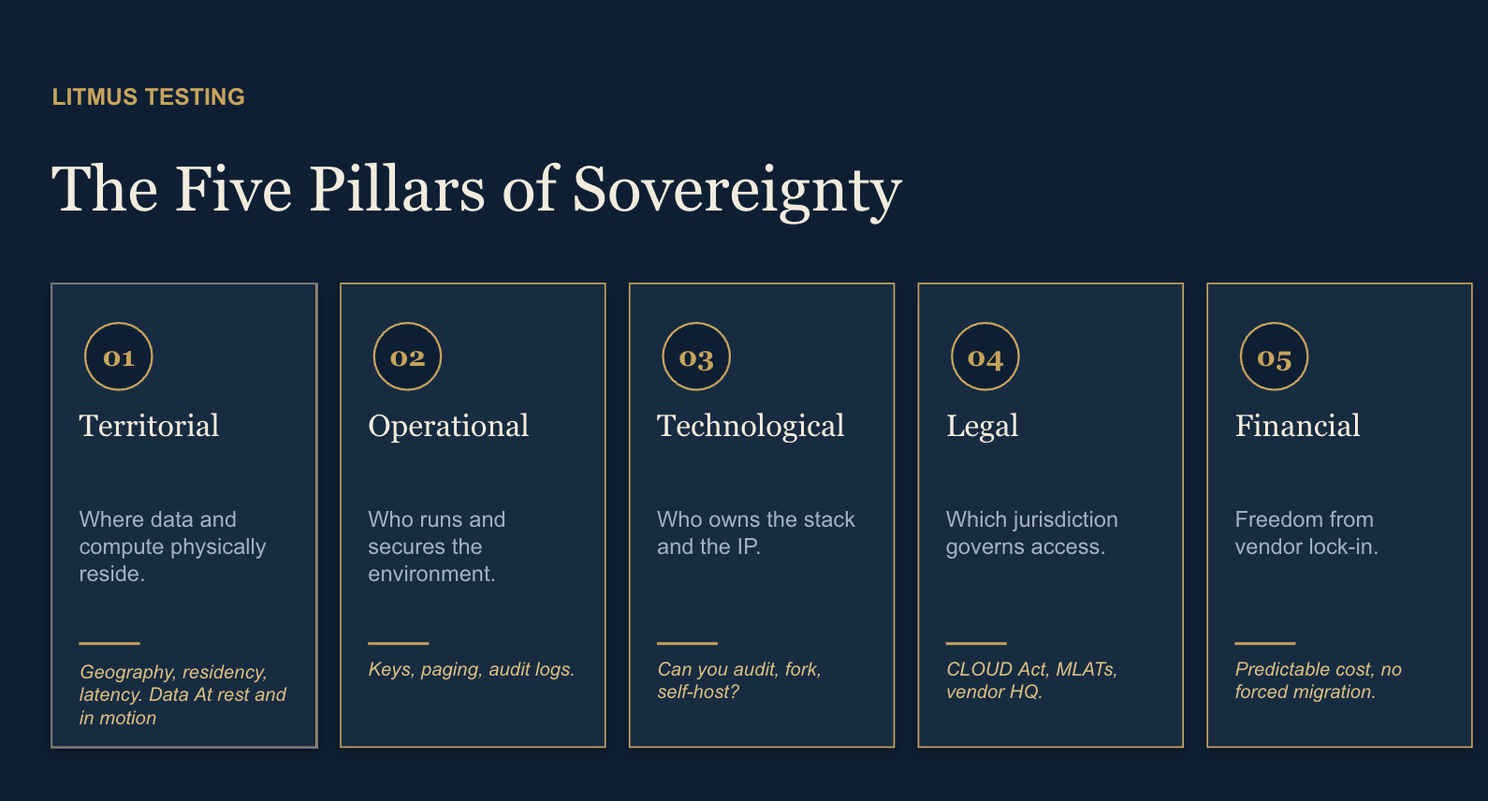
The five pillars, under the meter
Same test as always. Two seats this time: a US federal agency on the new OneGov terms, and a non-US ministry buying the same frontier API. I’m grading the dependency, not the company.
My standing rule applies: a hosted frontier model anywhere in the request path is an automatic fail on Territorial and Financial. Washington gets a waiver on the first one, because the soil and the vendor share a passport.
Pillar 1, Territorial: pass inside the US, fail outside it
The question: Where do your data and compute physically reside, at rest and in motion?
The story: FedRAMP-authorized offerings, US soil, a US vendor [5]. For Washington, that’s home turf. For a ministry abroad, the request path still leaves the country, even when the data center has a local flag on the roof.
Under pressure: your national data protection authority asks where last quarter’s prompts were processed.
Verdict: Pass inside the US. Fail outside it. Same treadmill, different passport.
Pillar 2, Operational: fail, with a very nice login page
The question: Who runs it, who holds the keys, who gets paged, and who can pull the plug?
The story: The vendor runs it. The vendor holds the keys. The vendor writes the status page. You hold a dashboard and a training deck.
Under pressure: an outage on the morning your agency’s benefits backlog is due.
Verdict: Fail. Your ops team finds out from the status page.
Pillar 3, Technological: fail
The question: Can you audit it, fork it, self-host it?
The story: Closed weights, hosted model, vendor roadmap. Model versions arrive and retire on someone else’s calendar.
Under pressure: the model your workflows were tuned on gets deprecated mid-fiscal-year.
Verdict: Fail. You can’t fork a promo code.
Pillar 4, Legal: holds for Washington, breaks for everyone else
The question: Which court can compel whoever holds your data, your keys or your model?
The story: For a US agency, the vendor and the statute sit on the same side of the table. For everyone else, my standing exhibit still applies. In June 2025, Microsoft France’s legal chief was asked under oath by the French Senate whether he could guarantee that French public-sector data would never reach US authorities without French consent. His reported answer: “No, I cannot guarantee it.” [13][14] Contracts lose to statutes. In both directions.
Under pressure: a US legal order reaches the vendor that processes your ministry’s prompts.
Verdict: Holds in Washington. Breaks abroad. The fine print has a home address.
Pillar 5, Financial: the loudest fail on the board
The question: Can you leave? On your timeline, at a survivable cost, without a meter you don’t own setting your gross margin three years out?
The story: You went from a fixed price of one dollar to an uncapped meter, discounted against a commercial rate the vendor also sets [4][5]. The contract lets you leave. The prompts, the cat-named assistants, the integrations and a million trained users make leaving a program, not a config change. And outside the US, the one buyer that solved this pillar did it by writing a ten-figure check to the landlord [11].
Under pressure: model your unit economic alpha at 3x token prices. Then let agentic workflows multiply your token count by ten. Then put both in the same spreadsheet.
Verdict: Fail. Half off a meter you don’t control is still a meter you don’t control.
Scores: US federal agency, 2 out of 5. Non-US ministry on the same API, 0 out of 5. Nobody scores five out of five, and nobody at this front desk was trying to.
The executive TCO
Three line items, none of which show up on the invoice:
- The cliff. Every promotional AI price in your estate has an expiry date. Find them all. Price the day after each one. Put a number on it.
- The elasticity. Usage grows when it’s free, and keeps growing when it isn’t. Agents don’t get tired, don’t take lunch, and don’t get billed by the hour. They get billed by the token.
- The switching tax. Prompts, custom assistants, integrations, and the training hours you spent teaching people one vendor’s interface. That’s the real cancellation fee, and nobody invoices it.
Same baseline-and-burst strategy as always. Baseline the routine work (summaries, drafts, classification) on open weights you hold, on hardware you control, at a cost you can forecast three years out. Burst to the frontier when the intelligence pays for itself, through a gateway you own, on a meter you can switch off.
Hybrid is fine. I’d sign off on it. A free trial is not a strategy.
Own the crown jewels. Rent the edges. And never rent the edges at an introductory rate without knowing what day 366 costs.
What to do Monday
- Inventory every introductory rate. Every $1, every 47 cents, every “limited time offer.” Write the expiry date next to each one. That list isn’t a price sheet. It’s a calendar of invoices.
- Run the 72-hour drill, priced-out edition. Not down. Not prohibited. Priced out. If the meter tripled on Monday, could you keep operating by Thursday?
- Export your prompts and your assistants. Version them, and keep them in a format that runs on someone else’s model. That’s your exit, in a folder.
- Pay for answers you can check. Kong is right: buy outcomes where you can, and build independent evaluation into the contract where you can’t [8]. If nobody grades the output, the meter grades your budget.
- Write it into the risk register. “Frontier dependency, metered, vendor-priced, renewal on a vendor calendar.” If that line makes your CFO uncomfortable, good. That’s the line working.
And one question for every vendor still offering you a dollar:
“What does this cost on day 366? And who decides?”
If the answer is “we’ll work something out,” congratulations. You’ve just been offered a gym membership.
So who’s holding the card?
I don’t think anyone did anything wrong here. GSA got real discounts. The labs got real adoption. Washington got fourteen months of frontier AI for less than a sandwich, and it bought them with eyes open.
But a free trial is customer acquisition wearing a public-service costume. It always was. The only surprise is how many buyers forgot they’d handed over the card.
Washington can afford to find out what the meter costs. It has the largest budget on earth and a vendor that shares its passport.
You don’t. You have a renewal date.
The trial ended. The card was on file. Cancel anytime. Go ahead. Try it.
Want your AI estate run through the 5 Pillars before the next promo expires? Agentcy Labs runs procurement-facing Sovereignty Assessments: your vendor estate through all 5 Pillars, named risk factors, no pass/fail theater. We build the crown jewels layer and you own it outright. Not licensed. Not hosted on our terms. Book one: amit@agentcylabs.com
Amit
Amit Eyal Govrin is Principal Analyst, Sovereign AI at theCUBE Research and CEO and co-founder of Agentcy Labs.
References
[1] GSA, “GSA Announces New Partnership with OpenAI, Delivering Deep Discount to ChatGPT Gov-Wide Through MAS,” Aug 6, 2025. https://www.gsa.gov/about-gsa/newsroom/news-releases/gsa-announces-new-partnership-with-openai-delivering-deep-discount-to-chatgpt-08062025 [2] GSA, “GSA Strikes Another OneGov Deal with Anthropic to Offer Claude AI to all Branches of Gov for Just $1,” Aug 12, 2025. https://www.gsa.gov/about-gsa/newsroom/news-releases/gsa-strikes-onegov-deal-with-anthropic-08122025 [3] GSA, “GSA, Google Announce Transformative ‘Gemini for Government’ OneGov Agreement,” Aug 21, 2025. https://www.gsa.gov/about-gsa/newsroom/news-releases/gsa-google-announce-gemini-onegov-agreement-08212025 [4] Nextgov/FCW, Christian Robles, “GSA unveils new, token-based OneGov discount with OpenAI,” Sep 10, 2026. https://www.nextgov.com/acquisition/2026/09/gsa-unveils-new-token-based-onegov-discount-openai/415908/ [5] ExecutiveGov, “GSA, OpenAI Reach OneGov Deal for Discounted ChatGPT Access,” Sep 11, 2026. https://www.executivegov.com/articles/gsa-openai-onegov-agreement-chatgpt [6] FedScoop, “Anthropic extends its GSA OneGov deal for Claude by one month,” Sep 17, 2026. https://fedscoop.com/anthropic-extends-gsa-onegov-deal-for-claude-by-one-month/ [7] Nextgov/FCW, “Google extends Gemini OneGov deal into November,” Sep 29, 2026. https://www.nextgov.com/acquisition/2026/09/google-extends-gemini-onegov-deal-november/416320/ [8] FedScoop, Savan Kong, “The government is buying AI by the token. It should buy results.,” Oct 6, 2026. https://fedscoop.com/the-government-is-buying-ai-by-the-token-it-should-buy-results [9] Democracy Now, “CNN: AI Agent Provides U.S. Military with False Intel Report on Chinese Ship in the Middle East,” Sep 21, 2026 (summarising CNN reporting). https://www.democracynow.org/2026/9/21/headlines/cnn_ai_agent_provides_us_military_with_false_intel_report_on_chinese_ship_in_the_middle_east [10] Resultsense (summarising Reuters), “OpenAI Launches Global Initiative to Expand AI Access,” Jan 21, 2026. https://www.resultsense.com/news/2026-01-21-openai-countries-global-ai-initiative/ [11] Bloomberg, “OpenAI in Talks With UAE Funds, BlackRock for $30 Billion Funding Round,” Oct 5, 2026. https://bloomberg.com/news/articles/2026-10-05/openai-in-talks-with-uae-funds-blackrock-for-30-billion-round [12] Tech Funding News, “OpenAI in talks with UAE funds and BlackRock for $30B round at a fixed $1.4T price: Report,” Oct 2026. https://techfundingnews.com/openai-in-talks-with-uae-funds-and-blackrock-for-30b-round-at-a-fixed-1-4t-price-report/ [13] heise online, “Not sovereign: Microsoft cannot guarantee the security of EU data,” Jul 21, 2025. https://www.heise.de/en/news/Not-sovereign-Microsoft-cannot-guarantee-the-security-of-EU-data-10494789.html [14] Dr. Datenschutz, “Microsoft kann US-Zugriff auf EU-Cloud nicht verhindern,” Jul 2025. https://www.dr-datenschutz.de/microsoft-kann-us-zugriff-auf-eu-cloud-nicht-verhindern/