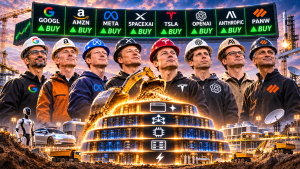

Sovereignty isn’t just a ministry hosting on-prem. It’s a company owning its stack through and through, from the dirt to the application. Eight to ten companies are building exactly that, and they keep spending when the tape turns red. The rest are mailing shareholders a check and trending toward captured.
Shaping the discussions around Sovereign AI · November 21, 2026 · Sovereign AI | theCUBE Research | Amit Eyal Govrin
Election week
On Thursday, November 19, Anthropic opened on the Nasdaq at $111.50 against an $83 IPO price and closed at $97.17. Largest IPO in history. About $1.76 trillion fully diluted [1].
The rest of the market spent that afternoon looking for the exits. By Friday, the Nasdaq had wiped out its gains for 2026, and the S&P 500 and the Dow were both in correction territory [2].
Let me lay out the week, because the sequence is the story.
- November 12. Jensen Huang resigns. CFO Colette Kress becomes interim CEO [3].
- November 17. Nvidia reports $115.8 billion in quarterly revenue, up 103% [4]. It also bought back a record $22 billion of stock in the quarter [5], with $227.3 billion still authorized [6].
- November 18. With buybacks already climbing, Kress reportedly promises pay raises at her first employee town hall [7]. That evening, Palo Alto Networks beats, raises, and agrees to buy Applied Compute, an open-weight post-training and inference platform, for $4.5 billion in stock [8].
- November 19. ANT lists. Palo Alto closes up 6% [9]. Intel rises on its first outside customer for its 18A foundry process [10]. Nvidia, AMD, Microsoft and Oracle sink [11].
- November 20. Nvidia has shed more than $900 billion in seven sessions [12]. That’s about 37% in a month, on a record quarter [13].
Record revenue. Record buyback. Worst month in memory. Take a guess which of the three the market read.
Here’s the thing, though. The ticker isn’t the ballot. Prices swing. Almost everything with an AI label fell this week, builders included.
The real vote is cast by the companies themselves, with their own dollars. Every quarter each one decides: build the next layer, buy it, or hand the cash back. Eight to ten of them keep voting to build, through every red day. The rest are voting for a dividend. That’s the whole edition.
The platform: dirt to application
Credit first, because the framing isn’t mine. On this week’s All-In, Chamath laid out a theory: AI ends up with nine or ten vertically integrated megacorps that own everything from the land and the power, the dirt, up to the application [14]. Per 24/7 Wall St.’s summary of the episode, he argues land and power are becoming the binding constraint, which moves pricing leverage away from the GPU maker and toward whoever holds the physical ground. And cash-rich incumbents that sit out models and data centers get bought to fund the ones that build [15].
Read that twice. That’s my definition of sovereignty with a market cap attached.
Sovereignty was never about where a server sits. It’s four questions: who controls it, who can switch it off, who sets the price, and can you leave. Own every layer from the substation to the app, and the answer to all four is you. Everyone else is a tenant with good branding.
And that’s the true nature of sovereignty. The industry has spent two years treating it as a public sector problem: nation-states, ministries, and regulated industries hosting on-prem. That’s one seat at the table. The bigger story is corporate. A company that owns its stack through and through, dirt to application, is building resiliency into its own future. Nobody can reprice it, ration it, or switch it off.
That isn’t a growth strategy wearing a sovereignty costume. It’s sovereignty, run as a business plan.
The incumbent who ran on a rebate
Credit before the knife. Nvidia’s quarter is real. Revenue doubled, Vera Rubin is shipping, and Kress’s line in the release was “Our momentum is real” [4]. It is. Nobody on Wall Street thinks Nvidia forgot how to sell GPUs.
Under Jensen, Nvidia was on the right track. It wasn’t sitting on its cash. It was spending it to climb into every layer around the chip: more than $90 billion in acquisitions, investments, and strategic deals committed in 2026 by May [48], an equity book that reached $99 billion by July, including a stake in Intel, plus the outright acquisition of Hugging Face [49], and a licensing agreement for Groq’s inference technology [50]. Call some of it vendor financing if you like. It was still a company buying its way into the next stack.
Now the founder is gone, and the board is searching. The first big message from the new leadership is capital return: a record $22 billion repurchase in one quarter [5], $227.3 billion still authorized [6], and pay raises at the town hall [7]. It reportedly didn’t even file its 10-Q alongside the earnings release [16].
That’s not a strategy for the next decade. That’s a rebate check for the last one.
The buyback is the tell. A company that was buying its way into the layers around it is now buying back its own stock. Chamath reads the slide as the end of Nvidia’s over-earning era as compute spreads across chip formats [15]. I read it as investors pricing the risk that the expansion strategy walked out the door with the man who ran it, and that the cautious playbook is back. That strategy, and the future it was buying, is now at risk.
In Sovereignty Wars, round one, I asked who wanted Jensen out. Round three asks something simpler. Who spends Nvidia’s money the way the next stack needs it spent? So far, the answer is Nvidia’s shareholders.
The write-in candidate
Palo Alto Networks wasn’t on the dirt-to-application ballot. It’s a security company. It got the votes anyway.
What it bought: Applied Compute, a platform for post-training and inference of open-weight models that hit $100 million in annualized revenue within 18 months of its founding [18]. Nikesh Arora’s line on the call: Palo Alto will “train and serve secure sovereign implementations of open-weight models” for enterprises [19]. He also said open-weight models went from under 5% of token traffic to over 60% in a year, and that if the deal works it “will dwarf” the cybersecurity business [20].
And it paid in its own stock. The opposite of a buyback.
I don’t hand out credit I can’t back, so let me be precise. Palo Alto owns no dirt and no chips. It owns the security layer at a big chunk of the enterprise market, and it just bought its way into the model layer instead of renting it from a frontier lab. That’s not a megacorp yet. It’s a company that read the memo, already dominates one layer, and is now going full tilt down the stack.
Volatility is not a verdict
On October 29 the market fined Alphabet about $500 billion in one session, the worst day in the company’s public history, over a $9 billion free cash flow hole driven by capex [21]. Alphabet is the closest thing to a finished dirt-to-application stack: its own data centers, its own TPUs, Gemini, and a Gemini app it says has a billion users [22]. It fell with everyone else this week too.
Look at what Alphabet did with the fine. It held 2026 capex at $195 to $205 billion [23] and has reportedly told investors 2027 goes up significantly from there [24].
That’s what a candidate looks like. The market charged a toll. Alphabet paid it and kept driving. Nvidia got a record quarter and pulled over to cash a check.
Short-term volatility is the entry fee. The ones who pay it and keep building are writing the next decade. The ones who flinch and buy back stock are handing someone else the keys, one authorization at a time.
The candidates: eight to ten with full sovereignty on the ballot
Chamath didn’t name his, eight, nine or ten [15]. I’ll name mine, and I’m grading the dependency, not the company. The bar isn’t how many layers you hold today. It’s which way you’re moving: a stated intent to own the stack from the dirt to the application, and dollars still pushing down the stack when the tape turns red. That’s why a security company makes this list and a hyperscaler with every layer doesn’t.
- Alphabet. Data centers, TPUs, Gemini, Search and Workspace. Toll paid in full, capex still rising [21][23]. And it’s buying the power layer outright: Intersect, a data center and power developer, for $4.75 billion in cash [58].
- Amazon. Its own data centers, Trainium, the Nova models, AWS and the retail app, plus, with Google, close to 28% of Anthropic [29]. And the proof it’s playing for the whole board: Amazon is reportedly closing in on Decart for more than $7 billion. Decart’s software lets AI workloads move between processors and run efficiently on whichever chip is available [51]. Per Calcalist and Globes, the deal is led by Annapurna Labs, the team behind Trainium, and is expected to be unveiled at re:Invent on November 30 [52]. Anthropic looked at the same company in August and walked [51]. Amazon is buying the layer that turns its own silicon into a first-class home for anyone’s model. That’s not a buyback. That’s a shovel.
- Meta. Hyperion in Louisiana, a campus priced above $50 billion [25], its own models, 3.64 billion daily users across its apps [26], and the bond market funding the gap with another $20 billion-plus raise this month [27].
- SpaceXAI. Colossus, Grok and X under one roof since SpaceX absorbed xAI in February [28]. Add Terafab, the chip plant Tesla and SpaceX will run together in Austin [59], and the chip layer is on the way. The only candidate whose dirt includes a launch pad.
- Tesla. The other half of the Musk stack. Its own factories and energy business, robots and vehicles as the physical-AI application layer, and the same Terafab plan to make its own AI chips [59]. Its AI5 chip has already slipped to mid-2027, so the fab is still a promise [60]. The direction isn’t.
- OpenAI. Designing its own accelerators with Broadcom, 10 gigawatts of them, deployed across its own facilities and partner data centers through 2029 [42], with Stargate sites underway with Oracle and SoftBank [43]. ChatGPT is the app. The dirt is the part it reportedly struggled to finance on its own terms [44]. Aspiration: full marks. Balance sheet: still renting.
- Anthropic. Still rents most of its dirt. But its S-1 describes Anthropic Direct, accelerators it procures itself in dedicated facilities built to its spec, with the first one operational this year [30]. It also took on a $3.4 billion gas-powered deal [31] and built a proprietary orchestration layer that decides which work runs on Trainium, TPUs, or GPUs [32]. The model company is learning to dig.
- Palo Alto Networks. The write-in. Dominates the security layer, just bought the model layer, and is going full tilt down the stack [8][19].
Count the European names on that list. I’ll wait.
Trending toward captured
These aren’t dying companies. They’re megacorps with the cash to build, trending the other way: renting the layers they could own and handing the difference back to shareholders. Follow that line far enough and you end up captured by whoever owns the layers you skipped. Chamath’s version: cash-rich incumbents that sit out models and data centers get bought to fund the ones that build [15].
- Nvidia. Under Jensen, climbing into every layer around the chip. Under the interim team, a record buyback as the first big message. Every dollar of that $227.3 billion authorization [6] is a dollar not spent on dirt, power, models, or apps.
- Apple. Rents Siri’s brain from Google, reportedly about $1 billion a year for a custom 1.2 trillion parameter Gemini [33]. Roughly $14 billion of capex in fiscal 2026 against $90.7 billion of buybacks [34], on top of a fresh $100 billion repurchase authorization [35]. Apple owns the best application layer on the planet and pays rent on the brain behind it.
- Microsoft. Owns the dirt, with calendar-year capex around $170 billion [36]. Owns chips in Maia 200. Owns models, trained from scratch, under MAI [37]. Then won’t take the risk of betting on any of it. Per Seeking Alpha, its discounted models run three to six months behind the frontier, OpenAI is roughly 45% of a $677 billion backlog, and it’s the last big hyperscaler still throwing off positive free cash flow [38]. Its October-quarter capex came in under expectations [36]. Microsoft has every layer and votes for none of them. That’s not a stack. That’s a hedge, and hedges don’t win elections.
- Salesforce. Owns the application layer and did something smart one layer down: Koa, post-trained on an Nvidia Nemotron base, with Salesforce controlling the weights [53]. Then it voted with the buyback desk. A $50 billion authorization, including a $25 billion accelerated repurchase partly funded with debt [54], after returning 99% of free cash flow to shareholders in fiscal 2026 [55]. No dirt, no chips, and the frontier tokens still come from someone else. Credit to Koa. Captured on everything underneath it.
One footnote for the risk-takers. Oracle is taking all the risk anyone could ask for, borrowing to build data centers for its anchor tenant, OpenAI, with about $125 billion of debt as of August and more off the balance sheet [39]. But it’s building dirt for someone else’s brain. Risk is the entry fee. It isn’t the platform.
And Palantir? Not on either list, because it isn’t running for megacorp. It’s the outfitter. Its Sovereign AI OS now ships with Armada’s modular data centers, so enterprises and governments can run open-weight models on compute, data, and physical infrastructure they own outright [56], on a reference architecture built with Nvidia [57]. That’s dirt-to-application sovereignty sold to the customer as a kit, which is exactly the right direction. One caveat I’ve made before: the OS layer itself stays closed, and the agentic OS is the alpha. Sell me the whole kit. Then give me the code to the part that thinks.

The five pillars, under pressure
Same test as always. This week the subject isn’t a vendor. It’s the stack itself, graded from the seat of anyone choosing which of these companies to marry for the next ten years.
Territorial
The question. Who owns the dirt, and the power under it?
The story. Chamath’s binding constraint is land and power [15]. Meta is putting more than $50 billion into one parish in Louisiana [25]. Anthropic now leases its own facilities and signed for its own gas [30][31]. Oracle owns plenty of dirt, but OpenAI is the tenant [39].
Under pressure. Power doubles in price, or the anchor tenant misses a payment.
Verdict. Pass for owners. Fail for landlords with one tenant. A data center with one customer is a mortgage with a press release.
Operational
Covered above. Who runs the stack is the candidates list and the captured list. Running the plant isn’t the same as owning the plan.
Technological
The question. Can you audit it, fork it, self-host it?
The story. Palo Alto bought the ability to post-train and serve open weights [8], on Arora’s own number that open weights already carry over 60% of token traffic [20]. Microsoft built MAI from scratch on its own silicon [37], then, per Seeking Alpha, kept it three to six months off the frontier [38]. Nvidia owns the chip and buys equity in the layers above it [17].
Under pressure. A frontier lab reprices, rations, or restricts access to the model you rent.
Verdict. Pass for builders and buyers of the model layer. Fail for renters. Renting the brain is cheap right up to the renewal.
Legal
The question. Who has the vote?
The story. Amazon and Google will hold close to 28% of Anthropic after the IPO. All of it Class N stock. No vote [29]. Nvidia, Google and Microsoft bought into a $26 billion private placement on top [17]. Meanwhile, Washington is weighing a rule that would make US companies disclose their use of Chinese models, and Airbnb’s customer service agent runs on Alibaba’s Qwen [40]. Rep. Moolenaar says the risk remains even when you run those models on your own infrastructure [40].
Under pressure. The disclosure rule lands on your open-weight baseline.
Verdict. Fail on equity without control. A stake without a vote is a donation with a ticker symbol. Partial on open weights: you own the weights, and Washington may still want a word about where they came from.
Financial
The question. Can you leave? Who sets your gross margin three years out?
The story. Nvidia’s record buyback [5]. Apple’s $100 billion authorization against $14 billion of capex [34][35]. And Chamath’s line that incumbents who sit this out get bought to fund the ones who build [15]. The market’s reply to Nvidia: $900 billion in seven sessions [12].
Under pressure. The next five years of compute pricing get set by whoever owns the dirt and the power. If that’s not you, someone else is writing your margin.
Verdict. Fail for the buyback desk. A buyback is a concession speech with a dividend attached. This is the pillar that rules them all, and this week it ruled.
The executive TCO
You’re not building a megacorp. Your board isn’t funding a Hyperion. But you’re on the same ballot at a smaller scale, and three line items decide how you vote.
- The rent on the brain. Apple reportedly pays about $1 billion a year for Gemini [33]. Cheap until it isn’t. Your frontier API bill is the same check with fewer zeros. Model your unit economic alpha at 3x token prices.
- The stake without a vote. Every “strategic partnership” with a model vendor where you carry spend commitments and no control is your own Class N share. Put a number on it.
- The cautious tax. Choosing not to build the core is a decision, and the price is the lag. Write it into the risk register.
Same baseline-and-burst strategy as always. Baseline on open weights you own, which is where Palo Alto just bet $4.5 billion the majority of tokens already are [20]. Burst to the frontier when you need raw intelligence. Owning costs money. Renting costs alpha.
What to do Monday
- Find your buyback. The line in your AI budget that ships cash to a vendor instead of building something you keep. Every company has one.
- Name your dirt. Who owns the power and the floor your inference runs on, and what happens when that landlord reprices.
- Get the weights on your disk. While that’s still a thing nobody has put in a queue.
- Read your vendor’s cap table. If your model provider is part-owned by your cloud provider and your chip vendor, you aren’t diversified. You’re dating one family.
- Check your open-weight provenance before Washington asks you to publish it [40].
Own the crown jewels. Rent the edges.
So who got voted in?
Not the company with the best quarter. Nvidia had that. Not the company with the biggest IPO. Anthropic had that, and gave back a chunk of the first-day pop by Friday [41]. Next week the tape will say something else.
The votes that count are the ones the companies cast with their own money. Eight to ten of them keep voting for the whole stack, from the substation to the app, through every red day. The rest keep voting for the buyback desk. One group is building the next decade. The other is funding it, eventually as the acquired.
Sovereignty was never just a flag on a government data center. It’s a company owning the whole thing, dirt to application, so nobody else can switch it off. This week the builders said so in the only language that counts. Capex.
The incumbents mailed out a rebate. History will mail back the ballot.
Don’t get caught with your pants down.
Amit
Amit Eyal Govrin is lead analyst for sovereign AI at theCUBE Research and CEO of Agentcy Labs, which designs and builds sovereign AI platforms for enterprises and governments. His research for theCUBE Research is conducted under theCUBE Research’s editorial standards and is not sponsored or directed by Agentcy Labs. Agentcy Labs may hold commercial relationships with vendors covered in this research.
Nothing in this edition constitutes investment advice. It is analysis of corporate strategy through the 5 Pillars, not a recommendation to buy, sell or hold any security.
References
- CNN, “Anthropic valued at $1.76 trillion after historic first day of trading,” Nov 19, 2026. Link
- NBC News, “Markets plunge: Nasdaq erases 2026 gains, S&P and Dow enter corrections,” Nov 20, 2026. Link
- NVIDIA, Form 8-K, “NVIDIA Announces CEO Transition,” Nov 12, 2026. Link
- NVIDIA, Form 8-K, “NVIDIA Announces Financial Results for Third Quarter Fiscal 2027,” Nov 17, 2026. Link
- CNBC Investing Club, “Nvidia’s earnings report had something for the bulls, bears and everyone in between,” Nov 18, 2026. Link
- The Motley Fool, “Nvidia Stock Could Soar 90% After Jensen Huang’s Exit, According to One Wall Street Firm,” Nov 19, 2026. Link
- Semafor, “Nvidia shares fall despite bumper earnings,” Nov 18, 2026. Link
- Palo Alto Networks, “Palo Alto Networks to Acquire Applied Compute, Bringing Secure Open-Weight AI to the Enterprise,” Nov 18, 2026. Link
- CNBC, “Palo Alto stock jumps on earnings beat and company’s big bet on securing open-weight models,” Nov 19, 2026. Link
- The Motley Fool, “Why Intel Stock Is Gaining Today,” Nov 19, 2026. Link
- Decrypt, “Nvidia, AMD, Micron Sink as Anthropic Closes 17% Above IPO Price,” Nov 19, 2026. Link
- 24/7 Wall St., “Nvidia Loses $900 Billion in Seven Sessions as Bear Case Builds,” Nov 20, 2026. Link
- 24/7 Wall St., “NVIDIA Is Down 37% in a Month. Can NVDA Stock Get Back to $200?,” Nov 20, 2026. Link
- All-In Podcast, “Anthropic Goes Public, Nvidia in Crisis, Markets Tank, Open Source Crackdown?,” Nov 2026. Link
- 24/7 Wall St., “Why Chamath Thinks Nvidia’s Peak Earnings Era Is Already Over,” Nov 20, 2026. Link
- FX Leaders, “Colette Kress leads Nvidia Earnings Call, as NVDA Tests $150 Support,” Nov 18, 2026. Link
- Futurum Group, “Anthropic IPO Makes Its Biggest Suppliers Shareholders,” Nov 20, 2026. Link
- The Globe and Mail, “Palo Alto (PANW) Q1 2027 Earnings Call Transcript,” Nov 2026. Link
- CSO Online, “Palo Alto Networks bets $4.5B on enterprise AI with Applied Compute acquisition,” Nov 19, 2026. Link
- The Next Web, “Palo Alto Networks buys AI startup Applied Compute for $4.5bn in stock,” Nov 2026. Link
- CNBC, “Alphabet tanks nearly 13% for worst day ever, losing $500 billion in value,” Oct 29, 2026. Link
- 24/7 Wall St., “Alphabet Lost a Record $500 Billion in a Day. Is This the Buying Opportunity?,” Nov 2, 2026. Link
- The Motley Fool, “Alphabet Just Lost $500 Billion in Market Value,” Oct 29, 2026. Link
- Capital.com, “What you need to know about Alphabet after the biggest one-day drop in its history,” Nov 2026. Link
- Wikipedia, “Hyperion Data Center.” Link
- Meta Platforms, Free Writing Prospectus (SEC), Nov 2026. Link
- Investing.com, “Meta seeks at least $20 billion in bond sale as AI debt boom accelerates,” Nov 3, 2026. Link
- Wikipedia, “xAI (company).” Link
- Fortune, “Amazon and Google will own nearly 30% of Anthropic after today’s IPO,” Nov 19, 2026. Link
- Anthropic, PBC, Form S-1 (SEC), 2026. Link
- Fortune, “Anthropic inks $3.4 billion deal for gas-powered data centers,” Nov 10, 2026. Link
- Fortune, “Anthropic plans to spend up to $567 billion on compute. Its S-1 reveals plans to set up its own data centers,” Oct 26, 2026. Link
- FinanceFeeds, “Apple Spent Under $15bn on AI and Beat Every Mag 7 Peer” (citing CNBC), Sep 2026. Link
- AOL / 24/7 Wall St., “Apple Is Spending Far Less on AI Than Mag 7 Rivals,” Oct 2026. Link
- 24/7 Wall St., “Apple Skipped the AI Arms Race,” 2026. Link
- 24/7 Wall St., “Microsoft Beat Again. Its Stock Is Still Lower Than a Year Ago,” Nov 2, 2026. Link
- Microsoft AI, “Building a hill-climbing machine: Launching seven new MAI models,” Oct 2026. Link
- Seeking Alpha, “Microsoft: The Last Hyperscaler With Positive Free Cash Flow,” Nov 2026. Link
- The Motley Fool, “Why Oracle stock is falling after Democrats’ midterm sweep,” Nov 5, 2026. Link
- Reuters via Yahoo News, “Exclusive: Trump administration weighs forcing US firms to disclose Chinese AI use,” Nov 18, 2026. Link Moolenaar statement via The Jerusalem Post. Link
- Yahoo Finance, “Anthropic stock drops 8% after rip-roaring IPO,” Nov 20, 2026. Link
- OpenAI, “OpenAI and Broadcom announce strategic collaboration.” Link
- Constellation Research, “OpenAI will design its own AI accelerators and chips in deal with Broadcom.” Link
- Tom’s Hardware, “OpenAI couldn’t finance its data centers, so it took control of the hardware instead.” Link
- Alibaba Group, “Alibaba’s Full-Stack AI Accelerates Monetization with 22-Quarter-High Cloud Growth,” Aug 20, 2026. Link
- Alibaba Group, “Alibaba’s Cloud Revenue Growth Accelerates to 40% as AI Strategy Delivers,” May 13, 2026. Link
- Alibaba Cloud, “Alibaba Unveils Roadmap on Full-Stack AI Strategy from Chips, Cloud Infrastructure, Models to Agents,” Sep 22, 2026. Link
- European Business Magazine, “Nvidia Is Spending $90 Billion on AI, and Its Customers Are Funding the Entire Boom,” May 20, 2026. Link
- The Next Web, “Nvidia now holds $99bn in shares of the companies that buy its chips,” 2026. Link
- Wccftech, “NVIDIA’s True Power Lies in Its Infrastructure, but There’s an Overlooked Dimension to Its Grip: Jensen’s ‘Web of Alliances’,” Mar 25, 2026. Link
- SiliconANGLE, “Report: Amazon in talks with AI startup Decart over possible $7B acquisition,” Oct 11, 2026. Link
- FourWeekMBA, “Amazon Nears $7B Decart Deal, 1.75x Its May Valuation” (citing Calcalist and Globes), Nov 2026. Link
- 24/7 Wall St., “Why Salesforce’s Homegrown AI Model Won’t Move the Stock Until 2027,” Sep 18, 2026. Link
- Fortune, “Salesforce turbocharges $25 billion stock buying spree with debt, cuts cash flow guidance in half,” May 27, 2026. Link
- Yahoo Finance, “Salesforce Q4 earnings call highlights,” Feb 2026. Link
- Business Wire via Finviz, “Palantir and Armada Partner to Accelerate Sovereign AI Infrastructure,” Oct 2026. Link
- Constellation Research, “Palantir and Nvidia build sovereign, on-premises AI reference architecture.” Link
- TechCrunch, “Alphabet to buy Intersect Power to bypass energy grid bottlenecks,” Dec 22, 2025. Link
- Fortune, “Musk’s Terafab chip project will be built in Austin and jointly run by Tesla and SpaceX,” Mar 22, 2026. Link
- Automotive World, “Musk unveils Terafab as Tesla-SpaceX joint chip venture,” Mar 2026. Link