Agentic AI is being misread as a set of separate battles – e.g. Snowflake versus Databricks, copilots versus agents, model makers versus application vendors. We believe the larger fight is converging around a single question – i.e. who owns the new intelligent client and the AI backend that makes it useful? The new client is the agent-based system of engagement – Snowflake CoWork and CoCo, Databricks Genie, Microsoft Copilot, Google Gemini Enterprise, ChatGPT/Codex, Claude/Cowork and others. These clients will become the place where business users, builders and agents get work done. But they require a new backend – what we call the System of Intelligence – that models enterprise data, business rules, and tacit organizational knowledge in a way that both humans and agents can understand and act upon.
We frame this premise through Clay Christensen’s integrated innovation and Jensen Huang’s extreme co-design, applied to enterprise software. The intelligent client and the System of Intelligence backend have to be designed together because the back-end learns from business users and builders interacting through the intelligent client. That is why Snowflake is the focal point for this Breaking Analysis, but the story is much broader than Snowflake versus Databricks. Snowflake is now competing in the same strategic arena as Microsoft, Google, OpenAI, Anthropic, Salesforce, SAP, ServiceNow, Celonis and others. They are all trying to capture, harmonize, and encode a digital representation of how an enterprise operates.
The key premise is that the System of Intelligence ingests more than data and metadata from pipelines, catalogs and connectors. It also learns from the agentic client through skills, artifacts, semantic views, query history, agent actions, and human reasoning traces. Those signals become feedback into the intelligence layer and help turn individual productivity into organizational intelligence. In our view, the key success factor will be the tightest feedback loop between the agentic client and the enterprise intelligence backend. That requires deliberate software engineering and tighter coupling than developing the client and the back-end independently.
In this Breaking Analysis, we dig deeper into the emerging AI software stack and connect what we learned at Snowflake Summit and Microsoft Build, while setting up Databricks Data + AI Summit in mid-June. The key question we’ll explore is can Snowflake turn governed data gravity into enterprise intelligence, or will the model makers, application vendors and hyperscalers capture the higher-value control points of the agentic enterprise?
Agents everywhere create more silos
The tongue-in-cheek slide below is intended to provoke; positing that there are more agents and agent development tools than fleas on the average camel. While facetious, it is the market reality. That line captures what is happening in the market. Every week brings another vertical agent company or agent development framework. Most are chasing the Y Combinator dream of a vertical agent market that aspires to be ten times the size of vertical SaaS. But they are just reinforcing the 60 years of silos enterprise IT has left in its wake.

The key points we want to stress are:
- Vertical agents will proliferate because the near-term ROI is measurable and the tooling is accessible;
- The Y Combinator thesis that vertical agents can be much larger than vertical SaaS is directionally relevant, but it under-appreciates the enterprise silo problem in our view;
- Sustainable enterprise value requires building an end-to-end infrastructure that captures how the business actually works.
This is why the agentic client and the System of Intelligence backend have to be co-designed. The client gives users and builders a way to get work done. The back-end provides the client with the enterprise context required to act coherently while learning from all the interactions. Without that back-end, the enterprise gets many useful agents and no coherent operating model.
Agent-based clients need an intelligent back-end
The field is starting to coalesce around the AI software stack we’ve been describing for the past several years, but the picture is becoming clearer. The graphic below shows why and how the space is getting crowded. Snowflake and Databricks still sit in the data platform layer, but they’re moving up into governance with Horizon, Polaris, Unity and broadening their catalog strategies; grabbing share from legacy players like Collibra, Alation, Informatica, etc. Systems of record such as Oracle, SAP, Salesforce and Workday remain critical because that’s where business execution still happens. At the top, the system of agency orchestrates actions.
But the most important shift is happening on the left and in the middle. Specifically, the agent-based system of engagement is becoming the new client, and the system of intelligence is becoming the intelligent back-end that harmonizes the 60 years of silos that have accumulated in analytic data and operational applications.
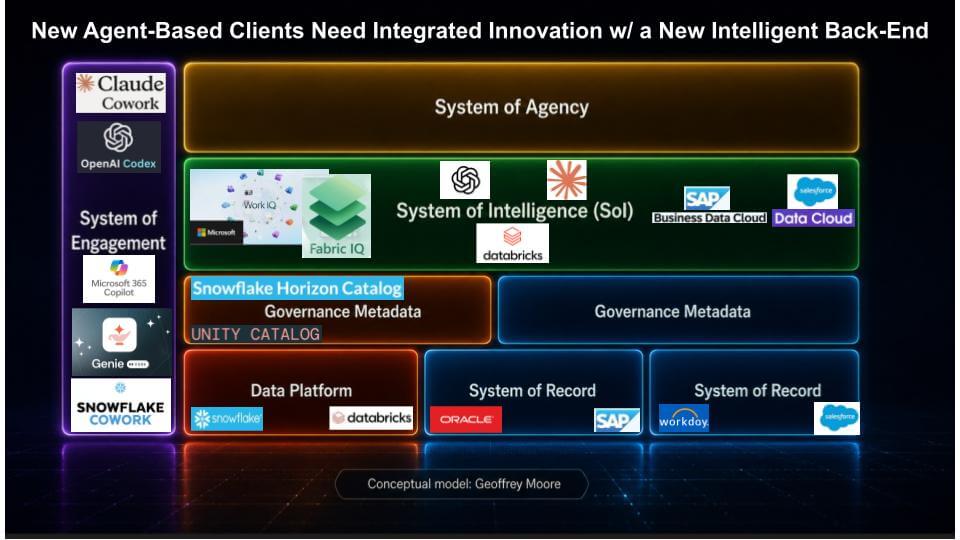
Snowflake CoWork, renamed from Snowflake Intelligence, Databricks Genie, Microsoft Copilot, Google Gemini Enterprise, OpenAI Codex, Claude Cowork and other agentic clients are all trying to become the place where users and builders interact with data and get work done. While Anthropic and OpenAI might have the highest volume agentic clients, they don’t yet have any back-end to capture and harmonize the intelligent interactions.
The middle green layer – the system of intelligence (SoI) – is emerging as the most valuable real estate in the stack in our view. This is where Microsoft is pushing Work IQ and Fabric IQ, where Snowflake is advancing Horizon Context and Cortex Sense, where Databricks is leaning into data intelligence through Unity Catalog, where SAP Business Data Cloud and Salesforce Data Cloud are trying to preserve their domain relevance, and where the LLM vendors would like to extend their influence. The system of intelligence is the layer that binds the stack because it harmonizes islands of analytic data, converts siloed application logic into shared business rules, and captures institutional knowledge so that agents can observe the state of the business, orient themselves, make decisions and act with confidence.
The key points are:
- The system of engagement is becoming the new intelligent client that acts on behalf of the user or builder.
- The system of intelligence is the back-end that represents how the business operates.
- The system of agency sits on top and acts, but its effectiveness depends on what the SoI knows.
The important update to our prior framework is that the system of engagement and the system of intelligence have to be co-designed. We previously treated the system of engagement as the way users interacted with the stack and the system of intelligence as the back-end layer. That was directionally right, but incomplete. The two layers must develop together. As business users and builders interact with CoWork, CoCo, Genie, Copilot, Codex, Claude Cowork and similar clients, they are not only asking questions. They are creating skills, refining semantics, resolving conflicting data points, correcting answers, reviewing reasoning, and teaching the system what is correct.
This is Christensen’s integrated innovation and Jensen’s extreme co-design applied to enterprise software. The front end and back end cannot evolve independently. The agentic client needs the SoI to provide context, governance and business state. The SoI needs the agentic client to capture the human and builder interactions that make the intelligence layer richer over time.
In other words, the system of intelligence is part specified and part learned. Some of the intelligence is deliberately programmed or specified through catalogs, semantic views, and business rules. Some of it is learned through usage – query history, artifacts, skills, agent traces graded by evals and human corrections. This is why we see Snowflake’s announcements as providing more clarity to its aspirations. CoWork and CoCo are not just engagement products; they are potential feeders into the SoI. The interactions that happen in those clients become the raw material for improving the back-end intelligence layer. Three years ago, Snowflake’s vision was the App Store for data apps. That has morphed into the agentic client and the intelligent back-end.
The takeaway is that the battle is no longer confined to data platforms, application vendors, or model providers. Snowflake’s opportunity is to use its data gravity, governance foundation and Summit announcements around CoWork, CoCo, Horizon Cortex and Cortex Sense to create a tight feedback loop. Databricks, Microsoft, Google, OpenAI, Anthropic, Salesforce, SAP and others are moving from different starting points, but toward the same prize. Winners will be the platform that most effectively links the place where work gets done with the place where enterprise intelligence is built.
Integrated innovation: The agentic client and intelligent back-end co-evolve
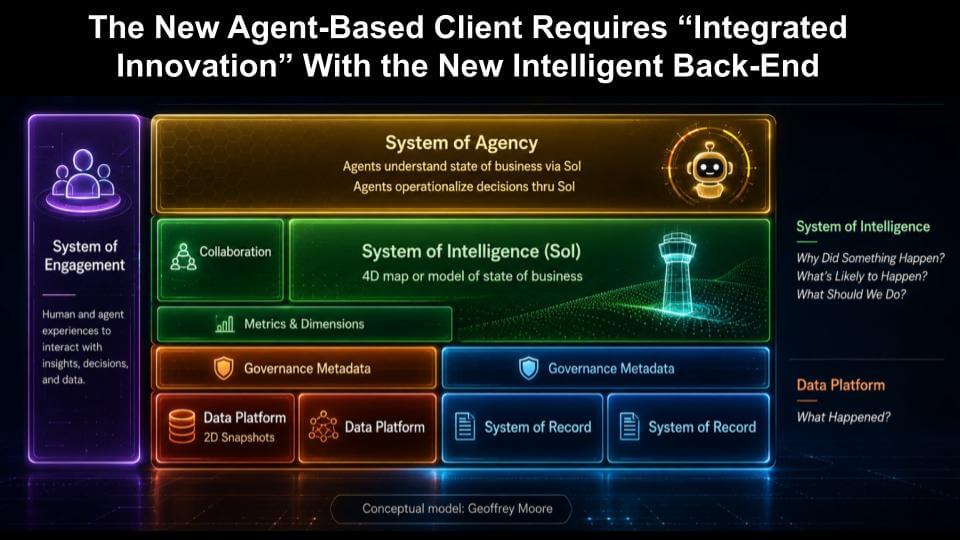
The rise of the new client and back-end is the same kind of architectural shift we saw in prior platform eras. Windows ultimately drove client-server computing. The browser drove web back-ends. Web and mobile clients drove cloud demand.
A key point here is that the modern data platform has already changed. Three years ago, we described a world where the data platform no longer necessarily owns the data. Databricks helped pioneer that shift with Delta, but the industry has increasingly coalesced around Iceberg, where Snowflake has taken a leadership role. Once the data platform no longer owns the data, the obvious question becomes: Is the modern data stack just an analytic compute engine? That is why value starts moving up into the governance and metadata layer – Horizon, Unity, and similar catalogs – where platforms begin adding meaning to data.
But catalogs are only an intermediate step. Horizon and Unity can define terms, capture metrics and dimensions, and start to describe relationships between entities such as customers, orders, line items, inventory, and fulfillment centers. Those definitions are critical because they give the system a vocabulary. But a System of Intelligence emerges when those definitions become live, executable code, and tied to the state of the business. At that point, the enterprise can start asking and answering higher-order questions, such as:
- Why did this happen?
- What is likely to happen next?
- What should we do now, under these constraints, in the current state of the business?
That is why the system of agency at the top of the slide, despite attracting much of the industry’s attention, is really driving the buildout of the system of intelligence underneath it. Agents need a world to operate in. They need a 4D map of the enterprise – a live model of business state, rules, context, constraints, and actions. Without that map, agent orchestration becomes an impressive demo with limited trust in production.
This back-end will not be built solely by armies of knowledge engineers manually modeling an intergalactic enterprise ontology. Some of it will be specified top-down. But much of it will be learned bottom-up through the system of engagement as business users and builders interact with the system.
That feedback loop is the aha moment:
- Business users ask questions, correct answers, create artifacts, define useful skills, and expose exception conditions.
- Builders create things such as pipelines, semantic views, and decide which agent traces are repeatable and should become business rules.
- Agents leave traces that show what context they used, what tools they invoked, and where they succeeded or failed.
- Shared skills and repeated workflows become candidates for governed assets.
This is why the agentic client and intelligent back-end have to be co-designed. The client needs the back-end for context and trust. The back-end needs the client because user and builder interactions are how the system learns how work actually gets done and how the business operates.
We saw the first version of this failure mode with RAG-based chatbots. Plugging an LLM into a vector database was interesting, but it did not deliver sufficient business value because the system lacked the deeper enterprise context required to reason and act. We are seeing the next version now with agent orchestration. The tooling is improving quickly, but orchestration alone cannot solve the trust problem. Agents need the System of Intelligence to understand business state and action boundaries.
The takeaway is that Snowflake’s opportunity is bigger than serving as a data platform with AI features. CoWork and CoCo become important because they are engagement surfaces that can feed back into the intelligence layer. The strategic question is whether Snowflake can integrate that loop faster and more coherently than Databricks, Microsoft, Google, OpenAI, Anthropic and the application vendors. The company that best co-designs the intelligent client with the intelligent back-end will have the strongest claim on the next enterprise software control point.
Snowflake CoWork as the business user client
Snowflake used Summit to clarify the split between its builder and business-user clients. Cortex Code is now CoCo, aimed at developers, data engineers, analysts and technical builders. Snowflake Intelligence is now CoWork, aimed at business users and knowledge workers. The naming may sound cute, and “cowork” is quickly becoming a crowded term in the market, but the strategic intent points to Snowflake trying to define the intelligent client for enterprise data work.
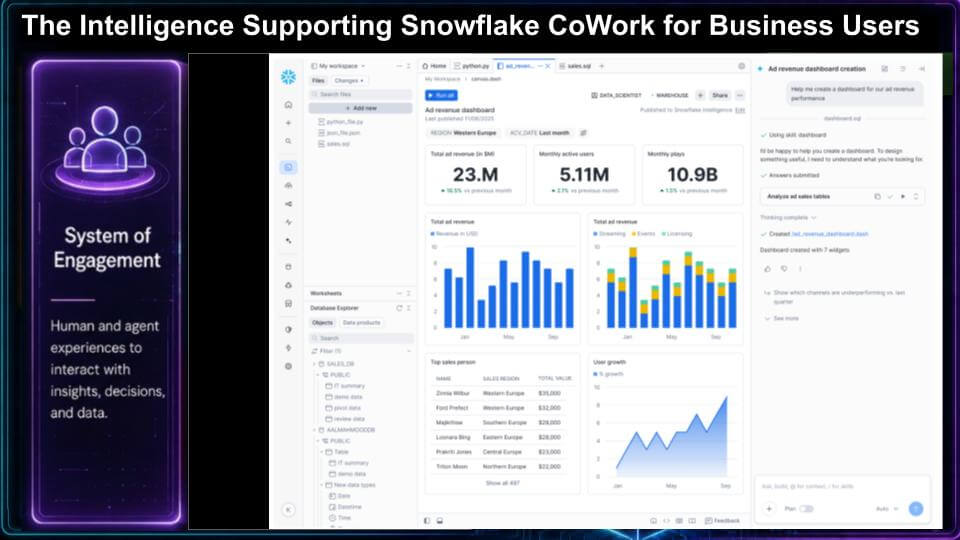
CoWork is critical because it shows how the system of engagement can feed the System of Intelligence. The business user interface becomes an input layer. Every question, correction, artifact, skill and shared workflow becomes a signal that can enrich the back-end intelligence model.
The near-term CoWork capabilities are useful in their own right:
- Deep research across enterprise data – not only web-based research, but structured Snowflake data combined with unstructured business information such as support notes, sales materials, documents and tacit knowledge;
- Artifacts and dashboards – generated visualizations, publishable dashboards and governed views of live, trusted data that teams can explore through conversation;
- Collaborative knowledge capture – analysts can create and publish rich artifacts, while business users can interact with them through natural language rather than only through clicks;
- Skills and reusable workflows – repeatable natural language instructions can be shared in a catalog and eventually become governed organizational capabilities;
- External application hooks – tools such as Excel and other familiar work surfaces become part of the broader engagement environment.
The deep research point is important because it plays to Snowflake’s wheelhouse. Snowflake already holds a large portion of the enterprise’s analytic data. That data becomes a magnet for related unstructured information. If a company has sales data, support data, usage data or financial data in Snowflake, the surrounding documents, comments, tickets and human explanations become more valuable when tied back to those trusted analytic objects. That is where deep research starts moving from generic synthesis to business-specific reasoning.
Artifacts are another key signal. We have seen artifacts in Claude and ChatGPT as generated objects – charts, code, documents, visualizations. In Snowflake’s context, artifacts can become governed dashboards and shared analytical workspaces backed by live data. A team can save the artifact, share it, collaborate around it and preserve context. That means the artifact is no longer just an output. It becomes reusable knowledge.
A skill starts out looking like a convenient feature – e.g. a repeatable instruction that helps a user get something done. But a shared skill can also become business logic. Once it is reused by a team, promoted into a catalog, governed, secured, and refined, it starts to look like the early form of business process logic. That is the bottom-up path from personal productivity to organizational intelligence.
Perhaps the more significant implication is that CoWork is part of a much richer client architecture. The screen above may show a dashboard, but the same logic can apply to a spreadsheet applet, a presentation or design layout applet, a workflow design canvas or an interactive business application. Hex and Sigma have been pushing in this direction with rich, interactive analytical canvases. Snowflake is now trying to bring that idea into a governed agentic work surface tied to enterprise data.
This also explains why Wall Street is rightly watching Microsoft Office. If coding agents can generate lightweight spreadsheet applets or presentation applets that are compatible with Office formats, even without reproducing every feature of Excel or PowerPoint, then Microsoft has to defend ownership of the canvas. The key strategic issue is who controls the container where applets, agents, dashboards, documents and workflows live. If Microsoft owns the canvas, it controls the boundaries of the applets. If Snowflake owns the data-centric canvas for analytical work, it can capture the interactions that enrich its System of Intelligence.
Anthropic’s MCP direction supports the thesis. MCP is evolving from tool connectivity toward richer user-interface support and back-end interaction. The client is becoming programmable. The backend is becoming intelligent. The boundary between user interface, agent harness, data platform and application logic is becoming more fluid.
That is why CoWork deserves attention beyond the product demo. It is Snowflake’s attempt to participate in the next intelligent client, the same way Windows, the browser and smartphones became defining clients in prior eras. The company that controls the engagement interface gets to observe how business users work, where they struggle, what they repeat, what they correct and which workflows become valuable enough to promote. Those interactions are exactly the feedback required to feed the System of Intelligence.
The bottom line is that CoWork is Snowflake’s business-user entry into the agentic system of engagement. CoCo serves builders. Together they give Snowflake two feedback channels into the intelligent back-end. If Snowflake can turn those signals into governed enterprise knowledge, CoWork becomes much more than an agentic interace to data. It becomes one side of the co-designed loop between the intelligent client and the intelligent back-end.
The intelligent back-end is where Snowflake maps to the SoI
The graphic below returns to the five-layer System of Intelligence model and maps what we heard at Snowflake Summit into that architecture. It is a live, governed representation of how the business works. For decades, the analytic DBMS was about ingesting, harmonizing, and activating summarized transactional data and interaction data – the “what happened” world, with clickstreams becoming the big new signal in the web era. The next layer is about ingesting, harmonizing, and activating intelligence and addressing why things happened, what is likely to happen next, and what should happen.
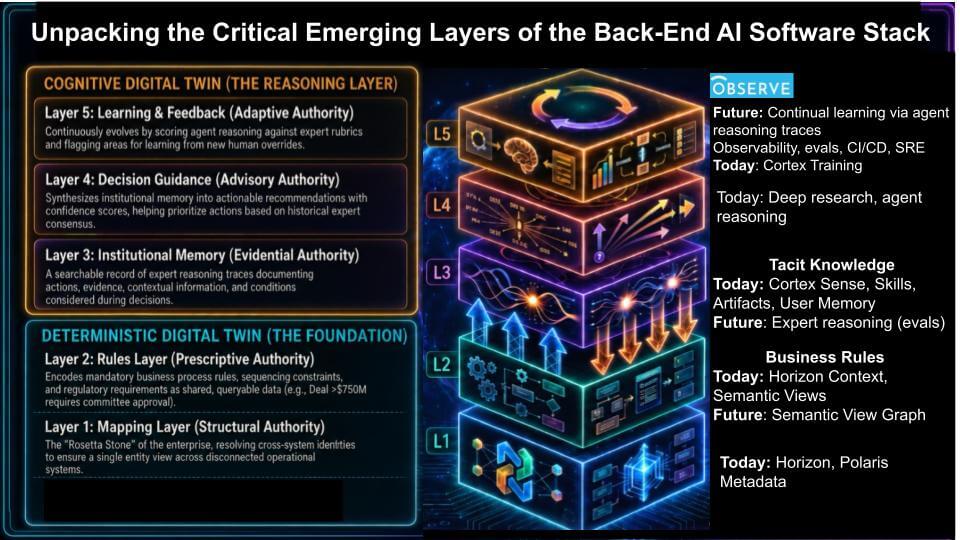
This intelligence becomes a company’s new crown jewels. For the last four decades, we said data was a core corporate asset. Now the higher-value asset is the combination of deterministic business rules and tacit knowledge. The deterministic rules live in the lower two layers of the model. The tacit knowledge lives in the upper three layers – the places where judgment takes over. That is the knowledge humans apply every day when they resolve exceptions, make calls under uncertain conditions and instinctively know what the process diagram doesn’t tell you.
The Snowflake mapping to the diagram above looks roughly like this:
- Layer 1 – Mapping: Horizon Catalog and Polaris Iceberg Catalog give Snowflake a way to map raw analytical data and external data into a governed structure;
- Layer 2 – Rules: Horizon Context and semantic views start to define business meaning, metrics, dimensions and governance rules;
- Layer 3 – Institutional memory: Cortex Sense, skills, artifacts, user memory and unstructured context begin capturing tacit knowledge and ambient business context;
- Layer 4 – Decision guidance: Agent reasoning begins synthesizing deterministic context and institutional memory into advice;
- Layer 5 – Learning and feedback: Cortex Training, Observe, evals and agent traces point toward the continual learning substrate.
The bottom two layers are where Snowflake is strongest today. Horizon and Polaris help map the underlying data estate. Horizon Context and semantic views add definitions and governance. But let’s be precise about the maturity levels. Today’s semantic views are still largely in the sphere of BI metrics and dimensions. They can define measures and clarify how data should be interpreted. Over time, that has to evolve into something richer – a semantic view graph that ties metrics, entities and relationships together. But metrics just give users measurements. A full ontology starts to describe the rules of the business.
To be more specific. A metric definition can tell you how to calculate revenue. A business ontology can capture the rules currently trapped inside operational applications such as SAP, Salesforce, Workday, ServiceNow, and custom systems. The System of Intelligence has to treat those rules as assets, the same way data platforms learned to treat data as an asset.
Layer three is where Snowflake’s story starts to get more interesting and more speculative. Cortex Sense enriches Horizon Context by pulling in unstructured knowledge, ambient context, skills, artifacts and user memory. We see this as an early move toward capturing tacit knowledge. The important point is that tacit knowledge is not just documents sitting in a repository. It is the accumulated context around how work gets done, what people mean, which definitions are authoritative, what users repeatedly correct and which workflows become reusable.
This is where skills become more important than they first appear. A skill may begin as a repeatable instruction in CoWork or CoCo, but once it is shared, governed and reused, it becomes an asset. It becomes part of the organization’s operating knowledge.
Layer four is where judgment begins to show up as guidance. A user or agent looks at the deterministic foundation – the mapped entities, governed data and explicit rules – and combines that with institutional memory from layer three. The system can then advise – e.g. given what we know about the current state of the business and how similar situations were handled before, what should we do now? This is the layer that begins to turn context into recommendations.
Layer five is the least appreciated and potentially the most strategic. Snowflake’s Cortex Training points in this direction, and the Observe acquisition makes much more sense in this context. Microsoft Build also reinforced the same point in that if enterprises are going to tune and improve agents on their own data, they need an observability layer that captures the reasoning traces of those agents.
Think of reasoning traces as the new exhaust. In the web era, clickstreams became the raw material for analytics. In the agentic era, the raw material becomes what the agent reasoned, what context it pulled, what tools it called, what came back, what action it took and whether the outcome was good. That becomes the system of truth for agent reasoning.
The critical disciplines start converging:
- Observability – what happened and where did the agent fail?
- Evals – did the agent reason well against the rubric?
- CI/CD – can a new version of the agent be released without regression?
- SRE for agents – can another system diagnose and remediate agent failures in real time?
- Continual learning – can the system improve from eval-scored traces, human corrections, and outcomes?
This is why the intelligent client and intelligent back-end have to be co-designed. The back-end does not get built by simply ingesting data from pipelines and catalogs. It learns from business users, builders and agents. CoWork and CoCo generate signals. Skills become reusable logic. Artifacts preserve context. Query history reveals intent. Agent traces reveal reasoning. Human corrections become training material. The SoI is part specified and part learned.
The bottom line is that Snowflake has credible pieces across all five layers, but the maturity is mixed. It is strongest in mapping, governance metadata and early context. It is moving into decision guidance through CoWork, Cortex Sense and prebuilt agents. It is laying the groundwork for learning through Observe, evals, telemetry and Cortex Training. The harder work remains business process logic, expert reasoning, institutional memory and the crystallization of repeated actions into governed rules. That is the road from a data platform with AI capabilities to a true System of Intelligence.
Horizon Context goes from catalog to one layer of the System of Intelligence
Snowflake has been moving toward this point for some time. Years ago, the question around Horizon and Polaris was largely about open governance, open table formats and how Snowflake would protect its monetization engine while expanding into a more open data architecture. That debate still persists, but the center of gravity has shifted. Horizon is no longer just about governing Snowflake data or reconciling Snowflake’s proprietary value with the Polaris/Iceberg ecosystem. With Horizon Context, Snowflake is trying to turn catalog metadata into active context for AI, BI, applications and agents.
The graphic below shows the following flow: collect, enrich, activate. Horizon Context pulls metadata from Snowflake, data lakes, SaaS systems, databases, BI and ETL tools. It then enriches that metadata with interaction data from CoWork and Coco in the form of lineage, popularity, descriptions, tags, semantic views and a business glossary. Finally, it activates that context back through CoCo, CoWork, Cortex Agents and BI tools. That activation step is critical because context becomes valuable when it changes the quality, cost and trustworthiness of what users and agents do.
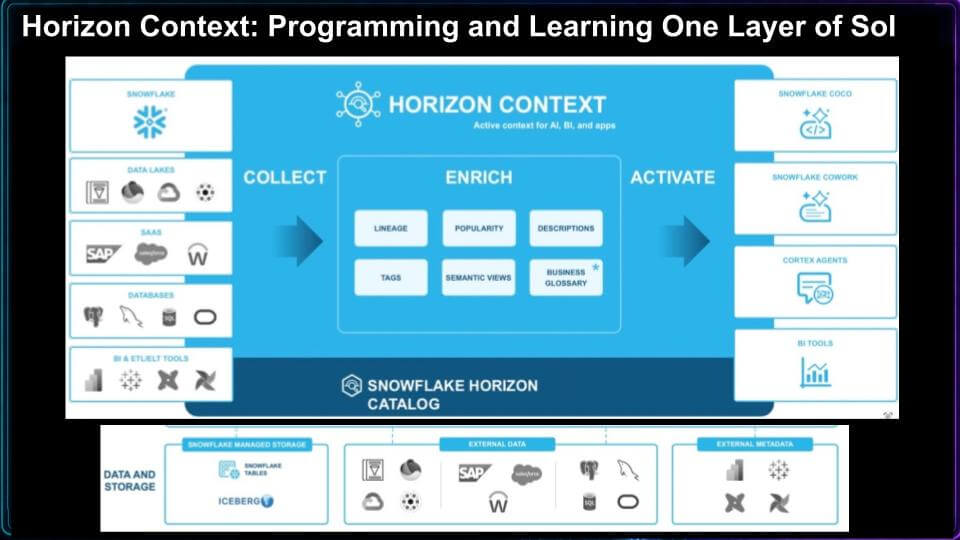
The following key capabilities are ones to watch:
- Lineage – where data came from, how it moved and what downstream assets depend on it;
- Popularity – which data assets are actually used, by whom and in what context;
- Semantic views – business definitions for metrics and dimensions;
- Business glossary – shared terminology that helps business users ask questions in natural language;
- Descriptions and tags – metadata that improves discoverability, governance and agent grounding.
This is an important step toward the System of Intelligence, but it is still early. Horizon Context can help standardize definitions, improve natural language querying and reduce ambiguity around metrics. A business glossary can tell users and agents what “customer” and “active account” mean. Semantic views can help normalize the measures and dimensions that power BI and agentic analytics. Those are important capabilities because they give the intelligent client better grounding.
The next step is much more challenging, technically. A glossary and metric layer define terms. A full ontology captures business process rules and relationships. That means representing how customers, orders, inventory, contracts, approvals, exceptions, risks and workflows interact. It means modeling the verbs of the business, not just the nouns. That is what ultimately gets us closer to the enterprise digital twin.
Snowflake’s open question is both technical and strategic. Specifically, how far can a relational data platform go in supporting a true ontology? Relational databases have historically struggled with rich graph-like business representations when the model becomes highly connected and dynamic. Snowflake may be able to constrain the problem and make it work in practical terms. It may partner. It may build more of the ontology layer itself. But this is where we need more clarity. The company has strong foundations in governance, metadata and semantic definitions; the harder question is how snowflake evolves from semantic views and glossary terms toward full business process modeling.
The most important nuance on the above slide is that Horizon Context is not only specified top down. It is also learned from usage. Popularity, lineage, query history, user behavior and interaction patterns become signals for harmonization. If there are five definitions of daily active user, the system can start to infer which definition is authoritative based on who uses it, where it appears, how fresh it is and how often it is reused. If there is ambiguity, the system can propose choices to a user or builder and use that interaction to refine the context layer. Or the system can impose that choice based on previous reconciliations.
That is the co-design loop in practice. The system improves as users ask questions, resolve conflicts, promote definitions, share artifacts and turn repeatable workflows into governed assets.
The bottom line is that Horizon Context is one of Snowflake’s most important moves toward the SoI. It takes Horizon beyond cataloging and into active business context. But we should be clear that it is immature. Today it is strongest at metadata, lineage, governance, semantic views and business glossary, which shows good progress from two years ago. But we feel the future is the full ontology.
Bidirectional learning: SoE and SoI Co-design and innovation
The slide below captures the closed loop that makes the agentic client and the System of Intelligence mutually reinforcing. On the left is the system of engagement – the place where business users, builders and agents interact with insights, decisions and data. On the right is the System of Intelligence – the emerging digital twin / 4D map of the business. The orange arrow going from left to right represents user intent and decisions flowing into the SoI. The green arrow coming back represents the SoI learning, asking questions and improving the experience in the client. This is the integrated innovation point we consistently stress. Specifically, the intelligent client and intelligent back-end have to be built together because each one teaches the other.
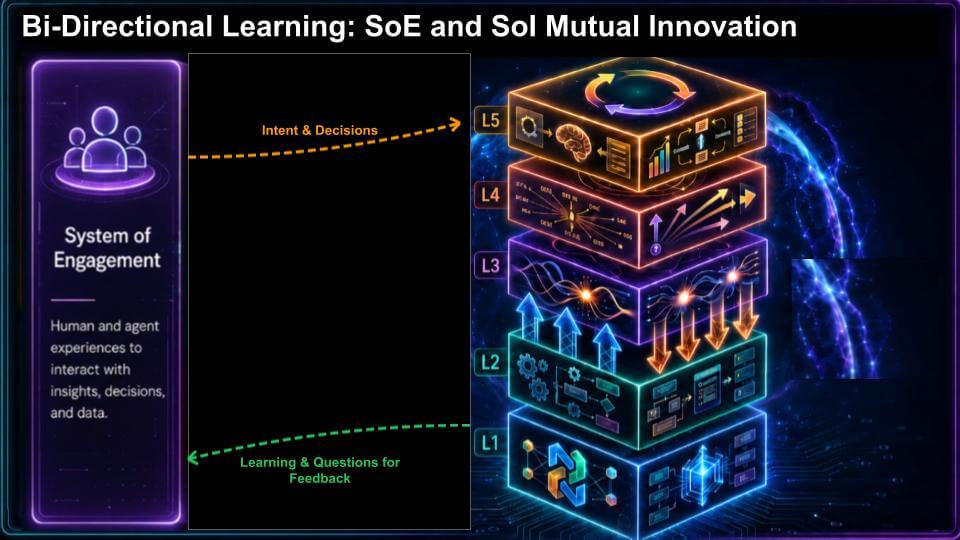
The mechanism is profound in our opinion. When a user asks a question, builds an artifact, creates a skill, approves an action, rejects a recommendation, or corrects an answer, that interaction becomes a signal to the SoI. It may become memory. It may become a reusable skill. It may become evidence that helps disambiguate definitions inside the SoI. Over time, those interactions help the system understand what the business actually means when people use terms like customer, revenue, churn, active user, bookings or customer lifetime value.
A simple example is customer lifetime value (LTV). Many companies have more than one definition of LTV. Finance may calculate it one way, marketing another way, customer success a third way. A mature SoI should be able to surface the conflict and say, in effect: “we have two definitions of customer lifetime value, here is the derivation for each, here is where each one is used, here is which one is more authoritative in this business context – which should we standardize around?” That interaction becomes part of the harmonization process. The system learns from the business user, and the business user gets a better governed experience the next time.
The key sequence we envision follows:
- Intent and decisions flow into the SoI – questions, approvals, corrections, workflows, artifacts and skills become signals;
- The SoI refines enterprise context – definitions, memory, relationships, rules and ambiguity get clarified over time;
- The SoI feeds the system of engagement – better context improves answers, recommendations, dashboards, skills and actions;
- The client becomes a teaching mechanism – business users and builders help train the enterprise intelligence layer through normal work.
This is why the system of engagement is strategically important. It is where intent is expressed. It is where users reveal what they are trying to accomplish, what definitions they trust, what actions they approve, where the system gets confused and which workflows are worth repeating. A platform that owns that client has a privileged view of how work actually happens. That view becomes critical input for the System of Intelligence.
It also explains why OpenAI and Anthropic will almost certainly need to move deeper into a system of intelligence. They have powerful models and increasingly capable agent harnesses. But building the back-end SoI is a very different business from building a frontier model, a coding harness or a general-purpose agent.
The same tension applies in the other direction. Snowflake and Databricks have historically built data platforms, catalogs and governance layers. Competing for the system of engagement is a different business. CoWork, CoCo, Genie and similar experiences require product design, collaboration, memory, skill catalogs, artifacts, interaction flows and agentic work surfaces with which users actually want to interact. The data platform vendors are moving upward; the model makers are moving downward. Each is entering the other’s turf.
Our view is that this bidirectional learning loop will determine the next control point in enterprise software. The winning architecture will be defined by who can connect user intent, business context, governed action and continuous learning into a single reinforcing system. That is how we see an organization moves from isolated agent productivity to enterprise intelligence.
Horizon Context is where the back-end learns from builders and business users
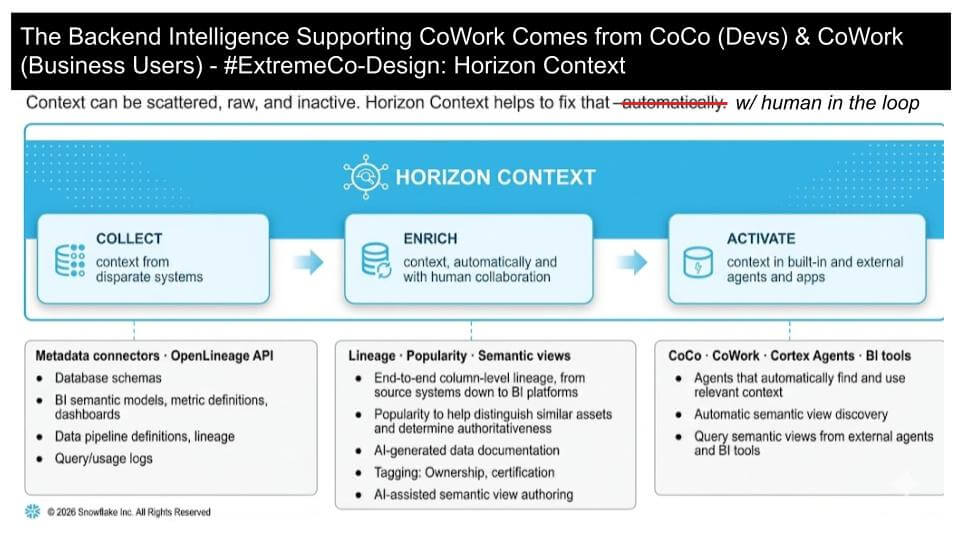
The graphic below gets to the heart of integrated innovation. Horizon Context is presented as a clean collect-enrich-activate flow, but the important point on the slide is the strike-through on “automatically” and the replacement words “w/ human in the loop.” The point is building the System of Intelligence is not a purely automated cataloging exercise. The back-end can collect metadata, infer patterns and suggest harmonization, but business meaning still comes from the people who understand the domain and the builders who encode how work actually gets done.
Snowflake has been moving toward this point for years.
The slide shows three steps:
- Collect: Pull context from disparate systems – databases, BI tools, ETL processes, schemas, dashboards, pipeline definitions, lineage and query logs;
- Enrich: Add business meaning – lineage, popularity, semantic views, descriptions, business glossary, tags, ownership and certification;
- Activate: Make that context usable in CoCo, CoWork, Cortex Agents and BI tools so agents can produce better answers and take more trustworthy action.
The human-in-the-loop point show up in the business glossary. Shared definitions do not appear magically. A domain expert, business user or builder has to validate what a term means, where it applies and when an exception is warranted. The same is true for semantic views. Snowflake can infer a great deal from query history, Power BI dashboards, Tableau reports, dbt models and pipeline definitions, but human review is still required to turn inferred structure into trusted enterprise context.
The future state is a richer ontology that captures business processes, rules and relationships – the digital twin we keep coming back to. That is much harder than building a glossary or a semantic layer. Enterprises have tried for 30 years to create top-down enterprise data models, and those efforts generally fail because the business changes faster than the modelers can keep up. The lesson is that the System of Intelligence has to be partly specified and partly learned.
That is why user skills are so important. A business user or builder may create a repeatable workflow in CoWork or CoCo. At first, that skill is local – a personal or team-level automation. If it proves useful, it gets shared in a catalog. Once it is shared, it becomes logic. Once it is governed, harmonized and reused, it starts becoming part of the organization’s operating knowledge. Over time, a collection of skills becomes one path toward building the ontology from the bottom up.
The system will still fail to harmonize everything on its own. That is where the intelligent client becomes essential. When Horizon Context detects ambiguity – for example, multiple definitions of customer lifetime value, daily active user or qualified pipeline – it can propose what it sees and ask a human or builder to disambiguate. “Here are the definitions we found. Here is where each is used. Here is the lineage and popularity. Which one applies to this business context?” That interaction becomes part of the intelligence layer.
This is the deeper meaning of co-design. CoCo and CoWork are not just front ends that consume Horizon Context. They are teaching surfaces. Builders create pipelines, data products and skills. Business users ask questions, correct answers, approve actions and share artifacts. Those interactions flow back into Horizon Context and Cortex Sense, where they help refine semantics, resolve conflicts and promote useful patterns into governed assets.
The bottom line is that Horizon Context is one of Snowflake’s most important moves toward the System of Intelligence, but the operative phrase is with human collaboration. The back-end collects and enriches context; the client captures intent, correction and workflow logic; the enterprise gets smarter when those two sides operate as one loop. That is why the agentic client and intelligent back-end have to be built together.
Atlan example shows what the context layer could become
This slide below uses Atlan as a proxy for something Snowflake did not yet show as clearly in our view. Specifically, what a richer enterprise context layer looks like when it connects metadata, semantics, ontology, skills, agents and feedback into one compounding system. The point is not that Atlan “is” Snowflake’s System of Intelligence. The point is that Atlan’s visual gives us a more complete picture of where Snowflake’s Horizon Context and Cortex Sense appear to be heading.
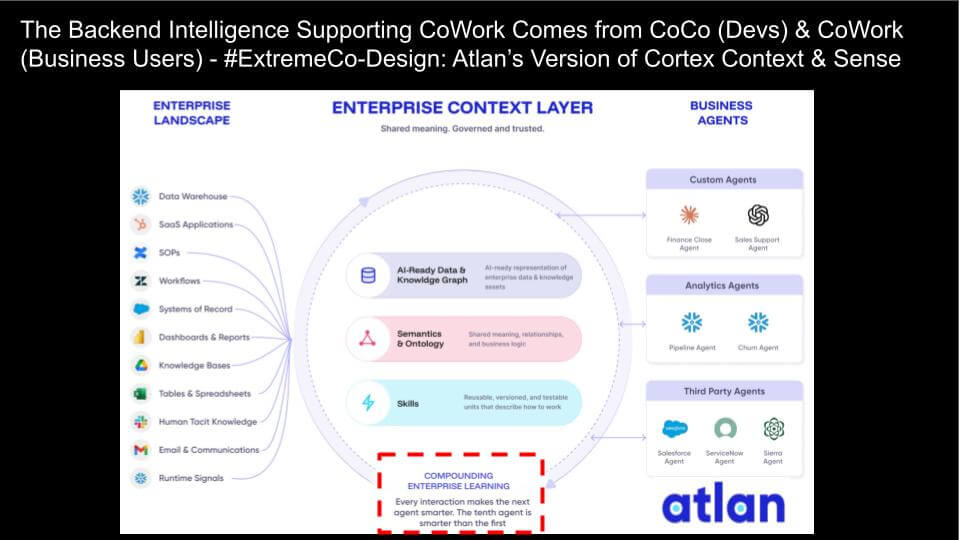
A firsthand walkthrough at Atlan’s booth at Snowflake Summit reinforced this point. The demo showed capabilities that seemed to go beyond what Snowflake can do natively today. Atlan’s product manager walked us through how the system handles conflicting definitions, surfaces the agreed-upon metric, forces clarity around a single metric of truth, and learns from exceptions over time. That is important to our premise because the hardest part of the System of Intelligence is not merely ingesting metadata. It is harmonizing meaning across messy enterprise environments where different teams use different definitions, different dashboards, different pipelines and different business assumptions.
The slide above shows Atlan’s enterprise context layer sitting between a fragmented enterprise landscape and multiple categories of agents. On the left are the raw inputs such as data warehouses, SaaS applications, SOPs, workflows, systems of record, dashboards and reports, knowledge bases, tables and spreadsheets, human tacit knowledge, email and communications, and runtime indicators. In the middle are the context-building layers like AI-ready data and knowledge graph, semantics and ontology, and skills. On the right are the consumers of that context such as custom agents, analytics agents and third-party agents such as Salesforce, ServiceNow and Sierra-style agents.
The important technical transition is from semantic views to semantic graphs. Semantic views are useful, but narrow. They define metrics and dimensions. Semantic graphs begin to express how those metrics relate to each other and how they connect to business entities. Customer lifetime value connects to sales, profitability, retention, service history, product usage, support tickets and other business objects. Once those relationships are explicit, AI can traverse them and answer better “why” questions.
The follow key ideas are worth emphasizing:
- Metadata ingestion is the starting point, not the destination;
- Semantic views define metrics and dimensions;
- Semantic graphs connect metrics, entities and business relationships;
- Skills capture repeatable work and begin to encode organizational logic;
- Every user and agent interaction sharpens the context layer.
This is why the Atlan example is so useful. It shows compounding enterprise learning in a way that is easy to understand. Every interaction makes the next agent smarter. Every dashboard, definition, correction, exception, workflow and skill becomes a signal. The system is not just cataloging the enterprise; it is learning how the enterprise uses data and meaning in practice.
Atlan’s position is also interesting strategically. It is a third party selling into the Snowflake base, which creates both opportunity and tension. It can add richness above Snowflake and operate across multiple engines, not just Snowflake. That is valuable for customers with heterogeneous estates. But it also highlights the gap Snowflake is trying to close with Horizon Context and Cortex Sense. If Snowflake can build enough of this context layer natively, it can preserve more of the value. If not, partners such as Atlan become critical, and potentially very powerful, in the ecosystem.
The broader implication is that the System of Intelligence will likely be assembled in layers. Snowflake brings governed data gravity, Horizon, Cortex Sense, CoWork and CoCo. Atlan brings a richer cross-system context and semantic graph layer. Application vendors bring process context. Model providers bring frontier reasoning and agent harnesses. Customers will need these pieces to work together without creating yet another set of intelligence silos.
The key takeaway is that Atlan gives us a clearer picture of the road ahead. The context layer has to ingest from many systems, represent business meaning, reconcile conflicts, learn from usage and feed agents with trusted enterprise context. Snowflake is moving in this direction, but Atlan shows that the ecosystem is already filling in the gaps. That makes the Snowflake opportunity larger, but also more competitive. The ultimate prize in our view is goes beyond the catalog. It’s the compounding context layer that turns fragmented enterprise knowledge into agent-ready intelligence.
Atlan example highlights the learning loop
The Atlan architecture is instructive because it shows the loop we think every serious System of Intelligence vendor will have to build. Snowflake describes this through Horizon Context and Cortex Sense; Atlan labels it as an AI context layer. Different vocabulary but the same strategic direction in that context is mined from enterprise systems, enriched into a foundation of data, semantics, ontology and skills, activated through agents and applications, then improved through continuous feedback.
This is where the focus becomes much more than metadata. The left side of the Atlan slide below shows the raw enterprise landscape with systems of record, systems of data, systems of knowledge, systems of work and runtime signals. In Snowflake terms, that includes the data platform, semantic views, query history, catalogs, BI assets and external systems such as Power BI, dbt and others. The goal is to build context across all of it so the enterprise does not simply create another set of disconnected intelligence islands.
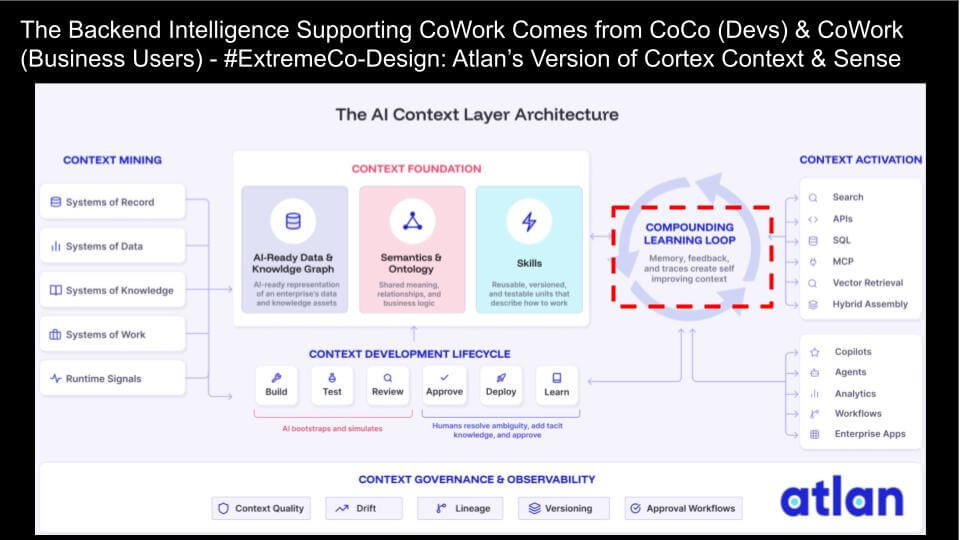
The key mechanism is the compounding learning loop. A platform such as Cortex Sense or Atlan’s context foundation starts by ingesting and inferring context. It finds conflicts – for example, five definitions of daily active user, multiple versions of lifetime value, or competing metrics that mean different things to different teams. Then a builder or domain expert guides the system through disambiguation. Which definition is authoritative? Which applies in this business context? Which one should become governed, and which should remain local?
That human role remains fundamental:
- Builders connect systems such as Power BI, dbt, query history, semantic views and catalogs;
- The context layer finds conflicts, gaps and hidden relationships;
- Business users in CoWork ask questions that fall outside existing semantic views or document intelligence;
- Builders inspect those failures and decide where the context foundation needs to be expanded;
- User memory, user skills, artifacts and repeated queries become signals that refine the model.
This is why the feedback loop is so critical. The richer the context foundation becomes, the richer the user interaction becomes. And the richer the interaction becomes, the better the feedback. A business user asks a question the semantic layer cannot answer. That gap becomes a signal. A builder creates a skill to solve a recurring workflow. That skill becomes reusable logic. A team repeatedly uses one definition of a metric and ignores another. Popularity and usage become evidence. Over time, the system learns which context is fresh, authoritative, trusted and relevant.
Atlan is important here because it is showing a cross-system version of this architecture. It is trying to sit above multiple engines and systems, bringing together semantics, skills, and governance across the enterprise landscape. That gives customers a richer context layer today than Snowflake appears to provide natively in some areas. It also gives Snowflake a roadmap problem and an ecosystem opportunity at the same time.
The strategic tension is that Snowflake needs partners because no single vendor can model the whole enterprise on its own. But Snowflake also needs to capture more of the context, learning and activation loop because that is where pricing power and strategic control will migrate. The company’s challenge is to preserve ecosystem leverage while ensuring Horizon, Cortex Sense, CoWork and CoCo become central to the compounding learning system – not just inputs to someone else’s System of Intelligence.
The takeaway is that the backend intelligence layer will be built through interaction. It will be specified by architects, enriched by builders, corrected by business users and continuously improved by agents. Atlan’s slide demonstrates that loop in explicit terms. Snowflake’s opportunity is to make that loop native, governed and deeply connected to its data gravity before the ecosystem around it hardens into a separate control layer.
Context and Sense: How the SoI matures in nine stages
The slide below focuses on the maturity model we introduced last week and ties it directly to what we saw at Snowflake Summit. The point is that Horizon Context and Cortex Sense sit in the early stages of a much larger System of Intelligence journey. They help customers move from cataloged data and semantic definitions toward a richer model of how the business actually operates. This implies in the age of agents, everything depends on the scope and fidelity of the enterprise data model. How well the model represents the business determines what questions the analytics layer can answer, and that in turn determines how much confidence an agent can have when it recommends or takes action.
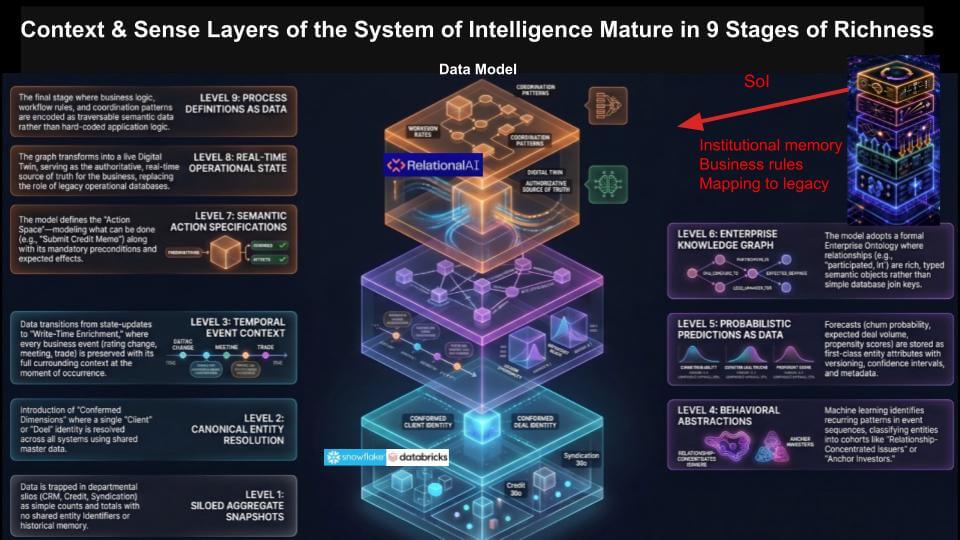
We are unpacking the bottom three layers of the System of Intelligence above, in particular the mapping layer, the rules layer and the beginning of institutional memory. These represent the rules about how the business runs, along with the first layer of tacit knowledge that applies when rules are incomplete, ambiguous or conflicting. This is where Snowflake’s Horizon Context and Cortex Sense are aimed today. They are early, but they are directionally important because they start to move the platform beyond “data about the business” toward a live model of the business.
The nine levels are a way to make that journey real are as follows:
- Level 1: Siloed aggregate snapshots – Classic BI reporting cubes, metrics and dimensions. This is the world of departmental dashboards and semantic views. Snowflake semantic views and the expected Databricks Unity Metrics push belong here initially, because they help standardize measures but still operate mostly in the reporting layer;
- Level 2: Canonical entity resolution – The enterprise begins harmonizing entities so there is one customer, one account, one product or one supplier across the estate. This is the master data management problem, but now it becomes foundational for AI because agents need a consistent view of the entities they are reasoning about;
- Level 3: Temporal event context – Events become first-class data. Streaming updates and real-time event flows update tables and context continuously. In an e-commerce scenario, customer interactions can update recommended products in real time as the customer moves through the digital experience;
- Level 4: Behavioral abstractions – The system begins to classify behavior. Customers become high-value shoppers, deal-driven replenishers, likely churners or suspected fraudsters. The model starts to recognize patterns, not just record transactions;
- Level 5: Probabilistic predictions as data – Predictions become part of the data model. A specific customer is likely to buy, churn, upgrade or default, and the enterprise can decide how to treat that customer in real time based on confidence scores and context;
- Level 6: Enterprise knowledge graph – The model represents a web of related things. A customer connects to an order, the order connects to SKUs, the SKUs connect to promotions, inventory, fulfillment centers, carriers and payment status. This is where relationship modeling becomes essential because the business is no longer represented as flat tables alone.
The next three levels are where the model crosses over from context into operational intelligence.
At Level 7, the business starts modeling actions. A sale is no longer just a record or a forecast. It becomes a set of possible moves – e.g., apply a promotion, reserve inventory, authorize payment, split the shipment, notify the customer, escalate the case or pause the transaction. The important point is that each action has preconditions and effects. The system understands what must be true before an action can happen and what changes after the action occurs.
At Level 8, the model becomes a live representation of the business. The enterprise is no longer pointing at external applications and trying to reconcile them after the fact. The state of the sale, the customer, the inventory, the payment authorization and the fulfillment path are represented in real time. This is the stage where, in the long run, parts of the operational application estate can be unplugged or subordinated because the System of Intelligence becomes the live operating substrate.
At Level 9, process definitions become data. The rules about how the business runs are managed as data, not buried in code deployments or application logic. Changing how a sale runs becomes a data update. Analytics can optimize the process itself. This is the farthest-out stage, but it is the direction of a robust roadmap – i.e., a business that can inspect, simulate and improve its own operating logic.
This is why we keep coming back to the maturity curve. Snowflake’s Horizon Context, semantic views, business glossary work and Cortex Sense are solid early steps, especially around levels one through three and parts of level four. But the higher-value layers require much richer business modeling. Metrics and dimensions give the system measures. Entity resolution gives the system nouns. A full System of Intelligence eventually has to model verbs – the actions, preconditions, effects, exceptions and process rules that define how the enterprise actually runs.
The practical implication for customers is that “AI-ready data” has to mean more than clean tables and well-governed access. It has to mean a progressive enrichment of the business model:
- From reports to entities;
- From entities to events;
- From events to behaviors;
- From behaviors to predictions;
- From predictions to relationships;
- From relationships to actions;
- From actions to live state;
- From live state to process logic.
That progression is what lets enterprises move from asking what happened, to understanding why it happened, to predicting what will happen next, to deciding what should be done, and eventually to letting agents act within governed boundaries. Snowflake is building important foundations for that journey. The strategic question is how far up this maturity curve Snowflake can go before business process logic remains locked in SAP, Salesforce, Workday, ServiceNow and other systems of record – or gets captured by a different System of Intelligence provider.
Context and Sense: Analytics maturity follows the richness of the business model
The slide below shows why Horizon Context, Cortex Sense and similar context layers are so important to this analysis. As the enterprise model becomes richer, the questions the business can ask become more sophisticated. The point is the maturity of the context layer determines the maturity of the analytics layer, and the maturity of analytics determines how much confidence humans and agents can have in taking action.
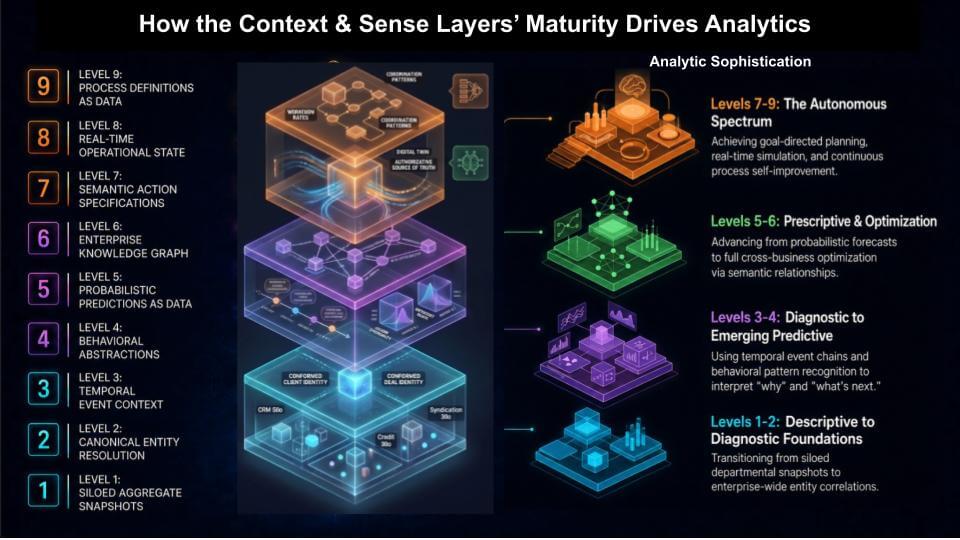
At the lower levels, the enterprise is still in the familiar BI world. Levels one and two are descriptive foundations that tell us what happened, how many, where, and by whom. The system can count and aggregate, first inside a silo and then across departments once entities are harmonized. In the Maria example, this looks like asking what Maria bought during the spring promotion, or whether gold-tier customers who bought during the campaign spend more per order than bronze customers. Useful, but still limited. The system can tell us the sale happened; it cannot yet explain the sequence of events that caused it.
Levels three and four begin the move from descriptive analytics into diagnostic and emerging predictive analytics. Events are preserved in temporal order and behavioral labels get layered on top. Now the system can ask why Maria’s tent purchase converted so quickly. At level four, the pattern gets a name: Maria is a deal-driven replenisher. That label tells us the model is starting to interpret behavior rather than simply count transactions. The enterprise now begins to understand the “why” behind the result.
Levels five and six move into prescriptive and optimization territory. At level five, each entity carries continuously updated predictions. Maria may have a 68% probability of repurchasing in this category within 30 days. At level six, the relationships become traversable. The system sees Maria, her purchase, the promotion, the fulfillment history, the carrier record, the service experience and the customer value model in relationship to one another. The analysis can evolve from “Maria may repurchase” to “Maria has a 68% repurchase probability and a 19% churn risk driven by two late deliveries, so a free-shipping offer may lift retained value by a measurable amount.”
The upper levels are where analytics starts to become operational. At levels seven through nine, the system understands the business’s possibility space, live state and operating logic:
- Level 7: the options are knowable. The system can ask which orders currently mid-checkout during the spring sale are eligible for split shipment and what delivery-time effect each option would create;
- Level 8: the present is knowable. The system can see how much tent inventory remains right now, how many carts contain one, which fulfillment centers are at capacity and where carrier delays are emerging;
- Level 9: the operating logic is knowable. The system can inspect the defined path from cart to settlement, identify the rules that govern each transition and show where orders stall versus where the business assumed they would.
The point is levels one and two count the sale; levels three and four explain it; levels five and six prescribe and quantify behavior around it; levels seven through nine act on and improve the process. Each band is unlocked by the representational sophistication of the data model underneath it.
That is why “context” cannot be treated as a marketing word. If Context and Sense only capture metrics and dimensions, the analytics ceiling is low. If they capture events, behaviors, relationships, predictions, actions, live state and process logic, the enterprise moves toward a much richer form of intelligence. That is the path from asking what happened, to understanding why it happened, to knowing what should happen next and eventually to improving how the business runs.
Actionability: agents can only do what the data model makes safe
This final slide below completes the picture. First, we described the maturity of the business model. Then we showed how that maturity drives analytic sophistication. Now we get to the question that matters most in the agentic era: What can an agent actually do?
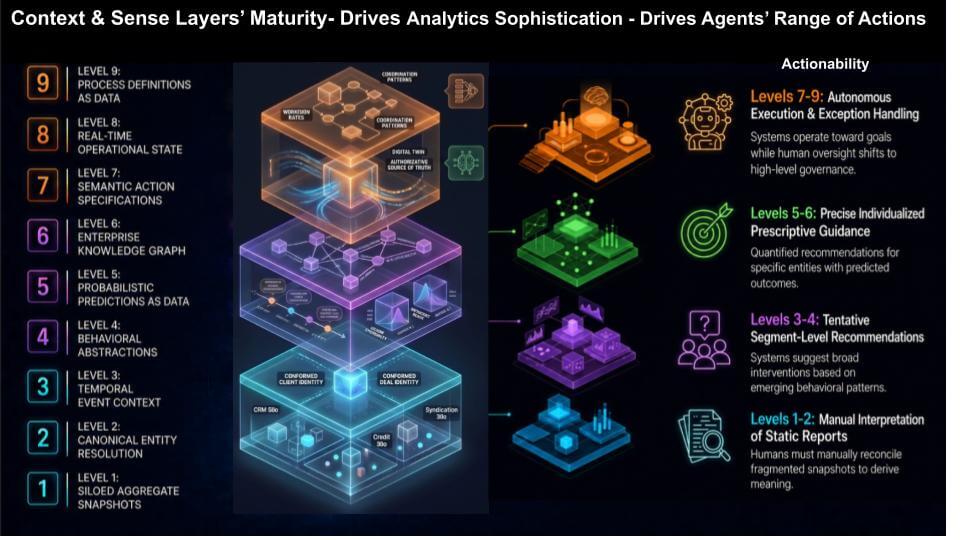
The answer is that agent action is gated by the richness of the underlying data model and the analytics built on top of it. A frontier model can reason, but an enterprise agent cannot safely act unless the system gives it a reliable view of business state, policy, context, available actions and expected effects. Each level of maturity supports a different range of “doing.”
At levels one and two, the system is still mostly reporting. Metrics and dimensions let a user ask questions and get dashboards or conversational answers. This is the “talk to your data” phase. It is useful, but action remains human-driven because the system can report on the state of the business without understanding enough about the process to intervene.
At levels three and four, the system begins making segment-level recommendations. This is where a platform such as Salesforce Data Cloud has an advantage in customer contexts because it understands enough about customer data to model customer actionability. The system might identify that customers showing Maria’s “hesitation broken by promotion” pattern convert three times better when sent a discount within 48 hours. That is a real recommendation, but it is cohort-based and heuristic. A human marketer still pulls the trigger, even if an agent later executes the campaign.
At levels five and six, recommendations become individualized and quantified. Every entity carries calibrated predictions. The system can say: issue Maria free shipping because it is predicted to cut her churn risk from 19% to 7%. That is a much richer action signal because it is tied to a specific person, a specific predicted outcome and a specific intervention. Humans still decide, but the system is now giving decision-grade guidance.
At levels seven through nine, the action model changes materially. Agents begin to discover, compose and execute within governance bounds:
- Level seven – actions are modeled. The agent can reason about an action space, such as retaining Maria at an acceptable margin by resolving her open delivery complaint and then issuing a retention offer;
- Level eight – action happens against live state. If the tent goes out of stock mid-flow, the agent can substitute or recommend an alternative rather than firing off an offer the company cannot fulfill;
- Level nine – process becomes data. The agent can observe that resolving complaints before offering promotions retains deal-driven buyers more effectively and can recommend improvements to the process itself.
This is where human oversight changes. Early on, humans approve each step. Later, humans increasingly handle exceptions, govern boundaries and refine the system. The role of the human remains important, but it moves up the stack toward judgment, policy, exception handling and teaching the system.
The point is that we move from humans interpreting static reports to systems recommending segment-level actions to quantified individual guidance to agents planning, executing and improving processes under governance. That is the progression from reporting to action.
This is also where the concept of a “learning enterprise” starts to come into view. Ongoing interactions with business users, consumers, builders and agents create traces of activity. Those traces enrich the model of the business over time. A richer business model enables richer analytics. Richer analytics allow agents to observe, orient, decide and act with greater confidence and less manual oversight.
That is the process and the prize.
Closing thought
We believe this gives a clearer picture of how the AI software stack is evolving and why the competitive landscape is shifting so quickly. This is not the end destination. Databricks Data + AI Summit is still ahead, and we will continue examining the frontier model players and the debate around whether OpenAI, Anthropic and others are better positioned than the data platform vendors to own the System of Intelligence.
For now, Snowflake is in focus and makes a great case study. A few years ago, Snowflake looked boxed into analytics – a strong business, but increasingly seen as modern data legacy in a post-ChatGPT world. Under Sridhar Ramaswamy, that perception has changed. The innovation engine appears to be humming. CoWork, CoCo, Horizon Context, Cortex Sense, Observe and the broader agent control plane all suggest Snowflake understands the prize.
We still think Snowflake could articulate a more explicit vision around the System of Intelligence and the enterprise digital twin. But the company clearly understands what is at stake – i.e., the need to preserve the core data business, move up the stack and capture a larger role in the agentic enterprise before model makers, application vendors, hyperscalers or ontology players harden the stack around it.
Action item
Data pros should stop treating AI readiness as a data modeling problem and start building the governed intelligence layer agents need to reason and act. That means capturing the interaction between specifying and learning: lineage and popularity signals, core entities across systems, defining semantic views, exposing trusted metrics, and beginning to encode business rules, workflows and tacit knowledge as governed assets. Clean tables and dashboards are no longer enough; the job is to make the state of the enterprise human and agent-readable, and eventually executable. Snowflake’s Horizon, Cortex Sense, CoWork, CoCo and Observe direction show where the market is heading, but customers still have to decide what becomes the enterprise System of Intelligence versus what remains vendor-specific context.
The immediate priority is to create a promotion path from individual work to organizational intelligence. When analysts, engineers or business users create useful skills, semantic views, artifacts, dashboards, evals or agent workflows, those should not stay trapped in personal agents or departmental tools. They should be reviewed, governed, connected to shared ontology, monitored and reused. Data pros who master this shift – from moving data to modeling business meaning, context, actions and learning loops – will become the architects of the agentic enterprise rather than caretakers of the old data stack.